Loading...
Done
An ethnic Kayaw couple Mu Htoo and her husband Htaw Eili rest at their home at Htaykho village in the Kayah state, Myanmar September 12, 2015. (Photo by Soe Zeya Tun/Reuters)

An ethnic Kayaw couple Mu Htoo and her husband Htaw Eili rest at their home at Htaykho village in the Kayah state, Myanmar September 12, 2015. With about 30,000 members, the Kayaw are one of the smallest ethnic minorities among Myanmar's 135 groups. Their village has for decades been off-limits, as armed rebels fought the military before a recent ceasefire stopped the bloody conflict here. The rebels in the area have put down their guns and taken to the hills to grow rice and corn, but slash-and-burn cultivation methods mean they struggle to find new places to farm. (Photo by Soe Zeya Tun/Reuters)
Details
21 Oct 2015 08:03:00
The world's first 3D printed car – the Stratti – was built in just 45 hours at the International Manufacturing Technology Show which took place between September 8 – 13, 2014. The Strati, which is Italian for layers, has a chassis body made of one solid piece and has a top speed of 40mph. (Photo by Barcroft Media/ABACAPress)

The world's first 3D printed car – the Stratti – was built in just 45 hours at the International Manufacturing Technology Show which took place between September 8 – 13, 2014. The Strati, which is Italian for layers, has a chassis body made of one solid piece and has a top speed of 40mph. The tyres, seats, wheels, battery, wiring, suspension, electric motor and window shield of the revolutionary vehicle were made using conventional methods. (Photo by Barcroft Media/ABACAPress)
Details
24 Oct 2014 12:44:00
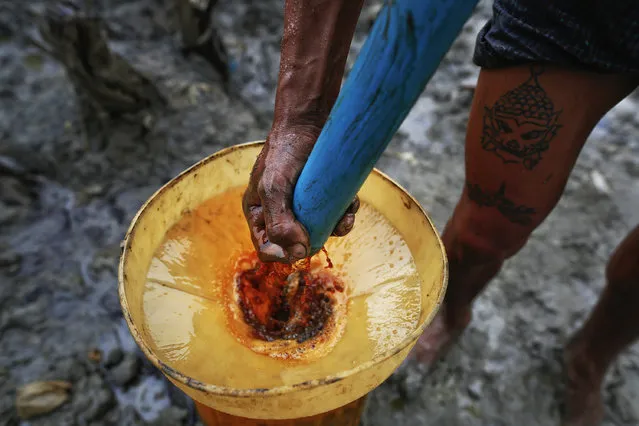
Ko Min, 26, manually extracts oil from one of three 300 feet deep wells he works on in the Minhla township of the Magwe district October 27, 2013. Everyday, Ko Min makes around $30 extracting crude oil from three small wells after he bought rights to use them for close to $1000 from a farmer who owns the land. (Photo by Damir Sagolj/Reuters)

Ko Min, 26, manually extracts oil from one of three 300 feet deep wells he works on in the Minhla township of the Magwe district October 27, 2013. Everyday, Ko Min makes around $30 extracting crude oil from three small wells after he bought rights to use them for close to $1000 from a farmer who owns the land. In Myanmar, an impoverished country rich with natural resources, people from poor communities find ways to supplement their income by exploiting such resources, such as the Minhla township, traditionally rich with oil, often using primitive and dangerous methods. (Photo by Damir Sagolj/Reuters)
Details
21 Apr 2014 10:06:00
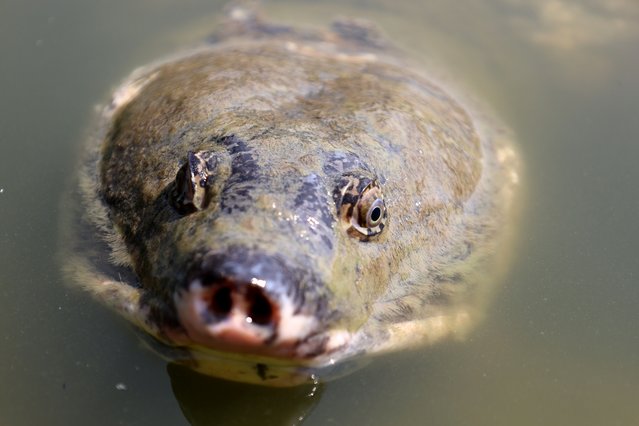
Black softshell turtle or Bostami turtle (Nilssonia nigricans), extremely rare and critically endangered species of tortoise is seen in a pond in Chittagong, Bangladesh on March 1, 2022. For decades, the breeding grounds have shrunk and their habitat has been threatened by habitat pollution. Through conservation methods and protection of the species, some of these turtles can be found today throughout the wild, and scientists and environmental biologists are continuing to work hard to preserve this endangered species and their natural habitat. (Photo by Mohammad Shajahan/Anadolu Agency via Getty Images)

Black softshell turtle or Bostami turtle (Nilssonia nigricans), extremely rare and critically endangered species of tortoise is seen in a pond in Chittagong, Bangladesh on March 1, 2022. For decades, the breeding grounds have shrunk and their habitat has been threatened by habitat pollution. (Photo by Mohammad Shajahan/Anadolu Agency via Getty Images)
Details
26 May 2024 04:02:00
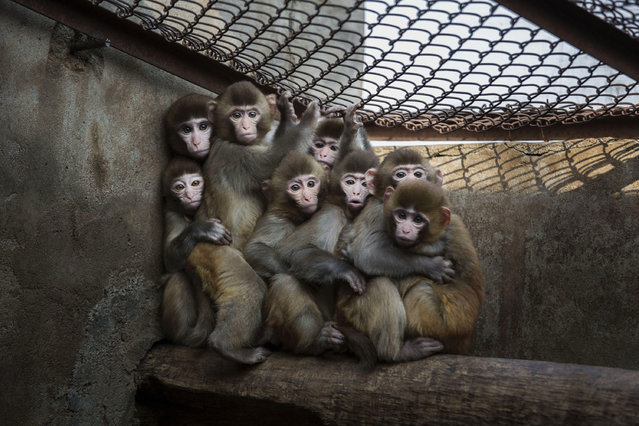
Macaque monkeys crowd together in their cage at a monkey farm on February 3, 2016 in Xinye county, Henan province, China. The area boasts a centuries-long and lucrative history of raising and training monkeys for performance. In Xinye, villagers are seeing an increase in business with the lunar calendar's “Year of the Monkey”. Farmers say most of the monkeys are bred and raised for domestic zoos, circuses, and performing groups, but add that some are also sold for medical research in China and the United States. Despite the popularity of the tradition, critics contend the training methods and conditions constitute animal cruelty. (Photo by Kevin Frayer/Getty Images)

Macaque monkeys crowd together in their cage at a monkey farm on February 3, 2016 in Xinye county, Henan province, China. The area boasts a centuries-long and lucrative history of raising and training monkeys for performance. In Xinye, villagers are seeing an increase in business with the lunar calendar's “Year of the Monkey”. Farmers say most of the monkeys are bred and raised for domestic zoos, circuses, and performing groups, but add that some are also sold for medical research in China and the United States. Despite the popularity of the tradition, critics contend the training methods and conditions constitute animal cruelty. (Photo by Kevin Frayer/Getty Images)
Details
31 Dec 2016 09:56:00
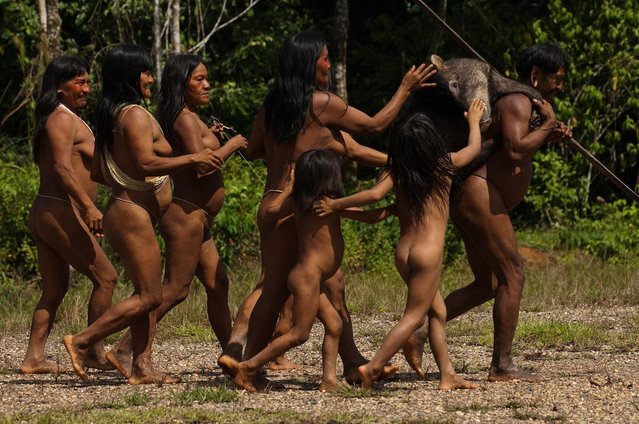
Spectacular images offering insight into the lives of the Huaorani people in the Ecuadorian Amazon have been revealed showing how they use traditional methods to hunt monkeys for food. The stunning pictures were taken by conservation photographer Pete Oxford from Torquay, Devon in the Ecuadorian Amazon. “The Huaorani Indians are a forest people highly in tune with their environment. Many are now totally acculturated since the 1950s by missionaries”, said Pete. “Today they face radical change to their culture to the proximity of oil exploration within their territory and the Yasuni National Park and Biosphere Reserve, they are vastly changed. Some still live very traditionally and for this shoot, through my Huaorani friend, a direct relative of those photographed he wanted to depict them as close to their original culture as possible. They still largely hunt with blow pipes and spears eating a lot of monkeys and peccaries”. The Huaorani are also known as the Waorani, Waodani or the Waos and are native Amerindians. Their lands are located between the Curaray and Napo rivers and speak the Huaorani language. Pete says that during his visit he was welcomed into the group and hopes that ancient cultures can be saved. Here: The tribe were seen celebrating after a hunter returned to camp with a wild pig. (Photo by Pete Oxford/Mediadrumworld.com)

Spectacular images offering insight into the lives of the Huaorani people in the Ecuadorian Amazon have been revealed showing how they use traditional methods to hunt monkeys for food. The stunning pictures were taken by conservation photographer Pete Oxford from Torquay, Devon in the Ecuadorian Amazon. Here: The tribe were seen celebrating after a hunter returned to camp with a wild pig. (Photo by Pete Oxford/Mediadrumworld.com)
Details
20 Jan 2017 07:58:00
“Whether that means getting up way before the sun, like I do most days, going out somewhere that I’m not comfortable or just trying to get different angles or styles of photos, I am trying to display the crazy beauty of the ocean, and usually moments that literally last less than a split second”. (Photo by Ryan Pernoski/Caters News Agency)

These kaleidoscopic images are the work of one persistent photographer’s efforts to capture vibrant hues at the exact moment a wave breaks. Ryan Pernofski‘s stunning shots feature brilliant yellows, reds, blues and purples as an array of sunlight hits the water at the perfect time. What’s even more impressive: Ryan, a 27-year-old Australian, began shooting his popular masterpieces without using a professional camera, taking his iPhone out into the water instead. Ryan began experimenting with this method in 2012, using an underwater housing to protect his phone, as he could not afford a professional camera. (Photo by Ryan Pernoski/Caters News Agency)
Details
09 Jun 2018 00:05:00
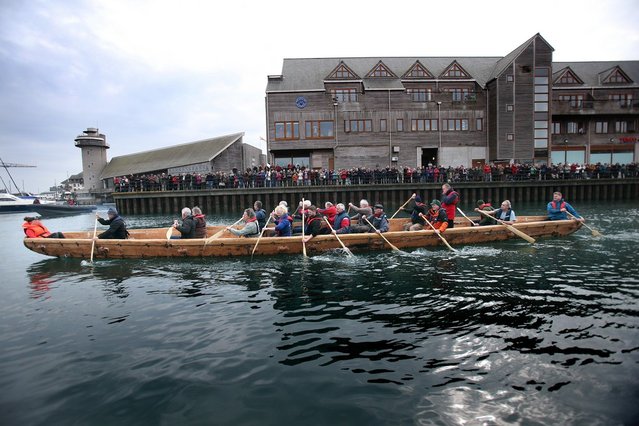
Crew in Britain's first ever full-size reconstructed sea-going Bronze Age boat, paddle out to sea near to the National Maritime Museum as it makes its maiden voyage on March 6, 2013 in Falmouth, England. With a crew of of 18, equipped with Bronze-Age-style wooden paddles, the 15 metre long experimental vessel – a replica of the sort of craft used for long-distance trade between Britain and the continent 4000 years ago – will be used to test prehistoric seafaring methods in a project in collaboration with the University of Exeter and the Falmouth-based National Maritime Museum Cornwall. (Photo by Matt Cardy)

Crew in Britain's first ever full-size reconstructed sea-going Bronze Age boat, paddle out to sea near to the National Maritime Museum as it makes its maiden voyage on March 6, 2013 in Falmouth, England. (Photo by Matt Cardy)
Details
07 Mar 2013 08:48:00