Loading...
Done
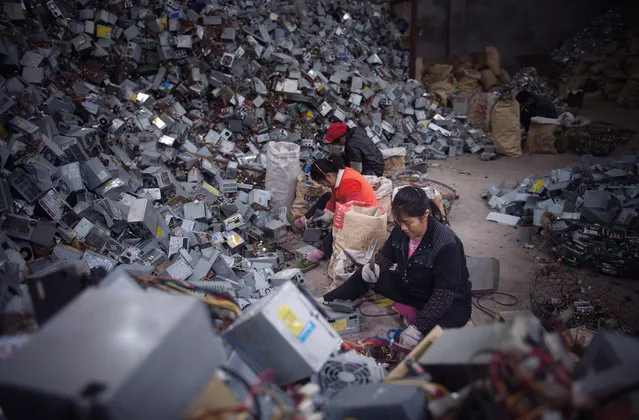
“The sustainable development goals cannot be met unless waste management is addressed as a priority”, says UK waste management charity Waste Aid. “E-waste is one of the fastest growing categories of the 7-10bn tonnes of waste produced globally every year”, adds director Mike Webster. “In our view, decent waste management is a basic right and we want governments around the world take this issue much more seriously – in 2012 only 0.2% of international aid went on improving solid waste management – it’s just not enough”. (Photo by Kai Loeffelbein/laif Agentur)

Sustainable development goal target 12.5 is to reduce waste. But with a planet increasingly dependent on technology, is that even possible? As of today, over 30m tonnes of electronic waste has been thrown out so far this year, according to the World Counts. Most e-waste is sent to landfills in Asia and Africa where it is recycled by hand, exposing the people who do it to environmental hazards. Kai Loeffelbein’s photographs of e-waste recycling in Guiyu, southern China show what happens to discarded computers. (Photo by Kai Loeffelbein/laif Agentur)
Details
19 Oct 2016 12:14:00
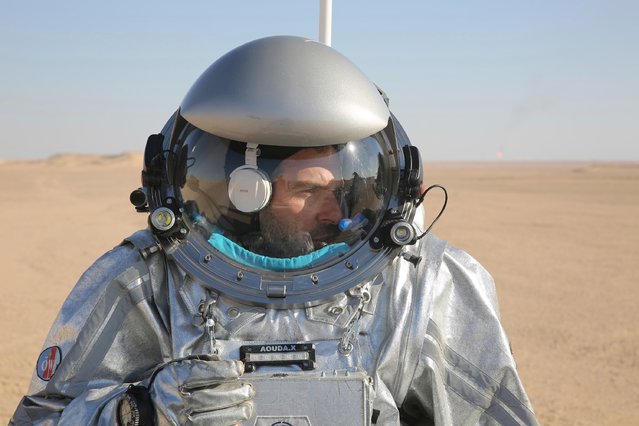
This February 7, 2018, photo shows João Lousada, a flight controller for the International Space Station, wearing an experimental space suit during a simulation of a future Mars mission in the Dhofar desert of southern Oman. (Photo by Sam McNeil/AP Photo)

This February 7, 2018, photo shows João Lousada, a flight controller for the International Space Station, wearing an experimental space suit during a simulation of a future Mars mission in the Dhofar desert of southern Oman. The desolate desert in southern Oman resembles Mars so much that more than 200 scientists from 25 nations organized by the Austrian Space Forum are using it for the next four weeks to field-test technology for a manned mission to Mars. (Photo by Sam McNeil/AP Photo)
Details
10 Feb 2018 07:02:00
Aliia Nasyrova laying her hair on the couch to show her hair's length on March 5, 2017 in Riga, Latvia. (Photo by  Eduard Kolik/Barcroft Media)

Aliia Nasyrova laying her hair on the couch to show her hair's length on March 5, 2017 in Riga, Latvia. Real-life Rapunzel Aliia Nasyrova has hair so long that her husband admits he thinks of it as another member of the family. Aliia, 27, who lives in Riga, Latvia, took 20 years to grow out her hair, which measures 90 inches to the floor – and even has its own space in the marital bed. And while her massive mane attracts stares when out in public, her husband Ivan Balaban says he loves it and is proud of her for not cutting it. Weighing in at 4.5lbs (2kg), Aliia says her lengthy locks weigh as much as the family cat. (Photo by Eduard Kolik/Barcroft Media)
Details
18 Mar 2017 10:46:00
Runner-up. “The City of London, looking towards the Royal Exchange and the Bank of England. The ever-changing London skyline provides many excellent opportunities for cityscape photography, none more exciting than the ebb and flow of traffic at night”. MICK RYAN, JUDGE: “Sophisticated new camera sensors, sharp lenses and the ability to take hundreds of shots in a session and check your work have made night photography much easier than it ever used to be. The results, like this scene, can be spectacular”. (Photo by Mark Caldon/The Guardian)

Runner-up. “The City of London, looking towards the Royal Exchange and the Bank of England. The ever-changing London skyline provides many excellent opportunities for cityscape photography, none more exciting than the ebb and flow of traffic at night”. (Photo by Mark Caldon/The Guardian)
Details
10 Dec 2018 00:03:00
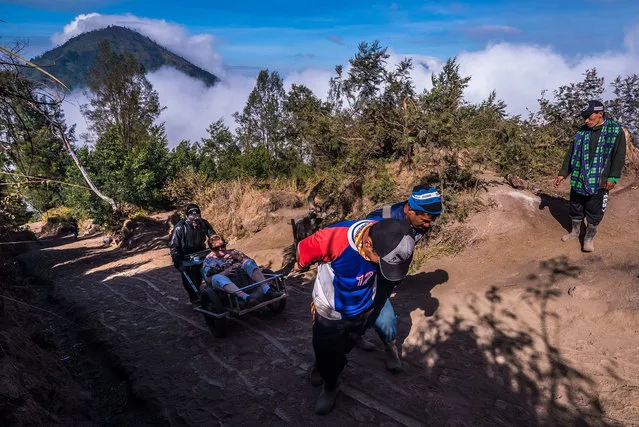
Miners pulling up lazy tourists to the rim of Kawah Ijen (Ijen Volcano), East Java, Indonesia on September 21, 2017. They will earn as much as they would bring down a load of sulfur. Nomadic Explorer, Cultural Lifestyle Photographer Claudio Sieber captured striking images of miners working at Ijen volcanic range in East Java, Indonesia. The sulphur miners risk their lives daily as they climb the active volcano carrying heavy loads, which they sell to sugar refineries. Shortly after midnight curious tourists are flocking in hundreds through the gate of Ijen's foothills to be right on time, driven by the images others took before them. Kawah Ijen is the one of the world's largest acidic volcanic crater lake; famous for its turquoise color as well as the unreal atmosphere it offers during darkness. A dusty path zigzags 3 kilometers up to the crater rim. This doesn't mean anything challenging; in particular, special sights have to be deserved anyway. The irritating smell of sulfur announces the near of the crater's existence. Arriving on the crater's rim the reward for the torture becomes visible. Blue fire darts its tongues through the fumes of sulfur dioxide. Somehow, the spectacle isn't as romantic as expected, since it is also the rough working space of approx. 150 sulfur miners who start their shift at 1 am. Lately, harvesting the abundance of devil's gold received international attention. This did obviously not really improve a miner's lifestyle; neither did it contribute to a better wage. (Photo by Claudio Sieber/Barcroft Images)

Miners pulling up lazy tourists to the rim of Kawah Ijen (Ijen Volcano), East Java, Indonesia on September 21, 2017. They will earn as much as they would bring down a load of sulfur. Nomadic Explorer, Cultural Lifestyle Photographer Claudio Sieber captured striking images of miners working at Ijen volcanic range in East Java, Indonesia. The sulphur miners risk their lives daily as they climb the active volcano carrying heavy loads, which they sell to sugar refineries. (Photo by Claudio Sieber/Barcroft Images)
Details
02 Oct 2017 08:31:00
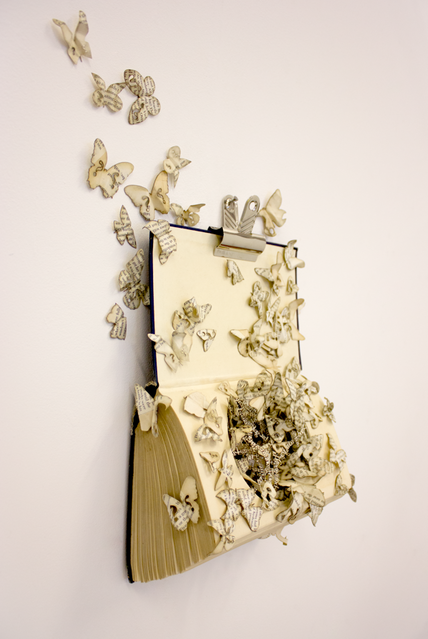
Plagued by Doubt By Thomas Wightman

Thoughts. They fly through the broad expenses of our mind, floating gracefully in midair, going into the clouds, and then reemerging once again. Some are quick and furtive, others are grand and majestic. We reflect upon them as they enter our minds, and once they leave, they are usually gone for good. However, some thoughts are different. These thoughts resemble a flock of angry birds or a swarm of hungry moths that invade your mind, slowly eating away at your sanity, strength, and desire to live. Such thoughts often plague that minds of people with Obsessive Compulsive disorder. They completely occupy their time; constantly there; ever-present. With his book sculpture, Thomas Wightman was able to accurately convey the way these thoughts consume the mind, slowly building a nest within it, resisting all attempts to drive them away.

Thomas Wightman


See Also: Derailing My Train of Thought
Details
19 Mar 2015 09:11:00


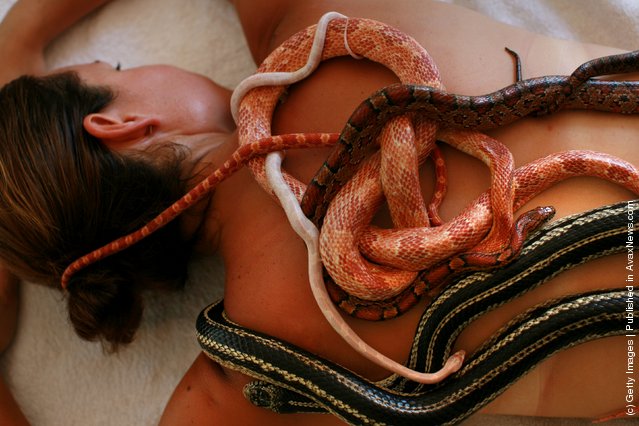
Meirav Stardinner receives a snake massage from Ada Barak at Barak's snake spa on September 11, 2008 in Talmei Elazar, Israel. Barack's income comes mostly from exhibiting her plants which eat everything from insects to small mammals. She discovered snakes' therapeutic value after letting people hold them after her act “Some people said that holding the snakes made them feel better, relaxed”, she says. “One old lady said it was soothing, like a cold compress”. Now she uses a combination of big snakes for deep massage and little ones for light massage, though all are non-venemous. (Photo by Uriel Sinai/Getty Images)
Details
07 May 2011 11:58:00


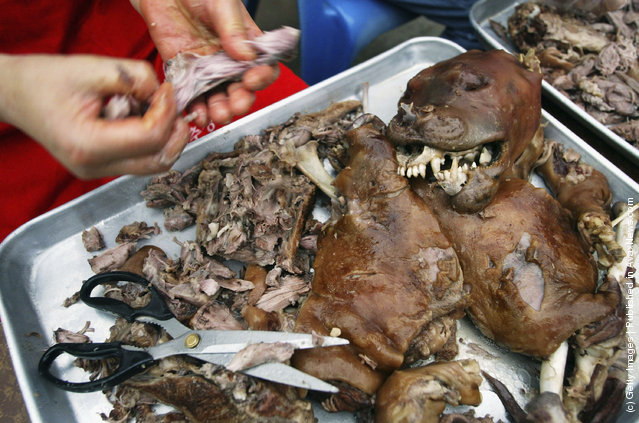
“Dog meat refers to edible parts and the flesh derived from (predominantly domestic) dogs. Human consumption of dog meat has been recorded in many parts of the world, including ancient China, ancient Mexico, and ancient Rome. According to contemporary reports, dog meat is consumed in a variety of countries such as Switzerland, China, Vietnam, the Philippines, and Korea. In addition, dog meat has also been used as survival food in times of war and/or other hardships”. – Wikipedia

Photo: A chef prepares dog meat at a restaurant on July 4, 2005 in Gwacheon, South Korea. Dog meat is a traditional dish in Korea dating back to the Samkuk period (period of the three kingdoms BC 57 – AD 668). Although many recipes existed historically for dog meat, now chefs only make soups, or dishes using boiled or roasted meat. Koreans traditionally eat dog meat on the hottest day of the summer, for it's reputed benefits of virility, invigoration and health. (Photo by Chung Sung-Jun/Getty Images)
Details
24 Jul 2011 13:21:00