Loading...
Done
Tennis star Maria Sharapova poses with a Porsche 911 RSR race car at the 2016 Los Angeles Auto Show in Los Angeles, California, U.S November 16, 2016. (Photo by Mike Blake/Reuters)

Tennis star Maria Sharapova poses with a Porsche 911 RSR race car at the 2016 Los Angeles Auto Show in Los Angeles, California, U.S November 16, 2016. (Photo by Mike Blake/Reuters)
Details
17 Nov 2016 11:28:00
Students hold their weapons before the swearing in ceremony for the military students, in Bucharest, Romania, Wednesday, October 25, 2017. (Photo by Vadim Ghirda/AP Photo)

Students hold their weapons before the swearing in ceremony for the military students, in Bucharest, Romania, Wednesday, October 25, 2017. The Romanian Army is proudly celebrating their Army Day and marking 100-years since the landmark battle of Marasesti, a key World War I battle in 1917 when Romanian and Russian soldiers defeated German troops, halting a German offensive. (Photo by Vadim Ghirda/AP Photo)
Details
29 Oct 2017 08:52:00
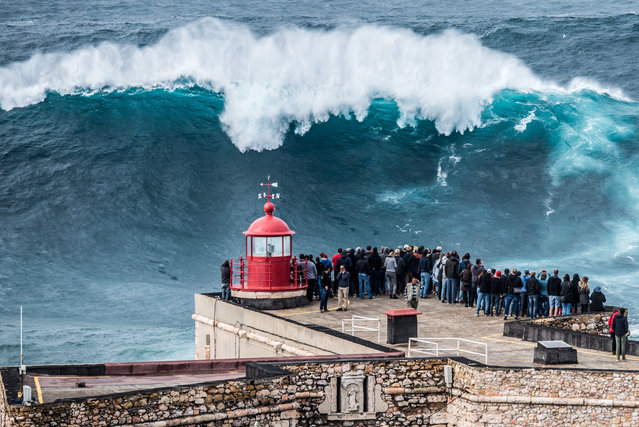
Crowds watch surfers as the first big swell of the year arrives in Nazaré, Portugal on October 28, 2015. (Photo by Pedro Miranda/Demotix/Corbis)

Crowds watch surfers as the first big swell of the year arrives in Nazaré, Portugal on October 28, 2015. (Photo by Pedro Miranda/Demotix/Corbis)
Details
30 Oct 2015 08:07:00
Japanese college students look at cheerleaders during a job-hunting rally in Tokyo January 29, 2014. According to the rally organizers, about 1,500 students from vocational schools attend the rally to boost their morale ahead of their job hunt. (Photo by Yuya Shino/Reuters)

Japanese college students look at cheerleaders during a job-hunting rally in Tokyo January 29, 2014. According to the rally organizers, about 1,500 students from vocational schools attend the rally to boost their morale ahead of their job hunt. (Photo by Yuya Shino/Reuters)
Details
01 Feb 2014 13:10:00
On August 31, 2012, a long filament of solar material that had been hovering in the sun's atmosphere, the corona, erupted out into space at 4:36 p.m. EDT. The coronal mass ejection, or CME, traveled at over 900 miles per second. The CME did not travel directly toward Earth, but did connect with Earth's magnetic environment, or magnetosphere, causing aurora to appear on the night of Monday, September 3. (Photo by NASA/GSFC/SDO)

On August 31, 2012, a long filament of solar material that had been hovering in the sun's atmosphere, the corona, erupted out into space at 4:36 p.m. EDT. The coronal mass ejection, or CME, traveled at over 900 miles per second. The CME did not travel directly toward Earth, but did connect with Earth's magnetic environment, or magnetosphere, causing aurora to appear on the night of Monday, September 3. (Photo by NASA/GSFC/SDO via The Atlantic)
Details
14 Sep 2012 09:01:00
A girl rides on a train as she takes part in the first edition of the No Pants Subway Ride in Bucharest, Romania, Sunday, January 11, 2015. (Photo by Vadim Ghirda/AP Photo)

A girl rides on a train as she takes part in the first edition of the No Pants Subway Ride in Bucharest, Romania, Sunday, January 11, 2015. The No Pants Subway Ride is an annual which was started in 2002 by Improv Everywhere in New York, the goal is for riders to get on the subway train dressed in normal winter clothes without pants and keep a straight face. (Photo by Vadim Ghirda/AP Photo)
Details
13 Jan 2015 14:41:00
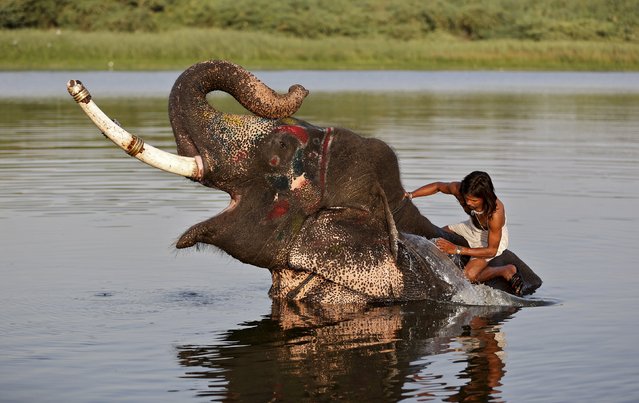
A mahout splashes water on his elephant in the river Sabarmati on a hot summer day in Ahmedabad, India, May 20, 2015. (Photo by Amit Dave/Reuters)

A mahout splashes water on his elephant in the river Sabarmati on a hot summer day in Ahmedabad, India, May 20, 2015. (Photo by Amit Dave/Reuters)
Details
21 May 2015 12:26:00
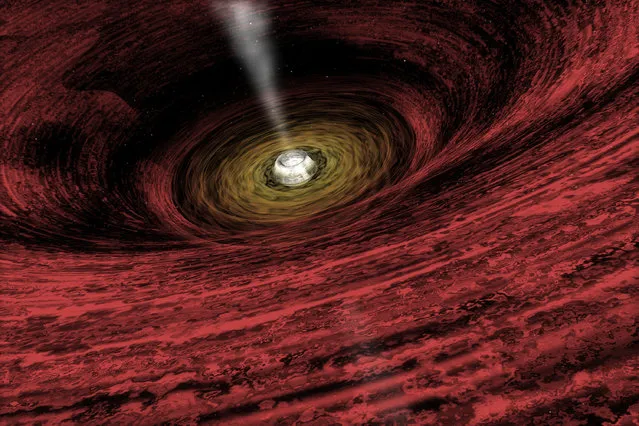
An artist's impression of a growing supermassive black hole located in the early Universe is seen in this NASA handout illustration released on June 15, 2011. Using the deepest X-ray image ever taken, astronomers found the first direct evidence that massive black holes were common in the early universe. This discovery from NASA's Chandra X-Ray Observatory shows that very young black holes grew more aggressively than previously thought, in tandem with the growth of their host galaxies. (Photo by Reuters/NASA/Chandra X-Ray Observatory/A.Hobart)


An artist's impression of a growing supermassive black hole located in the early Universe is seen in this NASA handout illustration released on June 15, 2011. Using the deepest X-ray image ever taken, astronomers found the first direct evidence that massive black holes were common in the early universe. This discovery from NASA's Chandra X-Ray Observatory shows that very young black holes grew more aggressively than previously thought, in tandem with the growth of their host galaxies. (Photo by Reuters/NASA/Chandra X-Ray Observatory/A.Hobart)

Details
11 Feb 2016 12:57:00