Loading...
Done
A man sells eels caught for a meal amid a lockdown to slow the spread of coronavirus, in a slum area of Yangon, Myanmar, October 21, 2020. (Photo by Shwe Paw Mya Tin/Reuters)

A man sells eels caught for a meal amid a lockdown to slow the spread of coronavirus, in a slum area of Yangon, Myanmar, October 21, 2020. (Photo by Shwe Paw Mya Tin/Reuters)
Details
31 Oct 2020 00:03:00
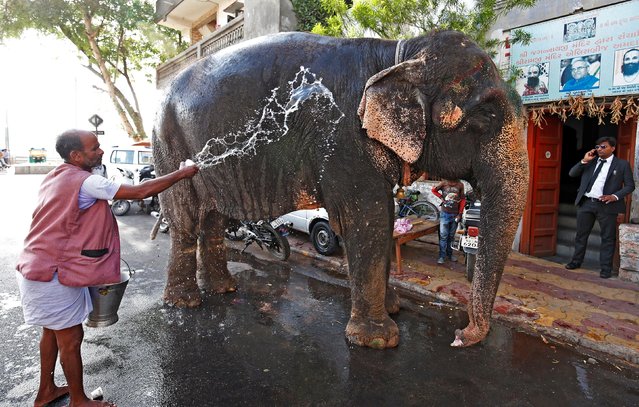
A mahout splashes water on his elephant on a hot summer day in Ahmedabad, India April 8, 2019. (Photo by Amit Dave/Reuters)

A mahout splashes water on his elephant on a hot summer day in Ahmedabad, India on April 8, 2019. (Photo by Amit Dave/Reuters)
Details
07 May 2019 00:01:00
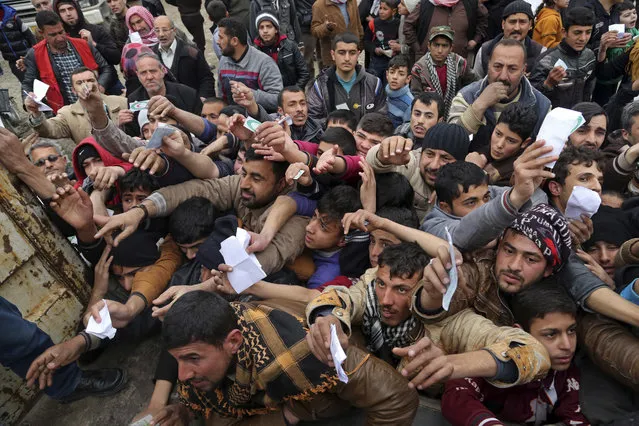
Civilians present their rations cards in order to receive humanitarian food aid being distributed by the Iraqi Red Crescent, in the eastern side of Mosul, Iraq, Tuesday, January 31, 2017. Iraqi forces declared Mosul's eastern half fully liberated, just over three months after the operation to retake the city from IS was formally launched in October. (Photo by Khalid Mohammed/AP Photo)

Civilians present their rations cards in order to receive humanitarian food aid being distributed by the Iraqi Red Crescent, in the eastern side of Mosul, Iraq, Tuesday, January 31, 2017. Iraqi forces declared Mosul's eastern half fully liberated, just over three months after the operation to retake the city from IS was formally launched in October. (Photo by Khalid Mohammed/AP Photo)
Details
06 Feb 2017 01:00:00
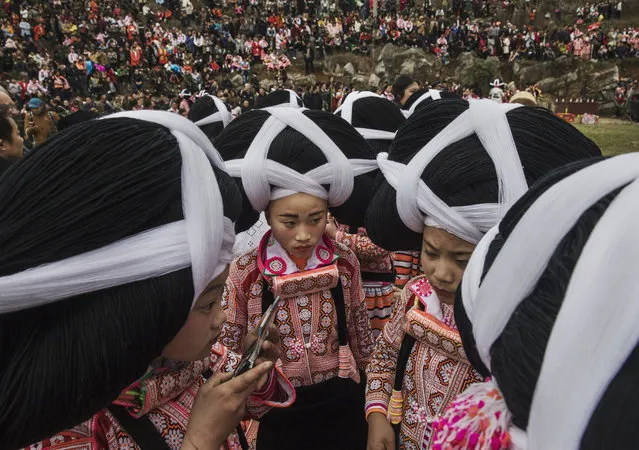
Girls of the Long Horn Miao ethnic minority group wear headdresses as they prepare gather for Tiaohua or Flower Festival as part of the Lunar New Year on February 6, 2017 in Longga village, Guizhou province, southern China. The Long Horn Miao are recognized for their declining practice of wrapping a blend of linen, wool, and the hair of their ancestors around animal horns or a wooden clip to make headdresses. Many young women say they now wear the headdresses only for special occasions and festivals, as the ornaments, which are attached by the horns to their real hair, have proved impractical for modern daily life in a fast changing world. China officially recognizes 56 different ethnic minorities, and statistics show over 7 million Chinese identifying themselves as Miao. But the small Long Horn Miao community counts only around 5000 people living in 12 villages, whose age-old traditions, language, and culture are fading. It is increasingly difficult in a modernizing China, as young people are drawn from remote rural villages to opportunities in bigger cities amongst wide-scale urbanization. Farming and labour remain the mainstays of life for the Long Horn Miao, leaving the area relatively poor in comparison with many parts of China. The government has invested significant amounts into local infrastructure and the tourism industry to try to bolster the local economy. (Photo by Kevin Frayer/Getty Images)

Girls of the Long Horn Miao ethnic minority group wear headdresses as they prepare gather for Tiaohua or Flower Festival as part of the Lunar New Year on February 6, 2017 in Longga village, Guizhou province, southern China. (Photo by Kevin Frayer/Getty Images)
Details
13 Feb 2017 00:01:00
An alpaca is seen near the Inca citadel of Machu Picchu in Cusco December 2, 2014. Machu Picchu, a UNESCO World Heritage Site, is Peru's top tourist attraction, with the government limiting tourists to 2,500 per day due to safety reasons and concerns over the preservation of the ruins. (Photo by Enrique Castro-Mendivil/Reuters)

An alpaca is seen near the Inca citadel of Machu Picchu in Cusco December 2, 2014. Machu Picchu, a UNESCO World Heritage Site, is Peru's top tourist attraction, with the government limiting tourists to 2,500 per day due to safety reasons and concerns over the preservation of the ruins. (Photo by Enrique Castro-Mendivil/Reuters)
Details
04 Dec 2014 11:24:00


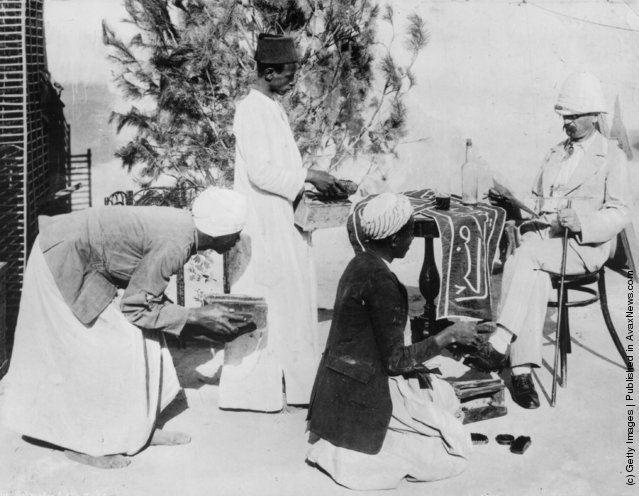
Egyptian bootblacks cleaning a European's shoes in Cairo. (Photo by Hulton Archive/Getty Images). Circa 1870
Details
24 Mar 2011 15:55:00
Visitors walk past the fully equipped dining table inside the “Crazy House”, which is completely built upside-down, in the village of Affoldern near the Edersee lake, May 7, 2014. Three friends came up with the idea to build the tourist attraction, which cost about 200,000 euros and took some six weeks to complete. (Photo by Kai Pfaffenbach/Reuters)

Visitors walk past the fully equipped dining table inside the “Crazy House”, which is completely built upside-down, in the village of Affoldern near the Edersee lake, May 7, 2014. Three friends came up with the idea to build the tourist attraction, which cost about 200,000 euros and took some six weeks to complete. (Photo by Kai Pfaffenbach/Reuters)
Details
11 May 2014 12:15:00
People search for shells on a beach in Sittwe, Rakhine State, Myanmar, 17 September 2020. International Coastal Cleanup Day is observed annually on the third Saturday of September and will occur on 19 September this year. The day was established to encourage global efforts to clean up garbage on beaches and coastal areas and raise awareness on protecting the world's oceans and waterways. According to a report released by the US-based nonprofit environmental advocacy group Ocean Conservancy on 08 September 2020, plastic food packaging topped the list of most common items found in beach trash. Close to five million food wrappers were collected in a single day during the International Coastal Cleanup Day in 2019. An approximate 11 million metric tons of plastic enters the ocean every year according to a 2016 analysis, affecting more than 800 marine species and causing contamination to human food chains and drinking water. (Photo by Nyunt Win/EPA/EFE/Rex Features/Shutterstock)

People search for shells on a beach in Sittwe, Rakhine State, Myanmar, 17 September 2020. International Coastal Cleanup Day is observed annually on the third Saturday of September and will occur on 19 September this year. (Photo by Nyunt Win/EPA/EFE/Rex Features/Shutterstock)

Details
24 Oct 2020 00:05:00