Loading...
Done
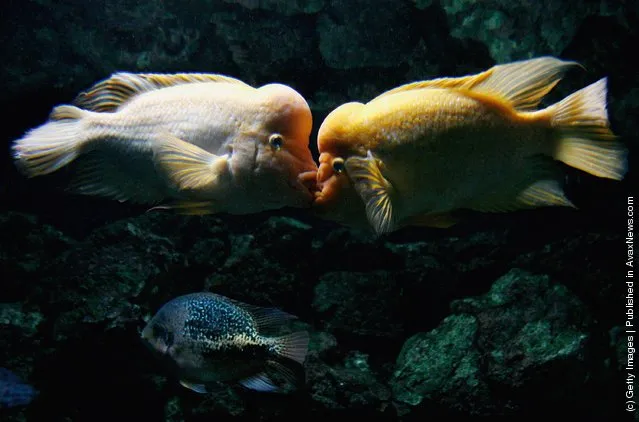
Midas Cichlid a.k.a. Amphilophus Citrinellus

“Amphilophus citrinellus is a large cichlid fish endemic to the San Juan River and adjacent watersheds in Costa Rica and Nicaragua. In the aquarium trade A. citrinellus is often sold under the trade name of Midas cichlid. A. citrinellus are omnivorous and their diet consists of plant material, molluscs and smaller fish”. – Wikipedia

Photo: Two Midas Cichlid (lat: amphilophus citrinellus) fish are seen in an aquarium at Hellabrunn zoo on December 23, 2009 in Munich, Germany. (Photo by Alexandra Beier/Getty Images)
Details
17 Aug 2011 11:29:00
Pencil Drawings By Guram Dolenjashvili

Dolenjashvili is a Georgian painter often working in a monochrome technique. He is a Meritorious Artist of Georgia and an honorary member of Russian Academy of Arts.
Details
15 Jun 2015 14:34:00
Runner-up; Hon Yen marine ecosystem. Phu Yen, Vietnam. Every year between May and August, the coral of this rich and diverse ecosystem becomes exposed at low tide. (Photo by Truong Hoai Vu/Royal Society of Biology Photography Competition)

Runner-up; Hon Yen marine ecosystem. Phu Yen, Vietnam. Every year between May and August, the coral of this rich and diverse ecosystem becomes exposed at low tide. (Photo by Truong Hoai Vu/Royal Society of Biology Photography Competition)
Details
31 Oct 2021 05:12:00
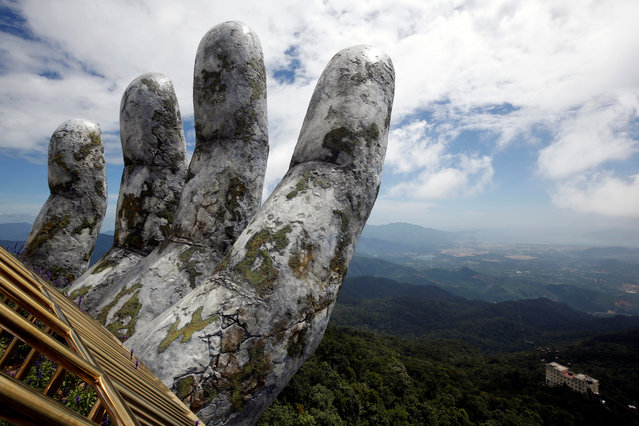
A giant hand structure at the Gold Bridge is seen on Ba Na hill near Danang city, Vietnam on August 1, 2018. (Photo by Reuters/Kham)

In the mountains of central Vietnam, a colossal pair of hands lifts a golden thread of walkway high above the clifftops, as if the mountain itself has sprouted limbs. Here: A giant hand structure at the Gold Bridge is seen on Ba Na hill near Danang city, Vietnam on August 1, 2018. (Photo by Reuters/Kham)
Details
03 Aug 2018 00:03:00
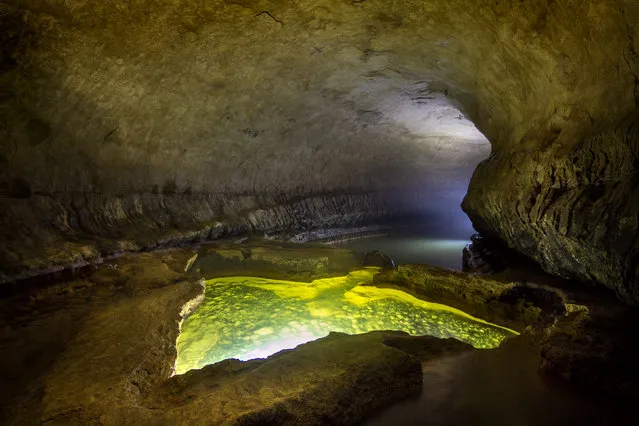
A large pool of water inside one of the tunnels. (Photo by Vladimir Mulde/Caters News)

These otherworldly images give a rare glimpse inside caves barely ever seen by the human eye. With its peculiar pools of water and strange colored sediments, the bizarre looking tunnels of the Shakuranskaya cave could be a set straight out of a science fiction film. Found in the disputed region of Abkhazia, around 75 miles outside of Sochi, Russia, it is rumored the incredible underground chambers were formed after a huge earthquake struck the area in 1892. After causing part of a nearby mountain to collapse into the Amtkel River, it is thought the dam-like affect has created a series of interconnecting underground tunnels. Here: a large pool of water inside one of the tunnels. (Photo by Vladimir Mulde/Caters News)
Details
07 Nov 2014 12:45:00
Youth category winner: Symphony No 5 by Giacomo Redaelli (Italy). (Photo by Giacomo Redaelli/2019 Nature Photographer of the Year)

Youth category winner: Symphony No 5 by Giacomo Redaelli (Italy). (Photo by Giacomo Redaelli/2019 Nature Photographer of the Year)
Details
16 Nov 2019 00:01:00
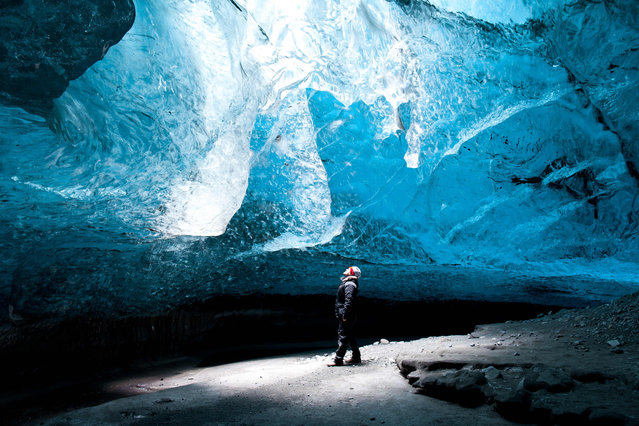
A wide view of Rob Lott  in the crystal ice cave in the Vatnajokull Glacier, Iceland. (Photo by Rob Lott/Barcroft Media)

Shimmering clearest blue and stretching as far as the eye can see, this is one of Iceland's famed crystal ice caves. The giant solid waves look frozen in time but they are slowly moving along as part of the Vatnajokull Glacier – which stretches across eight per cent of the island. The images were captured in February 2014 by British photographer Rob Lott, 49. Photo: A wide view of Rob Lott in the crystal ice cave in the Vatnajokull Glacier, Iceland. (Photo by Rob Lott/Barcroft Media)
Details
17 Mar 2014 08:26:00
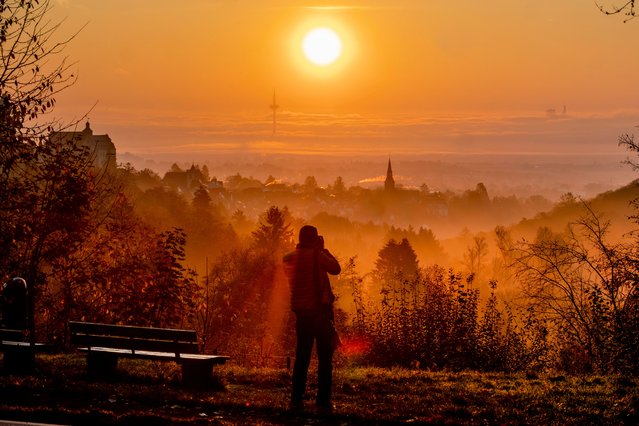
A photographer takes pictures as the sun rises over the city of Kronberg near Frankfurt, Germany, Monday, November 4, 2024. (Photo by Michael Probst/AP Photo)

A photographer takes pictures as the sun rises over the city of Kronberg near Frankfurt, Germany, Monday, November 4, 2024. (Photo by Michael Probst/AP Photo)
Details
02 Jan 2025 03:18:00