Loading...
Done
A Cat As Model By Joann Biondi

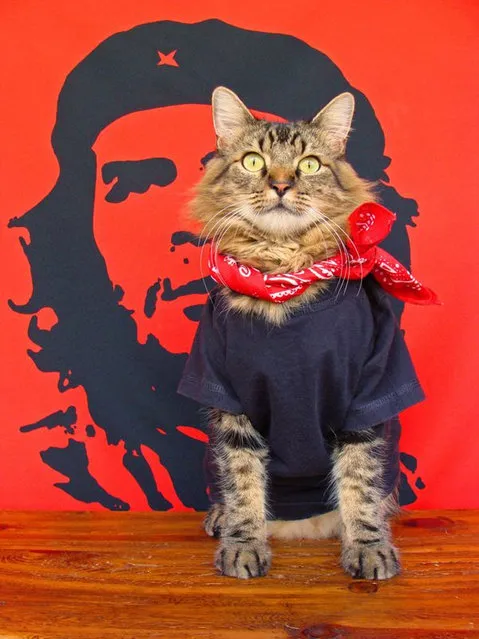
For 20 years, Joann Biondi worked as a freelance writer. Then one day she adopted a kitten that had been tossed in a garbage can and left for dead. That kitten had an unusual quirk; he liked to wear clothes and pose for the camera. So Joann started shooting, and then she got serious about photography. Fast forward four years and that kitten is now Lorenzo the Cat, a feline art photography project that has gotten both the cat and the photographer a lot of attention; gallery shows, museum exhibits, and stories in major media outlets throughout the world. Amid it all Lorenzo has remained a mellow dude who still likes to roll around in the dirt, chase lizards, and knock things off the kitchen counter when his food bowl is empty.
Details
21 Jun 2014 10:13:00
Author Fannie Hurst clad in mink coat, enjoying the jumping antics of her Yorkshire terrier Orphan Annie on the street. (Photo by Nina Leen/Pix Inc./The LIFE Picture Collection/Getty Images)

Nina Leen, one of the first female photographers to work for Life, took pictures for the magazine from 1940 to 1972. In the mid-1940s, her essay, “City Dogs”, featured actors and artists with their pets on the streets of New York City. In late-March, Daniel Cooney Fine Art in New York City, is opening a solo exhibition of Leen’s work that features images from that essay and others. Here: author Fannie Hurst clad in mink coat, enjoying the jumping antics of her Yorkshire terrier Orphan Annie on the street. (Photo by Nina Leen/Pix Inc./The LIFE Picture Collection/Getty Images)
Details
30 Mar 2015 12:48:00
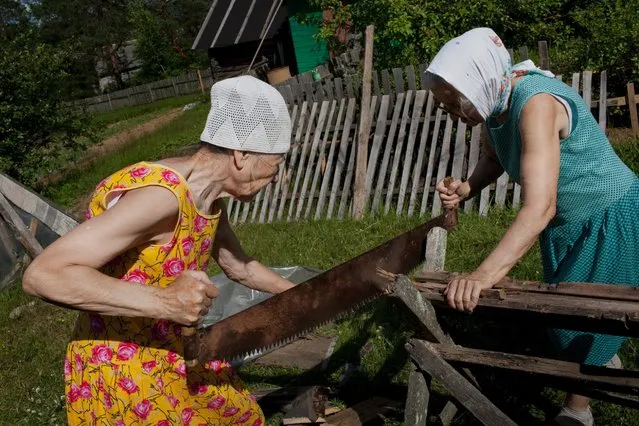
“Two-Handed Saw, 2014”. “Most of the neighbors have switched to power tools to run their households, the buzz of chain saws and weed-whackers overpowering the quieter sounds of country life, but my aunts hold on to the two-handed saw that's decades old, the sickle and scythe that need to be sharpened and polished after each use, the old axe that's becoming heavier each year. Each of these objects is familiar, holding memories of their brother, who succumbed to cancer a few years ago, of days before my grandfather lost his vision in the 50's, of busier days and longer futures”, Sablin told. (Photo by Nadia Sablin)

In northwest Russia, in a small village called Alekhovshchina, Nadia Sablin's aunts spend the warmer months together in the family home and live as the family has always lived, chopping wood to heat the house and making their own clothes. Sablin's book of photographs, “Aunties: The Seven Summers of Alevtina and Ludmila”, is published by Duke University Press. Here: “Two-Handed Saw, 2014”. (Photo by Nadia Sablin)
Details
25 Feb 2016 12:12:00
“The sustainable development goals cannot be met unless waste management is addressed as a priority”, says UK waste management charity Waste Aid. “E-waste is one of the fastest growing categories of the 7-10bn tonnes of waste produced globally every year”, adds director Mike Webster. “In our view, decent waste management is a basic right and we want governments around the world take this issue much more seriously – in 2012 only 0.2% of international aid went on improving solid waste management – it’s just not enough”. (Photo by Kai Loeffelbein/laif Agentur)

Sustainable development goal target 12.5 is to reduce waste. But with a planet increasingly dependent on technology, is that even possible? As of today, over 30m tonnes of electronic waste has been thrown out so far this year, according to the World Counts. Most e-waste is sent to landfills in Asia and Africa where it is recycled by hand, exposing the people who do it to environmental hazards. Kai Loeffelbein’s photographs of e-waste recycling in Guiyu, southern China show what happens to discarded computers. (Photo by Kai Loeffelbein/laif Agentur)
Details
19 Oct 2016 12:14:00
A year after hundreds of thousands of migrants and refugees snaked their way across southeastern Europe and onto television screens worldwide, the roads through the Balkans are now clear, depriving an arguably worsening tragedy of its poignant visibility. Europe's migrant crisis is at the very least numerically worse than it was last year. More people are arriving and more are dying. (Photo by Antonio Bronic/Reuters)

A year after hundreds of thousands of migrants and refugees snaked their way across southeastern Europe and onto television screens worldwide, the roads through the Balkans are now clear, depriving an arguably worsening tragedy of its poignant visibility. Reuters photographer, Antonio Bronic revisiting the people-packed locations where he and his colleagues captured last year's diaspora, found empty roads, unencumbered railway tracks and bucolic countryside. (Photo by Antonio Bronic/Reuters)


Details
12 Aug 2016 12:10:00
Brtukan. “Being a girl of colour in a society where the majority of the people are white, I have had to get used to all the different ways people approach me. From being asked what kind of rap music you listen to and how you wash your hair, to getting told, “you don’t sound black”, “you’re pretty for a black girl” or “you’re not that black so it’s OK”, as if being black is such a bad thing”. (Photo by Lisa Minogue/The Guardian)

As part of FLAIR Melbourne – a Flinders Lane art festival – Melbourne’s Lisa Minogue presents stylised photographic portraits of Australian women of colour, their faces painted vibrantly to accentuate their individuality and encourage the viewer to study each face more closely. Minogue asked each woman the same question: “What do the words “coloured girl” mean to you?”. (Photo by Lisa Minogue/The Guardian)
Details
17 Aug 2016 11:16:00
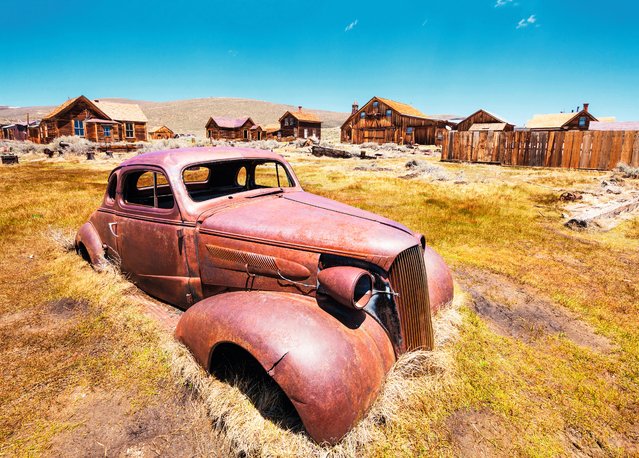
Bodie, Mono County, California. Gold was discovered at Bodie in 1859 (just after the initial California gold rush) and it went from mining camp to boomtown. Its decline began in 1880, when word spread of new boomtowns elsewhere. The Standard Consolidated Mine closed in 1913, and four years later the Bodie Railway was abandoned. By 1940 the population was down to 40. Today, Bodie is maintained in a state of arrested decay as a visitor attraction. (Photo by Alamy Stock Photo)

Kieron Connolly’s new book of photographs of more than 100 once-busy and often elegant buildings gives an idea of how the world might look if humankind disappeared. Here: Bodie, Mono County, California. Gold was discovered at Bodie in 1859 (just after the initial California gold rush) and it went from mining camp to boomtown. Its decline began in 1880, when word spread of new boomtowns elsewhere. The Standard Consolidated Mine closed in 1913, and four years later the Bodie Railway was abandoned. By 1940 the population was down to 40. Today, Bodie is maintained in a state of arrested decay as a visitor attraction. (Photo by Alamy Stock Photo)
Details
07 Sep 2016 09:50:00
This is a photo shoot like youve never seen before  a model in glamorous dresses surrounded by sharks. However, model and shark diver Liz Parkinson decided to take the plunge and get up close and personal with some of the most revered creatures of the deep. Here: Liz swimming with Hammerheads in the Bahamas, Bimini. (Photo by Jeremy Farris/Caters News)

This is a photo shoot like youve never seen before a model in glamorous dresses surrounded by sharks. However, model and shark diver Liz Parkinson decided to take the plunge and get up close and personal with some of the most revered creatures of the deep. She was joined at the depths of the ocean by Australian photographer Jeremy Farris, who travelled around the world to capture this quite stunning collection. In some pictures, Liz is seen hitching a ride on the fins of the placid whale shark whilst in others she is being examined by the vicious tiger shark. Here: Liz swimming with Hammerheads in the Bahamas, Bimini. (Photo by Jeremy Farris/Caters News)
Details
28 Jun 2015 12:34:00