Loading...
Done
“Whether that means getting up way before the sun, like I do most days, going out somewhere that I’m not comfortable or just trying to get different angles or styles of photos, I am trying to display the crazy beauty of the ocean, and usually moments that literally last less than a split second”. (Photo by Ryan Pernoski/Caters News Agency)

These kaleidoscopic images are the work of one persistent photographer’s efforts to capture vibrant hues at the exact moment a wave breaks. Ryan Pernofski‘s stunning shots feature brilliant yellows, reds, blues and purples as an array of sunlight hits the water at the perfect time. What’s even more impressive: Ryan, a 27-year-old Australian, began shooting his popular masterpieces without using a professional camera, taking his iPhone out into the water instead. Ryan began experimenting with this method in 2012, using an underwater housing to protect his phone, as he could not afford a professional camera. (Photo by Ryan Pernoski/Caters News Agency)
Details
09 Jun 2018 00:05:00
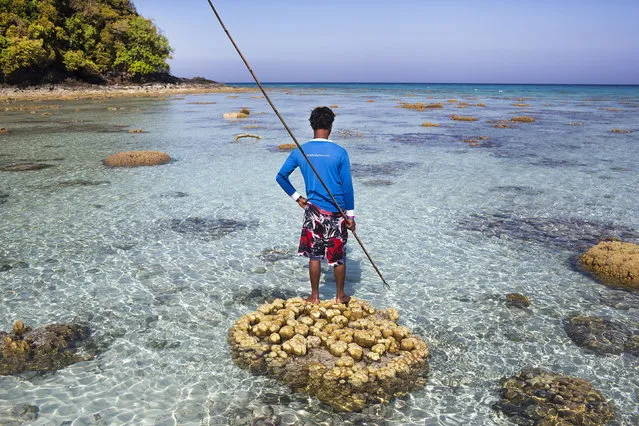
Hook, an indigenous Moken man, holds a three-pronged throwing spear and searches for fish in the waters of Ko Surin National Park. March 1, 2013 – Ko Surin, Thailand. (Photo by Taylor Weidman/zReportage via ZUMA Press)

“For centuries, the Moken sea nomads have traveled the islands between Thailand and Myanmar fishing and foraging for food on the sea floor. Throughout the Mergui Archipelago, Moken migrate in flotillas of Kabangs (traditional boat of the Moken people), stopping at different islands and beaches. Expert freedivers, the Moken have adapted physically to an aquatic life, developing unique characteristics that let them see better and hold their breath longer while underwater”. – Taylor Weidman. Photo: Hook, an indigenous Moken man, holds a three-pronged throwing spear and searches for fish in the waters of Ko Surin National Park. March 1, 2013 – Ko Surin, Thailand. (Photo by Taylor Weidman/zReportage via ZUMA Press)
Details
24 Mar 2014 06:45:00
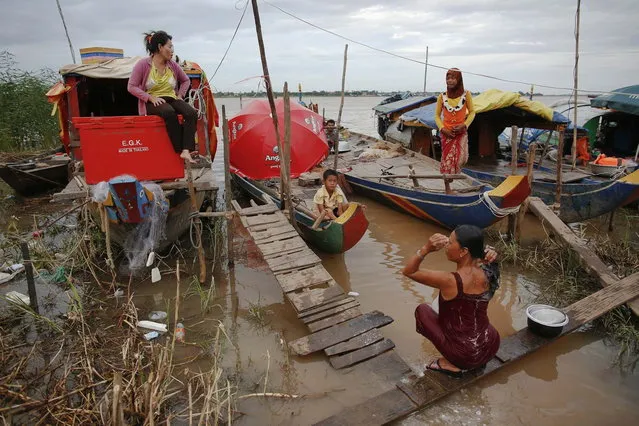
Ethnic Cham Muslim people pass the time near their boats on banks of Mekong river in Phnom Penh July 29, 2013. (Photo by Damir Sagolj/Reuters)

Ethnic Cham Muslim people pass the time near their boats on banks of Mekong river in Phnom Penh July 29, 2013. About 100 ethnic Cham families, made up of nomads and fishermen without houses or land who arrived at the Cambodian capital in search of better lives, live on their small boats on a peninsula where the Mekong and Tonle Sap rivers meet, just opposite the city's centre. The community has been forced to move several times from their locations in Phnom Penh as the land becomes more valuable. They fear that their current home, just behind a new luxurious hotel under construction at the Chroy Changva district is only temporary and that they would have to move again soon. (Photo by Damir Sagolj/Reuters)
Details
31 Jul 2013 06:34:00
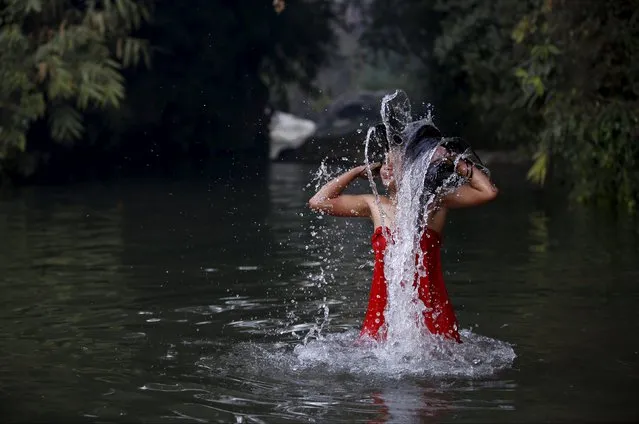
A devotee takes a holy bath in River Saali in Sankhu during the Swasthani Brata Katha festival in Kathmandu, Nepal, January 24, 2016. (Photo by Navesh Chitrakar/Reuters)

A devotee takes a holy bath in River Saali in Sankhu during the Swasthani Brata Katha festival in Kathmandu, Nepal, January 24, 2016. During the month long festival, devotees recite one chapter of a Hindu tale daily from the 31-chapter sacred Swasthani Brata Katha book that is dedicated to God Madhavnarayan and Goddess Swasthani, alongside various other gods and goddess and the miraculous feats performed by them. The devotees also go on pilgrimages to various temples, perform religious rituals, take a holy bath in the rivers and fast for a month, especially among women who believe fasting helps in their family's well-being or in getting them a good husband. (Photo by Navesh Chitrakar/Reuters)
Details
25 Jan 2016 12:05:00
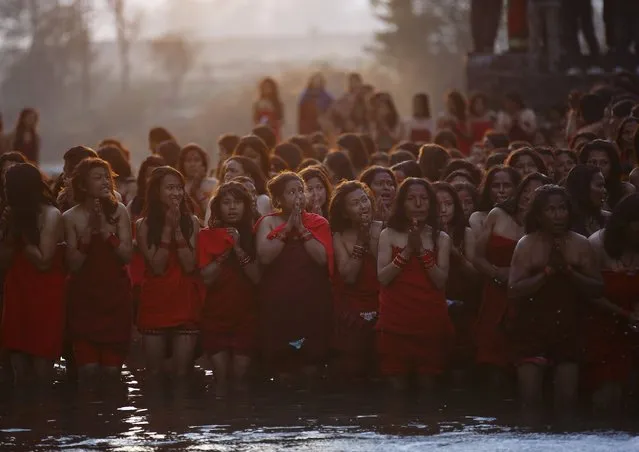
Devotees offer prayers before taking a holy bath during the Swasthani Bratakatha festival in the Triveni River in Panauti near Kathmandu January 24, 2015. (Photo by Navesh Chitrakar/Reuters)

Devotees offer prayers before taking a holy bath during the Swasthani Bratakatha festival in the Triveni River in Panauti near Kathmandu January 24, 2015. During the month long festival, devotees recite one chapter of a Hindu tale daily from the 31-chapter sacred Swasthani Brata Katha book that is dedicated to the God Madhavnarayan and the Goddess Swasthani, alongside various other gods and goddess and the miraculous feats performed by them. The devotees also go on pilgrimages to various temples, perform religious rituals, take a holy bath in the rivers and fast for a month, especially among women who believe fasting helps in their family's well-being or in getting them a good husband. (Photo by Navesh Chitrakar/Reuters)
Details
25 Jan 2015 10:02:00
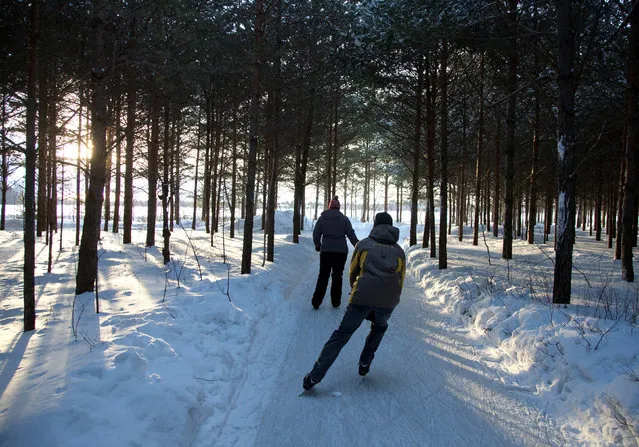
People skate through the forest at Domaine de la Foret Perdu or the Lost Forest, a 15km weaving and zambonied forest trail made for skating in Notre-Dame-du-Mont-Carmel, near Three Rivers, Quebec January 29, 2017. (Photo by Christinne Muschi/Reuters)

People skate through the forest at Domaine de la Foret Perdu or the Lost Forest, a 15km weaving and zambonied forest trail made for skating in Notre-Dame-du-Mont-Carmel, near Three Rivers, Quebec January 29, 2017. (Photo by Christinne Muschi/Reuters)
Details
01 Feb 2017 06:16:00
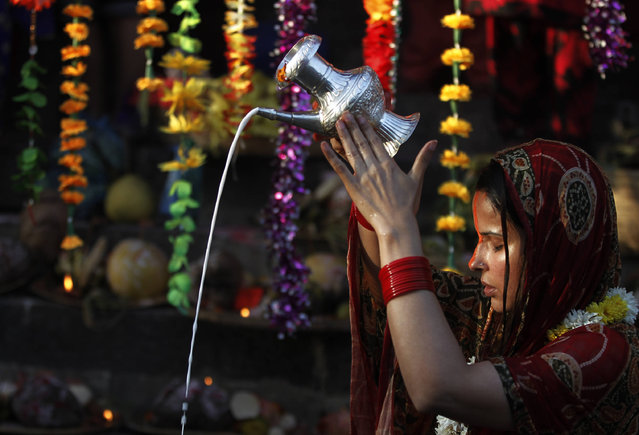
A Nepalese woman pours milk as she offers prayers to the setting Sun on the banks of the Bagmati River during the Chhath Puja festival in Kathmandu, Nepal, Sunday, November 6, 2016. During Chhath, an ancient Hindu festival, rituals are performed to thank the Sun God for sustaining life on earth. (Photo by Niranjan Shrestha/AP Photo)

A Nepalese woman pours milk as she offers prayers to the setting Sun on the banks of the Bagmati River during the Chhath Puja festival in Kathmandu, Nepal, Sunday, November 6, 2016. During Chhath, an ancient Hindu festival, rituals are performed to thank the Sun God for sustaining life on earth. (Photo by Niranjan Shrestha/AP Photo)
Details
08 Nov 2016 11:30:00
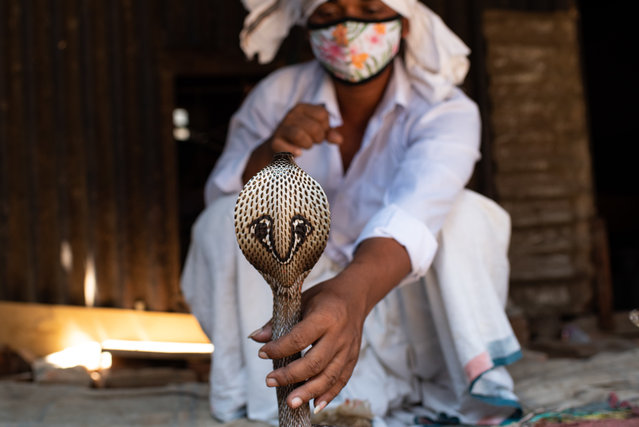
A gypsy man doing their traditional performance with a Cobra snack during the outbreak of coronavirus disease (COVID-19) at Savar the outskirts of Capital Dhaka, Bangladesh on April 24, 2021. The river gypsies in Bangladesh locally known as “Bede” community. (Photo by Fatima-Tuj Johora/ZUMA Wire/Rex Features/Shutterstock)

A gypsy man doing their traditional performance with a Cobra snack during the outbreak of coronavirus disease (COVID-19) at Savar the outskirts of Capital Dhaka, Bangladesh on April 24, 2021. The river gypsies in Bangladesh locally known as “Bede” community. (Photo by Fatima-Tuj Johora/ZUMA Wire/Rex Features/Shutterstock)
Details
20 May 2021 08:52:00