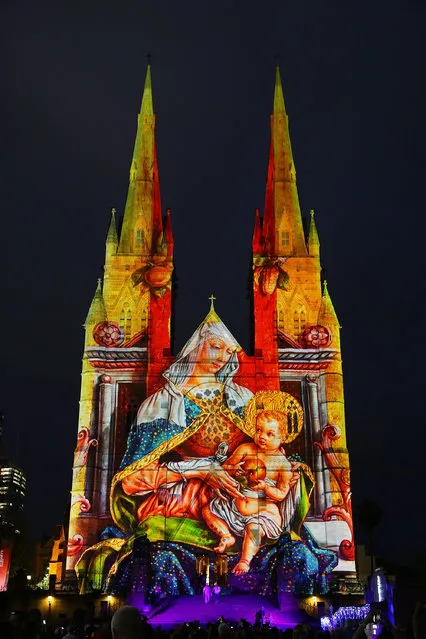
St Mary's Cathedral is illuminated as part of a Christmas lights display in celebration of Christmas on December 19, 2014 in Sydney, Australia. (Photo by Brendon Thorne/Getty Images)
Hindu devotees, their cheeks pierced with metal rods, wait to participate in a religious procession during Thaipusam festival in Chennai, India, Tuesday, February 3, 2015. Thaipusam, celebrated in honor of Hindu god Lord Murugan, is an annual procession by Hindu devotees seeking blessings, fulfilling vows and offering thanks. (Photo by Arun Sankar K./AP Photo)
A man dressed as Ironman takes a seat in the cafeteria on the second day of the London Super Comic Convention at the ExCel centre in east London, on March 15, 2015. (Photo by Justin Tallis/AFP Photo)
From Manhattan and Brooklyn's trendiest neighborhoods to the far-flung edges of theouter boroughs, Will Ellis has spent the last three years photographing and researching the lost and lonely corners of the United States' most populous city. His photo book Abandoned NYC is packed with 150 color images of sixteen of New York's most beautiful and mysterious abandoned spaces, paired with detailed essays on the fascinating history of these forgotten sites. Here: Letchworth Village is located just an hour's drive from NYC in Thiells, NY. It was founded in 1912 to house the city's developmentally disabled as a ”state institution for the epileptic and feeble-minded”. (Photo by Will Ellis)
Claire McGuire (C) smiles after winning the women's snowboard division of the Bikini & Board Shorts Downhill at Crystal Mountain, a ski resort near Enumclaw, Washington April 19, 2014. Skiers and snowboarders competed for a chance to win one of four season's passes. (Photo by David Ryder/Reuters)
A man roasts dog at Langowan traditional market on August 9, 2014 in Langowan, North Sulawesi. The Langowan traditional market is famous for selling a variety of extreme food such as dogs, bats, rats, wild boar, and snakes. (Photo by Putu Sayoga/Getty Images)
Hornets are insects that are the largest eusocial wasps. Some species can reach up to 5.5 cm (2.2 in) in length. The true hornets make up the genus Vespa and are distinguished from other vespines by the width of the vertex (part of the head behind the eyes), which is proportionally larger in Vespa and by the anteriorly rounded gasters (the section of the abdomen behind the wasp waist). The best known species is the European hornet (Vespa crabro), about 2–3.5 cm in length, widely distributed throughout Europe, Russia, North America and Northeast Asia.
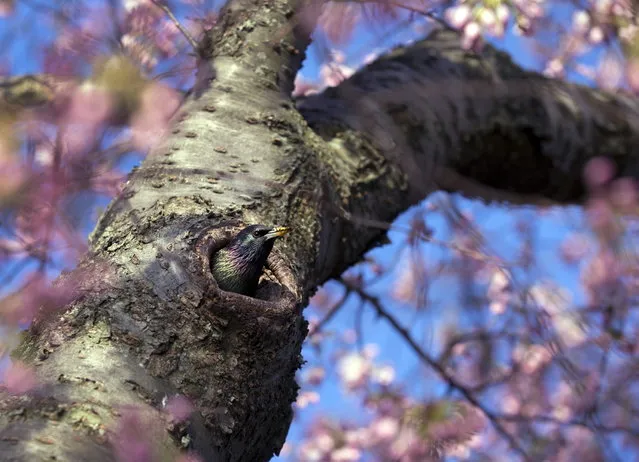
A nesting bird peeks out of the budding Japanese Yoshino cherry tree along the Tidal Basin in Washington, Sunday, April 7, 2013. Despite repeated predictions peak blossom time for the historic cherry trees is not yet here, but almost, almost. (Photo by Carolyn Kaster/AP Photo)