Loading...
Done
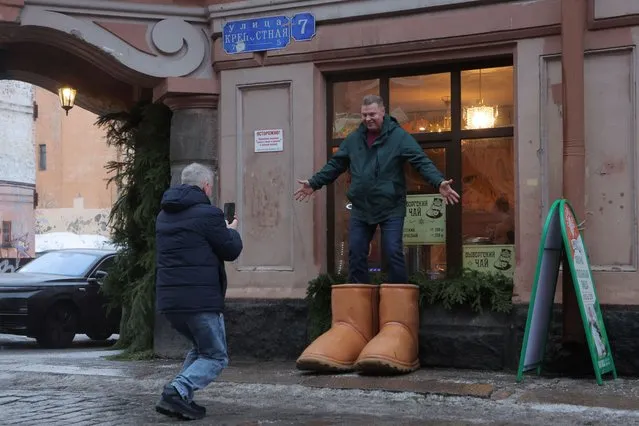
A man poses as his acquaintance takes pictures on a street in the town of Vyborg, Russia on January 28, 2024. (Photo by Anton Vaganov/Reuters)

A man poses as his acquaintance takes pictures on a street in the town of Vyborg, Russia on January 28, 2024. (Photo by Anton Vaganov/Reuters)
Details
14 Feb 2024 14:33:00
Wooden Churches - Travelling In The Russian North By Richard Davies Part 1

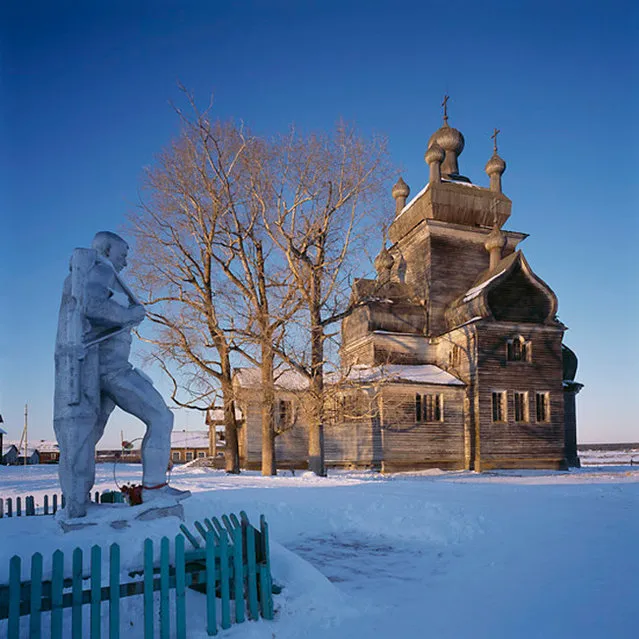
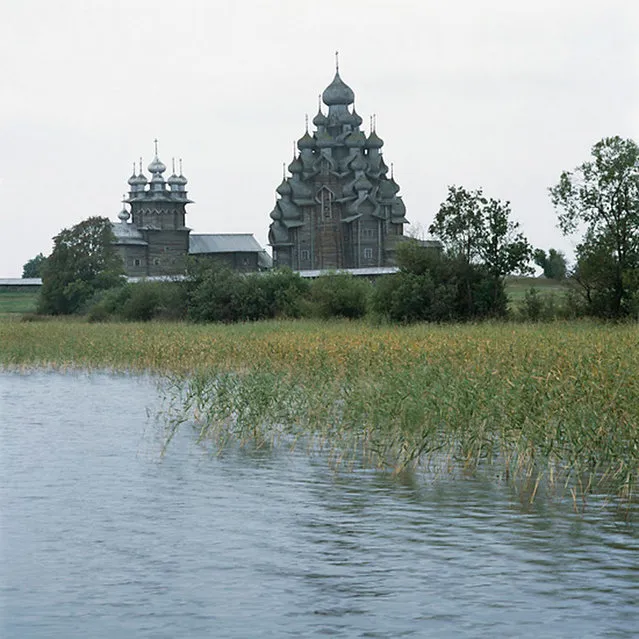
While communism, collectivism, worms, dry rot and casual looting failed to destroy the majestic wooden churches of Russia, it may be ordinary neglect that finally does them in. Dwindled now to several hundred remaining examples, these glories of vernacular architecture lie scattered amid the vastness of the world’s largest country. Just over a decade ago, Richard Davies, a British architectural photographer, struck out on a mission to record the fragile and poetic structures. Austerely beautiful and haunting, “Wooden Churches: Traveling in the Russian North” (White Sea Publishing; $132) is the result. Covering thousands of miles, Mr. Davies described how he and the writer Matilda Moreton tracked down the survivors from among the thousands of onion-domed structures built after Prince Vladimir converted to Christianity in 988.
Details
25 Nov 2013 12:47:00
Wooden Churches - Travelling In The Russian North By Richard Davies Part 2

While communism, collectivism, worms, dry rot and casual looting failed to destroy the majestic wooden churches of Russia, it may be ordinary neglect that finally does them in. Dwindled now to several hundred remaining examples, these glories of vernacular architecture lie scattered amid the vastness of the world’s largest country. Just over a decade ago, Richard Davies, a British architectural photographer, struck out on a mission to record the fragile and poetic structures. Austerely beautiful and haunting, “Wooden Churches: Traveling in the Russian North” (White Sea Publishing; $132) is the result. Covering thousands of miles, Mr. Davies described how he and the writer Matilda Moreton tracked down the survivors from among the thousands of onion-domed structures built after Prince Vladimir converted to Christianity in 988.


See also: Wooden Churches Part1
Details
28 Nov 2013 12:13:00
A squirrel begs for food from a scooter driver in a park in Moscow on September 2, 2025. (Photo by Alexander Nemenov/AFP Photo)

A squirrel begs for food from a scooter driver in a park in Moscow on September 2, 2025. (Photo by Alexander Nemenov/AFP Photo)
Details
15 Oct 2025 02:59:00
North Korean women in colorful traditional dresses are surrounded by flower blossoms known as “Kimilsungia” as they wait to guide guests at a flower exhibition in Pyongyang, North Korea, April 14, 2014. The flowers, named after Kim Il Sung, are on display to celebrate the late leader's official birth date of April 15, 1912. (Photo by David Guttenfelder/AP Photo)

North Korean women in colorful traditional dresses are surrounded by flower blossoms known as “Kimilsungia” as they wait to guide guests at a flower exhibition in Pyongyang, North Korea, April 14, 2014. The flowers, named after Kim Il Sung, are on display to celebrate the late leader's official birth date of April 15, 1912. (Photo by David Guttenfelder/AP Photo)
Details
28 Apr 2014 12:21:00
Model Natasha Poly poses on the red carpet as she arrives for the screening of the film “Carol” in competition at the 68th Cannes Film Festival in Cannes, southern France, May 17, 2015. (Photo by Eric Gaillard/Reuters)

Model Natasha Poly poses on the red carpet as she arrives for the screening of the film “Carol” in competition at the 68th Cannes Film Festival in Cannes, southern France, May 17, 2015. (Photo by Eric Gaillard/Reuters)
Details
18 May 2015 11:49:00
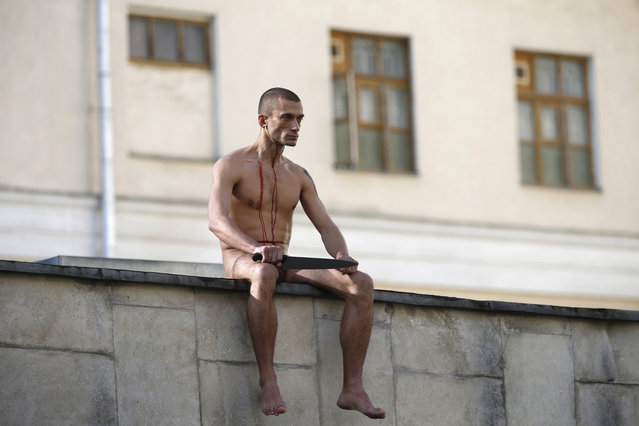
Artist Pyotr Pavlensky sits on the wall enclosing the Serbsky State Scientific Center for Social and Forensic Psychiatry after he cut off a part of his earlobe during his protest action titled “Segregation” in Moscow October 19, 2014. (Photo by Maxim Zmeyev/Reuters)

Artist Pyotr Pavlensky sits on the wall enclosing the Serbsky State Scientific Center for Social and Forensic Psychiatry after he cut off a part of his earlobe during his protest action titled “Segregation” in Moscow October 19, 2014. Pavlensky protested against the usage of forensic psychiatry for politically motivated purposes. He cut off his earlobe to demonstrate how authorities could “cut off” an unwanted individual from society by using psychiatric and medical diagnosis to forcefully send a person to a penitentiary hospital, according to Pavlensky. (Photo by Maxim Zmeyev/Reuters)
Details
21 Oct 2014 12:10:00
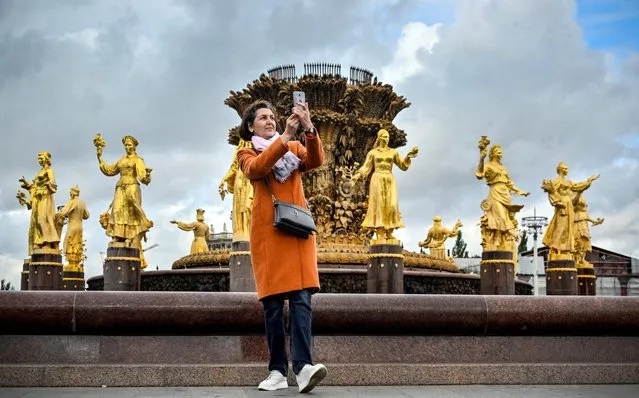
A woman takes a selfie photo by the “Friendship of Nations” fountain at the All-Russia Exhibition Centre (VDNKh) in Moscow on October 5, 2023. The fountain was installed at the All-Russia Exhibition Centre (VDNKh), a trade show and amusement park, in 1954, with 16 gilded bronze sculptures of young women representing 16 republics of the USSR around the oval fountain bowl featuring a wheat sheaf. (Photo by Alexander Nemenov/AFP Photo)

A woman takes a selfie photo by the “Friendship of Nations” fountain at the All-Russia Exhibition Centre (VDNKh) in Moscow on October 5, 2023. The fountain was installed at the All-Russia Exhibition Centre (VDNKh), a trade show and amusement park, in 1954, with 16 gilded bronze sculptures of young women representing 16 republics of the USSR around the oval fountain bowl featuring a wheat sheaf. (Photo by Alexander Nemenov/AFP Photo)
Details
12 Oct 2023 04:20:00