Loading...
Done
This picture taken on July 25, 2014 shows people cooling off in a waterpark in Suining, southwest China's Sichuan province. Meteorological departments issued an orange alert for high temperature as a heat wave embraces Sichuan province, with temperature of most area topped 37, local media reported. (Photo by AFP Photo)

This picture taken on July 25, 2014 shows people cooling off in a waterpark in Suining, southwest China's Sichuan province. Meteorological departments issued an orange alert for high temperature as a heat wave embraces Sichuan province, with temperature of most area topped 37, local media reported. (Photo by AFP Photo)
Details
02 Aug 2014 13:36:00
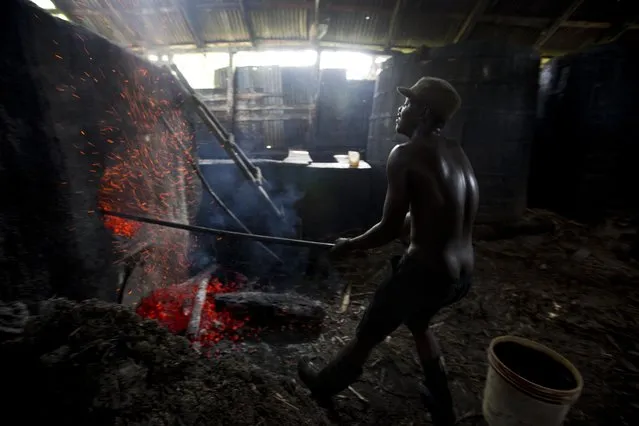
In this June 16, 2017 photo, Batel Delciner, 23, removes wood from a furnace to lower the heat cooking sugar juice at the Ti Jean distillery, which produces clairin, a sugar-based alcoholic drink, in Leogane, Haiti. The broth is cooked for about four hours after a fermentation period of four to eight days. (Photo by Dieu Nalio Chery/AP Photo)

In this June 16, 2017 photo, Batel Delciner, 23, removes wood from a furnace to lower the heat cooking sugar juice at the Ti Jean distillery, which produces clairin, a sugar-based alcoholic drink, in Leogane, Haiti. The broth is cooked for about four hours after a fermentation period of four to eight days. (Photo by Dieu Nalio Chery/AP Photo)
Details
12 Jul 2017 07:41:00
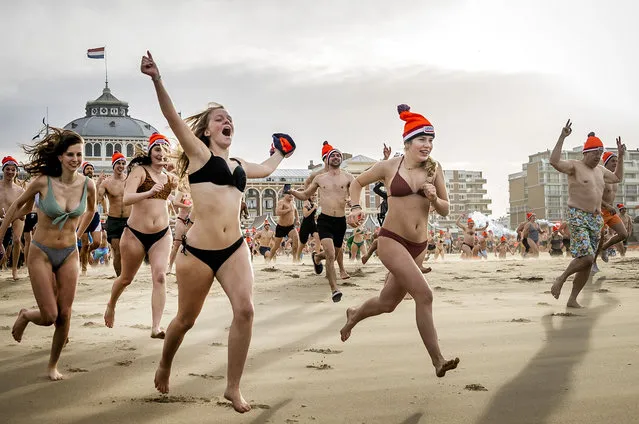
People run into the sea at the beach of Scheveningen on New Year's Day, Scheveningen, Netherlands, 01 January 2023. The traditional New Year's dive was resumed after the two previous editions were canceled due to the corona crisis. (Photo by Remko de Waal/EPA/EFE/Rex Features/Shutterstock)

People run into the sea at the beach of Scheveningen on New Year's Day, Scheveningen, Netherlands, 01 January 2023. The traditional New Year's dive was resumed after the two previous editions were canceled due to the corona crisis. (Photo by Remko de Waal/EPA/EFE/Rex Features/Shutterstock)
Details
08 Mar 2024 07:43:00
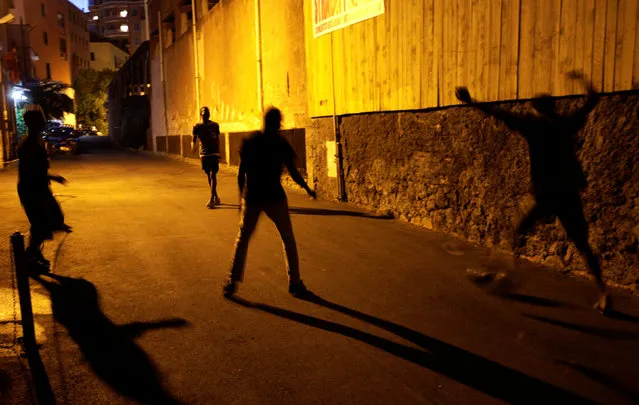
Migrants play soccer at makeshift camp in Via Cupa (Gloomy Street) in downtown Rome, Italy, August 2, 2016. Italy is taking in thousands of boat migrants every week for a third year in a row, and friction is common between them and those who live along the path many take on their journey towards northern Europe. Set up by volunteers, the Baobab centre, by Rome's Tiburtina train station, was shut down by police in December in the wake of the Paris attacks and because the European Union wants Italy to stop migrants from moving on, not help them to do so. B(Photo by Max Rossi/Reuters)

Migrants play soccer at makeshift camp in Via Cupa (Gloomy Street) in downtown Rome, Italy, August 2, 2016. Italy is taking in thousands of boat migrants every week for a third year in a row, and friction is common between them and those who live along the path many take on their journey towards northern Europe. (Photo by Max Rossi/Reuters)
Details
11 Aug 2016 14:31:00
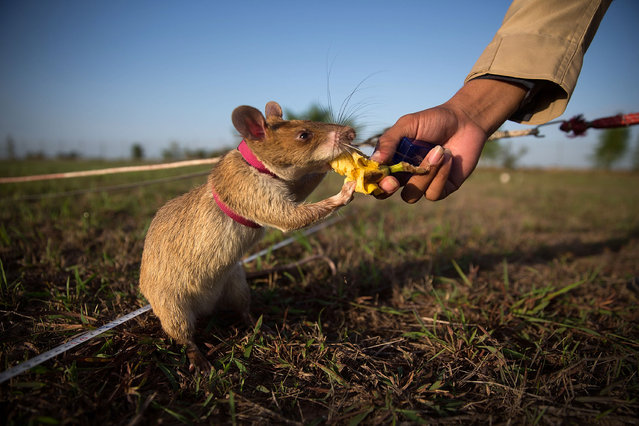
A mine detection rat is given banana as a reward after successfully identifying an inactive mine on July 2, 2015 in Siem Reap, Cambodia. (Photo by Taylor Weidman/Getty Images)

A mine detection rat is given banana as a reward after successfully identifying an inactive mine on July 2, 2015 in Siem Reap, Cambodia. The Cambodian Mine Action Center (CMAC) working with the Belgian NGO APOPO has recently begun testing the feasability of using large mine detection rats from Tanzania to help clear fields of mines and unexploded ordnance in one of the most bombed and mined countries in the world. (Photo by Taylor Weidman/Getty Images)
Details
03 Jul 2015 13:31:00
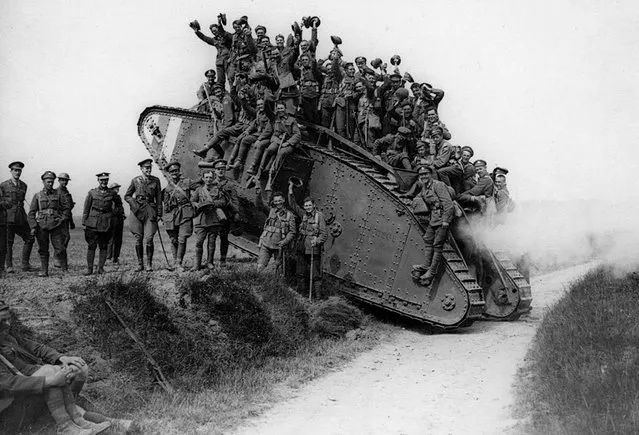
These black-and-white photos are taken from the new book “Armoured Warfare in the First World War 1916 – 1918” by Anthony Tucker-Jones and published by Pen & Sword Military. “Interestingly the British, French and Germans took completely different approaches with varying results”. The British military produced “Little Willie” in Autumn 1915 weighing 18 tonnes, which had a crew of two plus four gunners. “Inspired by a tracked artillery tractor “Little Willie” was referred to as a water tank – hence the name tank – to ensure secrecy”, said Anthony. “This led to the strange looking Mark I with its peculiar rhomboid shape, designed to cross trenches with guns in sponsons on either side. The Germans saw the tank as unchivalrous and were slow to grasp its utility. They favoured the Stormtrooper (specialist soldiers used to infiltrate enemy trenches) and artillery, not the tank”, said Anthony. “However, they didn’t hesitate to make use of captured British tanks. Although the tank helped secure victory and German soldiers dubbed it “Germany’s Downfall” the country was ultimately brought to its knees by the Allies blockade”. Here: British troops hitch a ride on a Mark IV after the massed tank fleet spearheading attack at Cambrai on November 20, 1917. (Photo by Anthony Tucker-Jones/Mediadrumworld.com)

These black-and-white photos are taken from the new book “Armoured Warfare in the First World War 1916 – 1918” by Anthony Tucker-Jones and published by Pen & Sword Military. Here: British troops hitch a ride on a Mark IV after the massed tank fleet spearheading attack at Cambrai on November 20, 1917. (Photo by Anthony Tucker-Jones/Mediadrumworld.com)
Details
23 Feb 2017 00:02:00
In this picture taken on November 28, 2016, a hot-air balloon carrying tourists sails over the archeological site at sunrise in Bagan. Located in central Myanmar, Bagan is home to more than 2,000 ancient Buddhist monuments deeply revered in the Buddhist-majority nation and is one of the country's most popular tourist destinations. (Photo by Dale De La Rey/AFP Photo)

In this picture taken on November 28, 2016, a hot-air balloon carrying tourists sails over the archeological site at sunrise in Bagan. Located in central Myanmar, Bagan is home to more than 2,000 ancient Buddhist monuments deeply revered in the Buddhist-majority nation and is one of the country's most popular tourist destinations. (Photo by Dale De La Rey/AFP Photo)
Details
10 Dec 2016 09:01:00
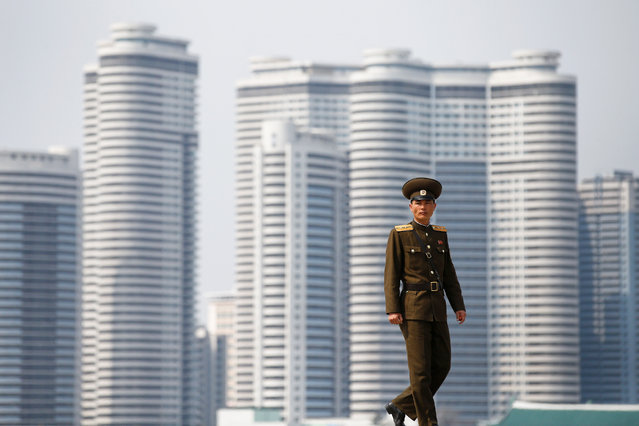
A soldier walks on the bank of the river in central Pyongyang, North Korea on April 16, 2017. (Photo by Damir Sagolj/Reuters)

A soldier walks on the bank of the river in central Pyongyang, North Korea on April 16, 2017. (Photo by Damir Sagolj/Reuters)
Details
20 Jan 2018 07:01:00