Loading...
Done
An athlete pulls a 15-tonne truck during a Truck-Pull event marking the upcoming Independence Day in the Belarus capital Minsk, on July 3, 2014. The former Soviet nation celebrates its Independence Day on July 3 in memory of the end of Belarus occupation by Nazi Germany troops during the Red Army main summer offensive in 1944. (Photo by Sergei Gapon/AFP Photo)

An athlete pulls a 15-tonne truck during a Truck-Pull event marking the upcoming Independence Day in the Belarus capital Minsk, on July 3, 2014. The former Soviet nation celebrates its Independence Day on July 3 in memory of the end of Belarus occupation by Nazi Germany troops during the Red Army main summer offensive in 1944. (Photo by Sergei Gapon/AFP Photo)
Details
05 Jul 2014 12:13:00
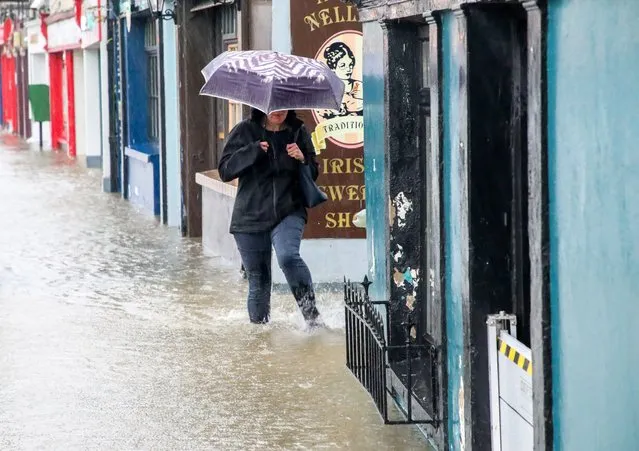
A woman wades throug a flooded Main Street as she makes her way to work in Carrigaline, Co. Cork, Ireland on October 18, 2023. (Photo by David Creedon/The Irish Times)

A woman wades throug a flooded Main Street as she makes her way to work in Carrigaline, Co. Cork, Ireland on October 18, 2023. (Photo by David Creedon/The Irish Times)
Details
23 Nov 2023 00:21:00
Lord Roscoe the cat runs through the crocuses on the lawns at the National Trust's 17th-century Ham House and Garden in Richmond, London on Monday, March 6, 2023. In recent years more than 500,000 bulbs have been planted to create a spectacle for visitors and to attract bees, butterflies and other pollinating insects. (Photo by Kirsty O'Connor/PA Images via Getty Images)

Lord Roscoe the cat runs through the crocuses on the lawns at the National Trust's 17th-century Ham House and Garden in Richmond, London on Monday, March 6, 2023. In recent years more than 500,000 bulbs have been planted to create a spectacle for visitors and to attract bees, butterflies and other pollinating insects. (Photo by Kirsty O'Connor/PA Images via Getty Images)
Details
26 Apr 2023 02:59:00
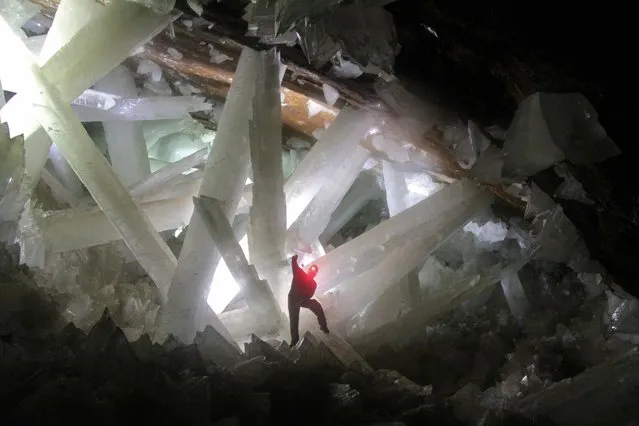
Giant Crystal Cave in Naica, Mexico

Cave of the Crystals or Giant Crystal Cave is a cave connected to the Naica Mine 300 metres (980 ft) below the surface in Naica, Chihuahua, Mexico. The main chamber contains giant selenite crystals (gypsum, CaSO4·2 H2O), some of the largest natural crystals ever found. The cave's largest crystal found to date is 12 m (39 ft) in length, 4 m (13 ft) in diameter and 55 tons in weight. The cave is extremely hot with air temperatures reaching up to 58 °C (136 °F) with 90 to 99 percent humidity. The cave is relatively unexplored due to these factors. Without proper protection people can only endure approximately ten minutes of exposure at a time.
Details
20 May 2014 07:56:00
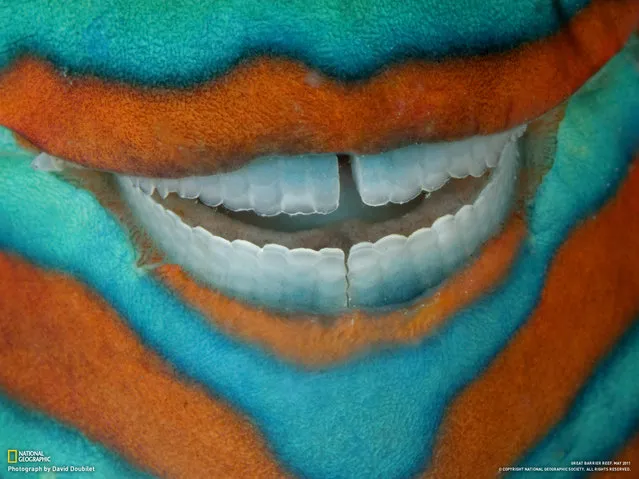
Photographers: David Doubilet

“David Doubilet (born 28 November 1946) is a well known underwater photographer known primarily for his work published in National Geographic Magazine. He was born in New York and started taking photos underwater at the young age of 12. He started with a Brownie Hawkeye in a rubber anesthesiologist's bag to keep the water out of the camera. During his summer holidays, he spent his time along the New Jersey coast. He later worked as a diver and photographer for the Sandy Hook Marine Laboratories in New Jersey. He also spent much time in the Caribbean. While a dive instructor in the Bahamas he found his motivation to capture the beauty of the sea and everything in it”. – Wikipedia. (Photo by David Doubilet/National Geographic)
Details
16 May 2012 12:21:00
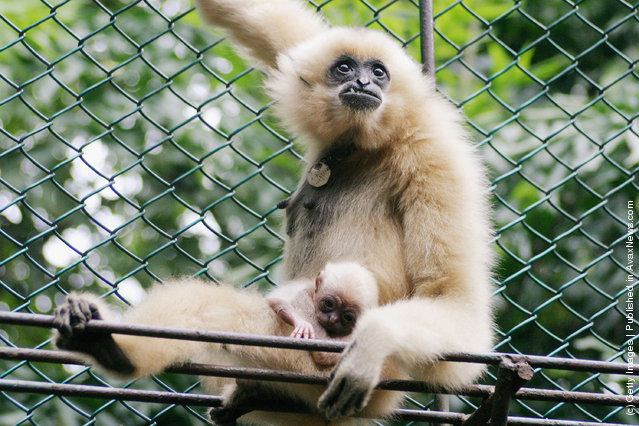
Newborn White-Cheeked Gibbon Nomascus

“Nomascus is the second most speciose genus of gibbons (family Hylobatidae). Originally this genus was a subgenus of Hylobates, and all individuals were considered one species, Hylobates concolor. Species within Nomascus are characterized by 52 chromosomes. Some species are all black, some light with a distinct black tuft of crown fur, and some by distinct, light-colored cheek patches. Nomascus is found from southern China (Yunnan) to southern Vietnam, and also on Hainan Island. One of the genus' species, Nomascus nasutus, has been deemed “the most critically endangered ape species in the world”. All of the species in this genus are endangered or critically endangered”. – Wikipedia

Photo: A newborn White-Cheeked Gibbon clings to its mother in the Nanning Zoo on April 12, 2004 in Nanning, Guangxi province, China. The White-Cheeked Gibbon's natural habitat is Southern China as well as Vietnam and Laos. They are classified as highly endangered and are on the brink of extinction due to poaching and reduction of natural rainforests. (Photo by Getty Images)

Details
12 Aug 2011 11:51:00
Filipino children frolic next to ships taking shelter inside a seaport in Navotas city, north of Manila, Philippines, 27 August 2019. According to the latest advisory from Philippine Atmospheric Geophysical and Astronomical Services Administration (PAGASA), Tropical Storm Podul intensified from a tropical depression into a tropical storm on August 27, while moving toward Central Luzon with a maximum winds of 65 kilometers per hour and gustiness of up to 80 km/h. (Photo by Francis R. Malasig/EPA/EFE)

Filipino children frolic next to ships taking shelter inside a seaport in Navotas city, north of Manila, Philippines, 27 August 2019. According to the latest advisory from Philippine Atmospheric Geophysical and Astronomical Services Administration (PAGASA), Tropical Storm Podul intensified from a tropical depression into a tropical storm on August 27, while moving toward Central Luzon with a maximum winds of 65 kilometers per hour and gustiness of up to 80 km/h. (Photo by Francis R. Malasig/EPA/EFE)
Details
14 Jan 2020 00:01:00
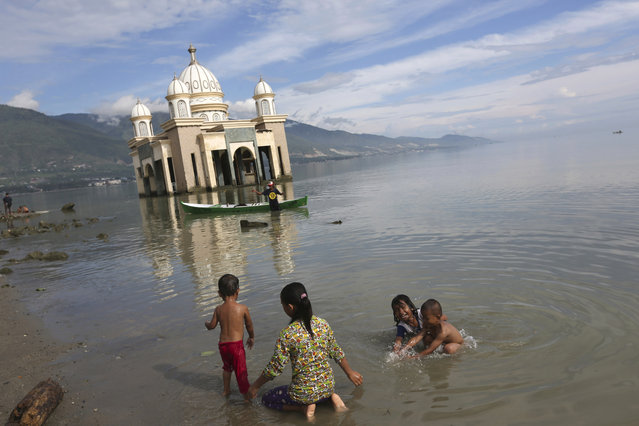
In this Wednesday, April 3, 2019, photo, children play in the water on a beach as a mosque collapsed during the Sept. 28, 2018, earthquake is seen in the background in Palu, Central Sulawesi, Indonesia. The earthquake spawned a large localized tsunami that wiped out coastal areas, while liquefaction caused by the shaking turned entire neighborhoods into rivers of sludge. The disaster killed thousands of people, making it the world’s deadliest seismic event in 2018. (Photo by Tatan Syuflana/AP Photo)

In this Wednesday, April 3, 2019, photo, children play in the water on a beach as a mosque collapsed during the Sept. 28, 2018, earthquake is seen in the background in Palu, Central Sulawesi, Indonesia. The earthquake spawned a large localized tsunami that wiped out coastal areas, while liquefaction caused by the shaking turned entire neighborhoods into rivers of sludge. The disaster killed thousands of people, making it the world’s deadliest seismic event in 2018. (Photo by Tatan Syuflana/AP Photo)
Details
04 May 2019 00:05:00