Loading...
Done
Kelsea Ballerini performs at the 59th Annual Country Music Association Awards in Nashville, Tennessee, U.S., November 19, 2025. (Photo by Seth Herald/Reuters)

Kelsea Ballerini performs at the 59th Annual Country Music Association Awards in Nashville, Tennessee, U.S., November 19, 2025. (Photo by Seth Herald/Reuters)
Details
26 Nov 2025 03:25:00
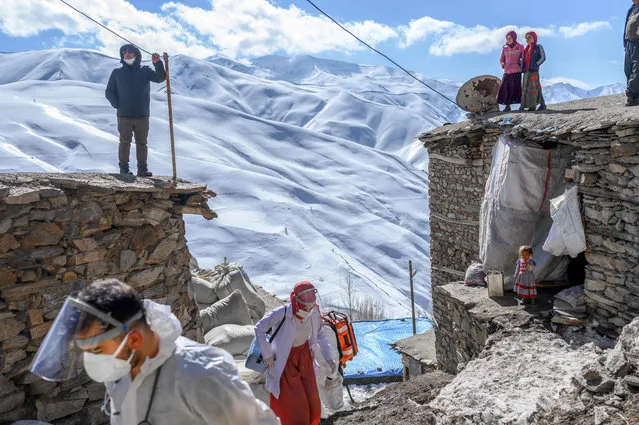
In this photograph taken on February 15, 2021, doctor Sergen Saracoglu (L) and nurse Yilzdiz Ayten (C) from the Bahcesaray public hospital vaccination team, arrive at the village of Guneyyamac in eastern Turkey, as part of an expedition to vaccinate residents of 65 years old or above with Sinovac's CoronaVac Covid-19 vaccine. Turkey's population of more than 83 million is spread out across Europe and Asia and covers some seemingly impregnable terrain. The vaccination effort with China's CoronaVac jab kicked off with a bang in mid-January when Turkey inoculated more than half a million people in the first few days. But it slowed down considerably when doctors left the big cities and tried to reach remote places such as Imamli and Ozbeyli – two ethnically Kurdish hamlets of a few hundred herders and farmers each. (Photo by Bulent Kilic/AFP Photo)

In this photograph taken on February 15, 2021, doctor Sergen Saracoglu (L) and nurse Yilzdiz Ayten (C) from the Bahcesaray public hospital vaccination team, arrive at the village of Guneyyamac in eastern Turkey, as part of an expedition to vaccinate residents of 65 years old or above with Sinovac's CoronaVac Covid-19 vaccine. (Photo by Bulent Kilic/AFP Photo)
Details
18 Mar 2021 09:32:00
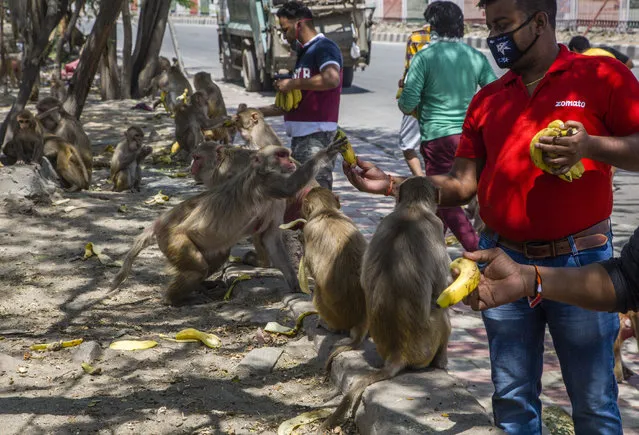
Men give bananas to monkeys gathered on the side of the road as India remains under an unprecedented lockdown over the highly contagious coronavirus (COVID-19) on April 08, 2020 in New Delhi, India. Wild animals, including monkeys, are roaming human settlements in India as people are staying indoors due to the 21-day lockdown. With India's 1.3 billion population and tens of millions of cars off the roads, wildlife is moving towards areas inhabited by humans. Wild animals in many countries have been seen roaming streets. A study says some 60 percent of the new diseases found around the globe every year are zoonotic, meaning they originate in animals and are passed on to humans. COVID-19 is a zoonotic disease that is suspected to have come from the wet markets of Wuhan, China. (Photo by Yawar Nazir/Getty Images)

Men give bananas to monkeys gathered on the side of the road as India remains under an unprecedented lockdown over the highly contagious coronavirus (COVID-19) on April 08, 2020 in New Delhi, India. Wild animals, including monkeys, are roaming human settlements in India as people are staying indoors due to the 21-day lockdown. (Photo by Yawar Nazir/Getty Images)
Details
12 Apr 2020 00:05:00
Models are seen at the backstage before the runway at The 2nd Skin Co. show during Mercedes Benz Fashion Week Madrid Spring/Summer 2020 at Ifema on July 09, 2019 in Madrid, Spain. (Photo by Pablo Cuadra/Getty Images)

Models are seen at the backstage before the runway at The 2nd Skin Co. show during Mercedes Benz Fashion Week Madrid Spring/Summer 2020 at Ifema on July 09, 2019 in Madrid, Spain. (Photo by Pablo Cuadra/Getty Images)
Details
11 Jul 2019 00:05:00
Cheerleaders wearing face masks due to the outbreak of the coronavirus disease (COVID-19) are seen at the first professional baseball league game of the season at Taoyuan International baseball stadium in Taoyuan city, Taiwan, April 11, 2020. (Photo by Ann Wang/Reuters)

Cheerleaders wearing face masks due to the outbreak of the coronavirus disease (COVID-19) are seen at the first professional baseball league game of the season at Taoyuan International baseball stadium in Taoyuan city, Taiwan, April 11, 2020. (Photo by Ann Wang/Reuters)
Details
25 Apr 2020 00:05:00
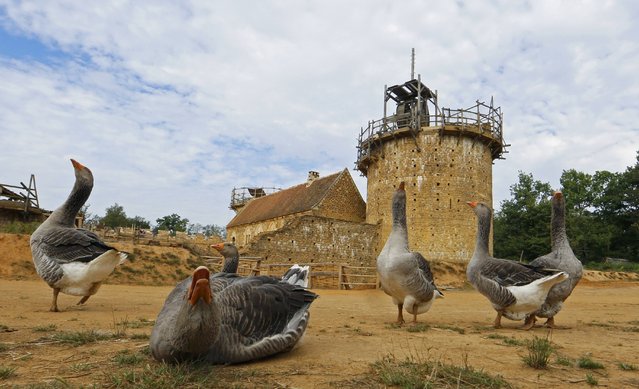
A view of the construction site of the Chateau de Guedelon near Treigny in the Burgundy region of France, September 13, 2016. Blacksmiths, stonemasons and quarry men are hard at work in a Burgundy forest building a 13th-century-style castle using the most basic tools and materials, replicating the methods used hundreds of years ago to better understand them. Forgoing all modern technology, workers use hammers to break stones and forge iron, operate wooden wheels to hoist their materials up to where they are needed, and rely on a quarry for stone, clay and sand as they build up a castle from scratch. Construction on Guedelon Castle in central France began in 1997 after an archaeological survey revealed a medieval fortress hidden inside the walls of nearby Chateau de Saint-Fargeau. Those behind the project hope to answer questions about medieval construction and provide lessons on sustainable building. (Photo by Jacky Naegelen/Reuters)

A view of the construction site of the Chateau de Guedelon near Treigny in the Burgundy region of France, September 13, 2016. Blacksmiths, stonemasons and quarry men are hard at work in a Burgundy forest building a 13th-century-style castle using the most basic tools and materials, replicating the methods used hundreds of years ago to better understand them. (Photo by Jacky Naegelen/Reuters)
Details
15 Sep 2016 09:43:00
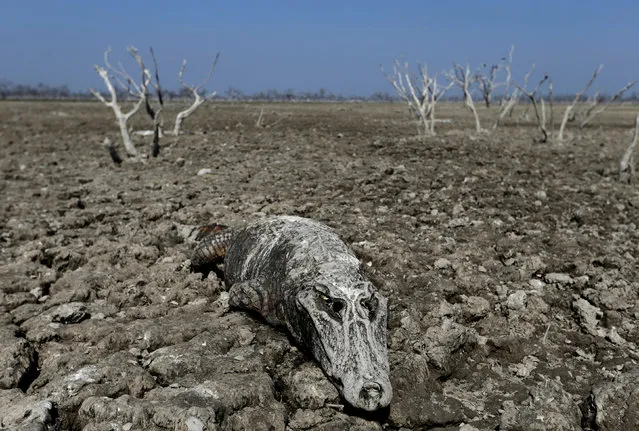
The carcass of a yacare caiman lies in the dried-up river bed of the Pilcomayo river in Boqueron, Paraguay, August 14, 2016. In Paraguay, alongside the Pilcomayo River, black vultures flew over a shrinking pond where a group of crocodilian reptiles known as yacare caimans sought refuge. Water from the river, which divides Paraguay and Argentina in the area of the Gran Chaco, was scarce. This is not an uncommon sight in the region of General Diaz, about 700 kilometres (435 miles) northwest of the country's capital Asuncion, where the Pilcomayo's waters form lakes and streams that give life to capybaras, birds and caimans. “The river's situation is critical. No water is forecast to enter the basin until December, as happens every year”, said Alcides Gonzalez, a resident of the area. (Photo by Jorge Adorno/Reuters)

The carcass of a yacare caiman lies in the dried-up river bed of the Pilcomayo river in Boqueron, Paraguay, August 14, 2016. In Paraguay, alongside the Pilcomayo River, black vultures flew over a shrinking pond where a group of crocodilian reptiles known as yacare caimans sought refuge. Water from the river, which divides Paraguay and Argentina in the area of the Gran Chaco, was scarce. This is not an uncommon sight in the region of General Diaz, about 700 kilometres (435 miles) northwest of the country's capital Asuncion, where the Pilcomayo's waters form lakes and streams that give life to capybaras, birds and caimans. (Photo by Jorge Adorno/Reuters)

Details
03 Nov 2016 12:40:00
Protesters on a freeway onramp amid a chaotic traffic situation with the shutdown of the freeway in downtown Los Angeles, California after midnight early on November 10, 2016 as protesters angry over Donald J. Trump's election as the next US president marched in downtown Los Angeles through the evening and shut down portions of the Hollywood (101) Freeway. Thousands of protesters rallied across the United States expressing shock and anger over Donald Trump's election, vowing to oppose divisive views they say helped the Republican billionaire win the presidency. (Photo by Frederic J. Brown/AFP Photo)

Protesters on a freeway onramp amid a chaotic traffic situation with the shutdown of the freeway in downtown Los Angeles, California after midnight early on November 10, 2016 as protesters angry over Donald J. Trump's election as the next US president marched in downtown Los Angeles through the evening and shut down portions of the Hollywood (101) Freeway. Thousands of protesters rallied across the United States expressing shock and anger over Donald Trump's election, vowing to oppose divisive views they say helped the Republican billionaire win the presidency. (Photo by Frederic J. Brown/AFP Photo)
Details
11 Nov 2016 08:18:00