Loading...
Done


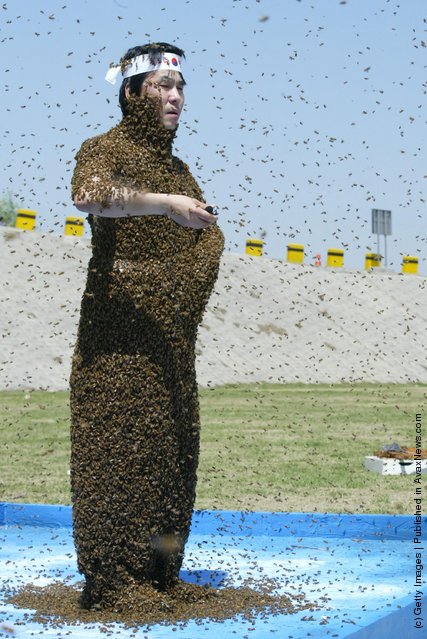
South Korean bee farmer Ahn Sang-Kyu protests Japan's claim of sovereignty over disputed islets May 2, 2006 in Seoul, South Korea. Ahn, a local bee farmer, released over 140,000 bees and attracted them to his body to protest Japan's sovereignty claims over a tiny group of islands located off the east coast of South Korea, called the Dokdo islets by the Koreans and Takeshima by the Japanese. The volcanic islets located about 90 kilometres east of South Korea's Ullung Island, have been a source of diplomatic friction between South Korea and Japan for years. (Photo by Chung Sung-Jun/Getty Images)
Details
05 May 2011 10:32:00
Royal Hindu Cremation Held In Bali

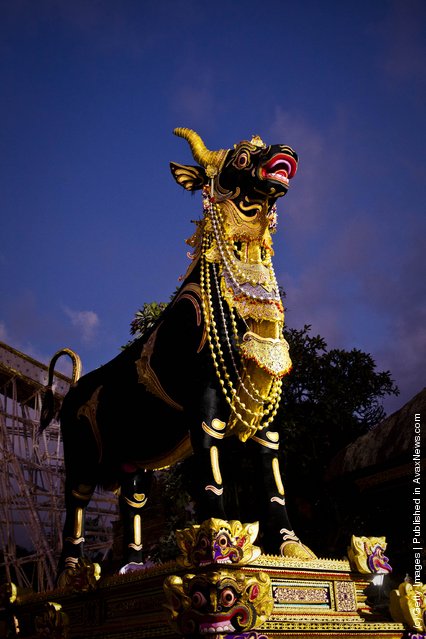
A black bull sarcophagus stands at Puri Ubud during the Hindu Royal cremation – also know as the Pengabenan – for the late Anak Agung Niang Rai, mother of Gianyar Regent, Tjokorda Oka Artha Ardana Sukawati, at Puri Ubud in Gianyar Bali on August 17, 2011 in Ubud, Bali, Indonesia. Niang Rai died in a Denpasar hospital in May; her actual cremation will take place on August 18 and will involve a nine level, 24m high 'bade' or body carring tower, made by upto 100 volunteers from 14 local villages. It will be carried to the cremation by 4500 Ubud residents. (Photo by Ulet Ifansasti/Getty Images)
Details
19 Aug 2011 09:30:00
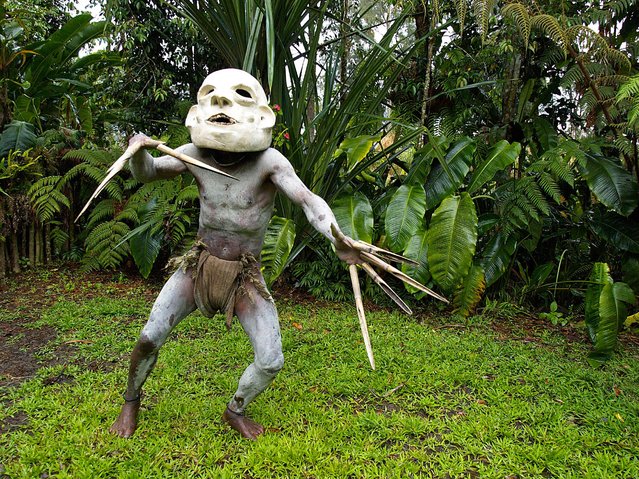
The mudmen come from the country’s western highlands, where there are virtually no roads, cars, electricity or shops. (Photo by Jeremy Hunter/Exclusivepix Media)

For centuries the Highlands peoples of Papua New Guinea fought over land, women and pigs. Sorcery and battle skills could elevate a clan to Bigmanship, where the bigger the “presentation”, the bigger the man. Clans therefore would paint their bodies and create fearsome masks as part of their psy. Here: These are the terrifying tribe of “mudmen” from a remote part of Papua New Guinea. (Photo by Jeremy Hunter/Exclusivepix Media)
Details
08 May 2017 08:12:00
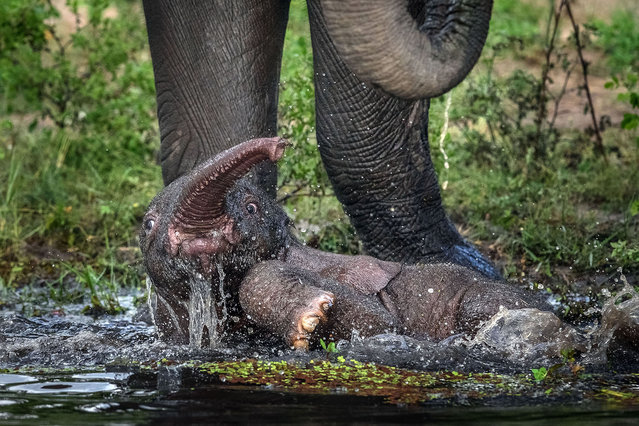
This cute elephant calf was spotted after it got stuck in a pool of water and required a helping trunk from its mum to get out. The young calf looked like it was having an incredible time however, as it frolicked about in the water and could have done with some waterproofs to boot. But mum clearly knew best with her tot, when she wrapped her trunk around the youngsters body and hoisted it out of the pool. The incident which took place on the Chobe River, Botswana, was captured by Neal Cooper, 50, a professional photographer from South Africa. (Photo by Neal Cooper/Caters News)

This cute elephant calf was spotted after it got stuck in a pool of water and required a helping trunk from its mum to get out. The young calf looked like it was having an incredible time however, as it frolicked about in the water and could have done with some waterproofs to boot. But mum clearly knew best with her tot, when she wrapped her trunk around the youngsters body and hoisted it out of the pool. The incident which took place on the Chobe River, Botswana, was captured by Neal Cooper, 50, a professional photographer from South Africa. (Photo by Neal Cooper/Caters News)
Details
15 Apr 2016 10:54:00
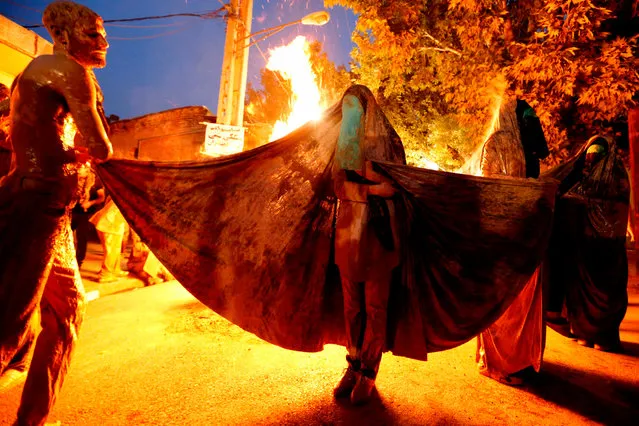
Iranian Shiite Muslim women gather around a bonfire after rubbing mud on their body during the “Kharrah Mali” (Mud Rubbing) ritual to mark the Ashura religious ceremony in the city of Khorramabad, some 470 kms southwest of Tehran, early in the morning on October 1, 2017. “Khrreh Mali” or “Mud Rubbing” is a ritual that is held in the city of Khorramabad every year to commemorate the seventh century slaying of Prophet Mohammed' s grandson Imam Hussein, in which Iranian men roll over in mud and dry themselves by gathering around the bonfires before flagellating themselves. (Photo by Atta Kenare/AFP Photo)

Iranian Shiite Muslim women gather around a bonfire after rubbing mud on their body during the “Kharrah Mali” (Mud Rubbing) ritual to mark the Ashura religious ceremony in the city of Khorramabad, some 470 kms southwest of Tehran, early in the morning on October 1, 2017. “Khrreh Mali” or “Mud Rubbing” is a ritual that is held in the city of Khorramabad every year to commemorate the seventh century slaying of Prophet Mohammed' s grandson Imam Hussein, in which Iranian men roll over in mud and dry themselves by gathering around the bonfires before flagellating themselves. (Photo by Atta Kenare/AFP Photo)
Details
02 Oct 2017 08:38:00


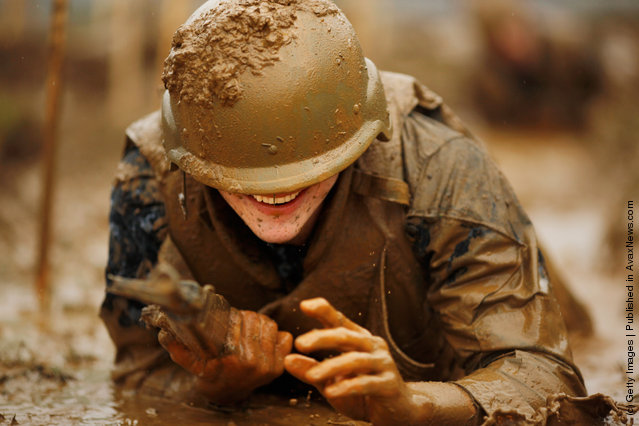
A member of the United States Naval Academy freshman class wears body armor, helmet and carries a rifle through a mud-filled ditch as part of the “Wet and Sandy” challenge during the rigorous Sea Trials May 17, 2011 in Annapolis, MD. Under strict safety supervision, about 900 freshmen, or “Plebes”, faced 14 hours of 32 rigorous physical and mental challenges during the trials, a daylong, action-oriented event modeled after the Marine Corps 54-hour Crucible and the Navy's Battle Stations. (Photo by Chip Somodevilla/Getty Images)
Details
18 May 2011 07:51:00


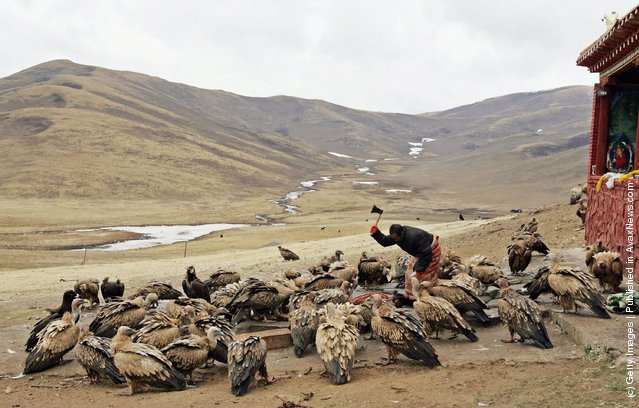
“Sky burial or ritual dissection was once a common funerary practice in Tibet wherein a human corpse is cut in specific locations and placed on a mountaintop, exposing it to the elements or the mahabhuta and animals – especially to birds of prey. The location of the sky burial preparation and place of execution are understood in the Vajrayana traditions as charnel grounds. In Tibet the practice is known as jhator, which literally means, «giving alms to the birds»”. – Wikipedia

Photo: A burial master chops bones of a body to feed vultures during a celestial burial ceremony on April 19, 2006 in Dari County of Guoluo Prefecture, Qinghai Province, northwest China. Celestial burial is a traditional funeral of Tibetan people, which began in the 7th century. (Photo by China Photos/Getty Images)
Details
18 Jun 2011 12:12:00
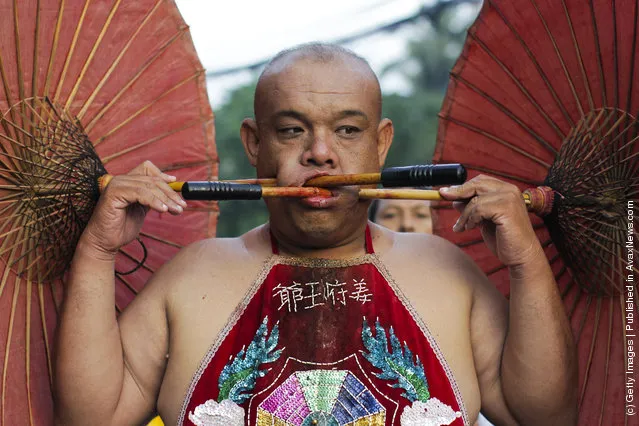
Devotees Practice Self Mutilation At Phuket Vegetarian Festival

A devotee of the Chinese shrine of Kathu Shrine, pierces his cheeks with umbrellas during a procession of Vegetarian Festival on October 4, 2011 in Phuket, Thailand. Ritual Vegetarianism in Phuket Island traces it roots back to the early 1800's. The festival begins on the first evening of the ninth lunar month and lasts for nine days. Participants in the festival perform acts of body piercing as a means of shifting evil spirits from individuals onto themselves and bring the community good luck. (Photo by Athit Perawongmetha/Getty Images)
Details
04 Oct 2011 10:49:00