Loading...
Done
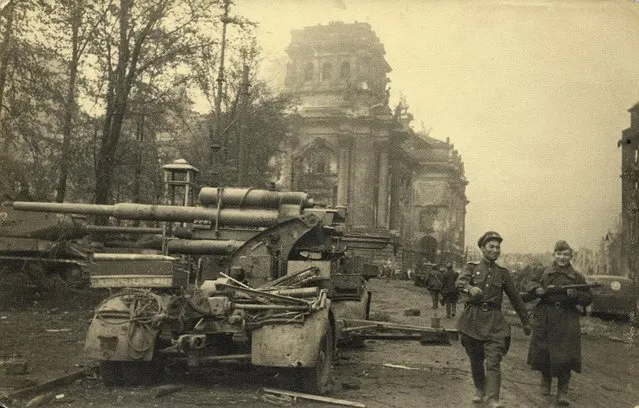
Russian soldiers are pictured next to the Reichstag building in this undated photo taken May 1945 in Berlin. Some 70 years on from the Battle for Berlin, instrumental in the end of World War II, Reuters photographer Fabrizio Bensch unearthed pictures by Red Army photographer Georgiy Samsonov, showing his portrayal of a city laid siege. (Photo by Georgiy Samsonov/Reuters/MHM)

Russian soldiers are pictured next to the Reichstag building in this undated photo taken May 1945 in Berlin. Some 70 years on from the Battle for Berlin, instrumental in the end of World War II, Reuters photographer Fabrizio Bensch unearthed pictures by Red Army photographer Georgiy Samsonov, showing his portrayal of a city laid siege. Bensch bought an exactly equivalent FED camera, a Soviet copy of the German-made Leica II, choosing to use black and white film to capture images of the self-same locations he detected his way to in modern-day Berlin. (Photo by Georgiy Samsonov/Reuters/MHM)
Details
07 May 2015 12:01:00
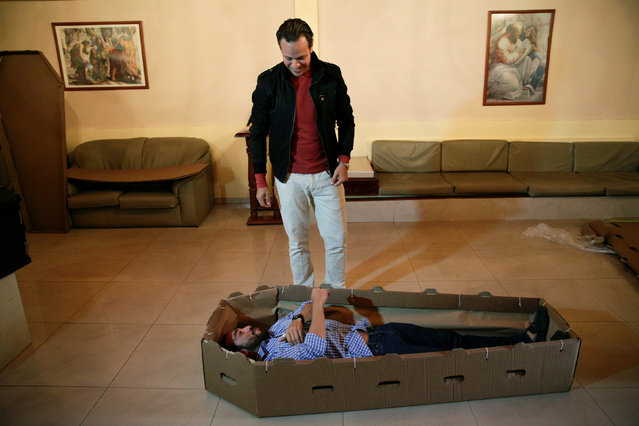
Elio Angulo (bottom C) lies inside a cardboard coffin next to Alejandro Blanchard as they introduce their product to potential customers at a mortuary in Valencia, in the state of Carabobo, Venezuela August 25, 2016. (Photo by Marco Bello/Reuters)

Elio Angulo (bottom C) lies inside a cardboard coffin next to Alejandro Blanchard as they introduce their product to potential customers at a mortuary in Valencia, in the state of Carabobo, Venezuela August 25, 2016. When Venezuelan entrepreneurs Alejandro Blanchard and Elio Angulo decided to create cardboard coffins, they were looking for an ecological selling point to compete against classic wood and brass caskets. Three years on, with the oil-rich country mired in deep economic crisis, their “bio-coffins” are becoming a viable option because of high prices for wooden coffins and shortages of brass ones. (Photo by Marco Bello/Reuters)
Details
27 Aug 2016 11:18:00
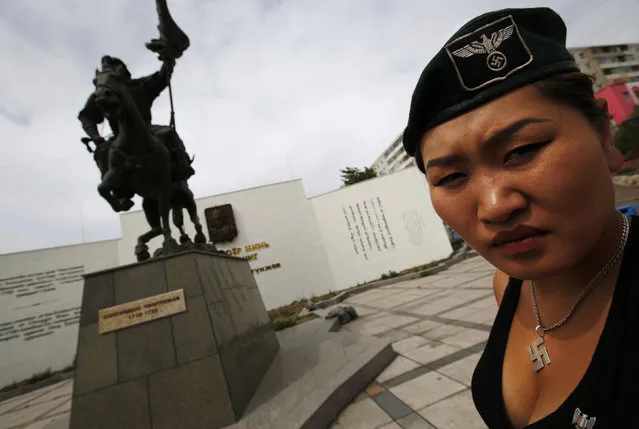
Uranjargal, a leader of the Mongolian neo-Nazi group Tsagaan Khass, stands next to a statue of Chingunjav, a Mongolian national hero, in Ulan Bator June 22, 2013. (Photo by Carlos Barria/Reuters)

Uranjargal, a leader of the Mongolian neo-Nazi group Tsagaan Khass, stands next to a statue of Chingunjav, a Mongolian national hero, in Ulan Bator June 22, 2013. The group has rebranded itself as an environmentalist organisation fighting pollution by foreign-owned mines, seeking legitimacy as it sends Swastika-wearing members to check mining permits. Over the past years, ultra-nationalist groups have expanded in the country and among those garnering attention is Tsagaan Khass, which has recently shifted its focus from activities such as attacks on women it accuses of consorting with foreign men to environmental issues, with the stated goal of protecting Mongolia from foreign mining interests. This ultra-nationalist group was founded in the 1990s and currently has 100-plus members. (Photo by Carlos Barria/Reuters)
Details
09 Jul 2013 07:23:00
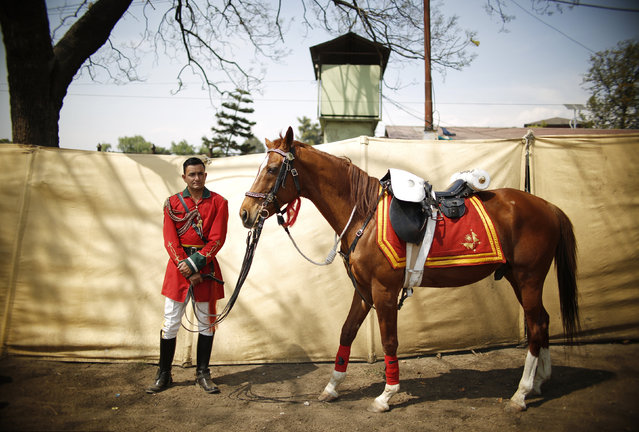
A Nepalese army solder stand next to a horse during the “Ghodejatra” Horse Race festival, which is organised by the Nepal Army, in Kathmandu, Nepal, April 7, 2016. Ghode Jatra, the horse racing festival of Nepal, celebrated on the New Moon day of mid March or early April is among the important celebrations of the Kathmandu Valley. exists a tree in the South-East part of the Tundikhel where Gurumapa supposed to be resides. (Photo by Navesh Chitrakar/Reuters)

A Nepalese army solder stand next to a horse during the “Ghodejatra” Horse Race festival, which is organised by the Nepal Army, in Kathmandu, Nepal, April 7, 2016. Ghode Jatra, the horse racing festival of Nepal, celebrated on the New Moon day of mid March or early April is among the important celebrations of the Kathmandu Valley. Grand horse parade including various acrobatic style of shows are performed by Nepal military at Tundikhel-a fenced parade ground located in the heart of Kathmandu city. (Photo by Navesh Chitrakar/Reuters)
Details
08 Apr 2016 14:33:00
Young women wearing facemasks and traditional costumes of Song dynasty and Tang dynasty are seated on a bench in a park next to the East Lake in Wuhan, in China’s central Hubei province on May 17, 2020. The Guardian picture desk has chosen on December 17, 2020, the AFP photojournalist Hector Retamal as “Agency Photographer of the Year 2020” for his coverage of the novel coronavirus Covid-19 pandemic in Wuhan, China. (Photo by Hector Retamal/AFP Photo)

Young women wearing facemasks and traditional costumes of Song dynasty and Tang dynasty are seated on a bench in a park next to the East Lake in Wuhan, in China’s central Hubei province on May 17, 2020. The Guardian picture desk has chosen on December 17, 2020, the AFP photojournalist Hector Retamal as “Agency Photographer of the Year 2020” for his coverage of the novel coronavirus Covid-19 pandemic in Wuhan, China. (Photo by Hector Retamal/AFP Photo)
Details
12 Jan 2021 00:03:00
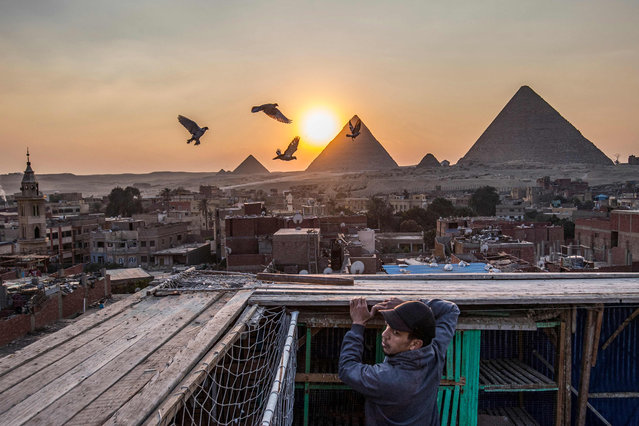
Omar Gamal, a 28-year-old pigeon keeper, stands next to his pigeon coop on his rooftop in the Egyptian capital's twin city of Giza on February 21, 2021, with the Pyramids of (R to L) Khufu (Cheops), Khafre (Chephren), and Menkaure (Menkheres) in the background. An ancient tradition handed down through the generations, the practice of domesticating pigeons stretches across borders from the banks of the Nile to north Africa and beyond, with people not only training birds for competitions, but also serving them up as a dining delicacy. (Photo by Khaled Desouki/AFP Photo)

Omar Gamal, a 28-year-old pigeon keeper, stands next to his pigeon coop on his rooftop in the Egyptian capital's twin city of Giza on February 21, 2021, with the Pyramids of (R to L) Khufu (Cheops), Khafre (Chephren), and Menkaure (Menkheres) in the background. An ancient tradition handed down through the generations, the practice of domesticating pigeons stretches across borders from the banks of the Nile to north Africa and beyond, with people not only training birds for competitions, but also serving them up as a dining delicacy. (Photo by Khaled Desouki/AFP Photo)
Details
27 Mar 2021 09:11:00
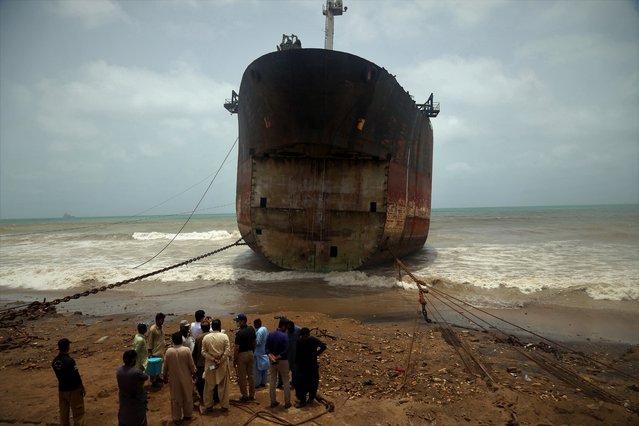
People stand next to a ship, containing tonnes of hazardous mercury-mixed oil, as it was allowed to anchor at Gadani ship-breaking yard in Gadani, Pakistan, 28 May 2021. Authorities have launched an investigation into the anchoring of a ship at the Gadani shipbreaking yard despite Interpol's warning that the ship contains dangerous chemicals. (Photo by Rehan Khan/EPA/EFE)

People stand next to a ship, containing tonnes of hazardous mercury-mixed oil, as it was allowed to anchor at Gadani ship-breaking yard in Gadani, Pakistan, 28 May 2021. Authorities have launched an investigation into the anchoring of a ship at the Gadani shipbreaking yard despite Interpol's warning that the ship contains dangerous chemicals. (Photo by Rehan Khan/EPA/EFE)
Details
18 Jun 2021 14:46:00
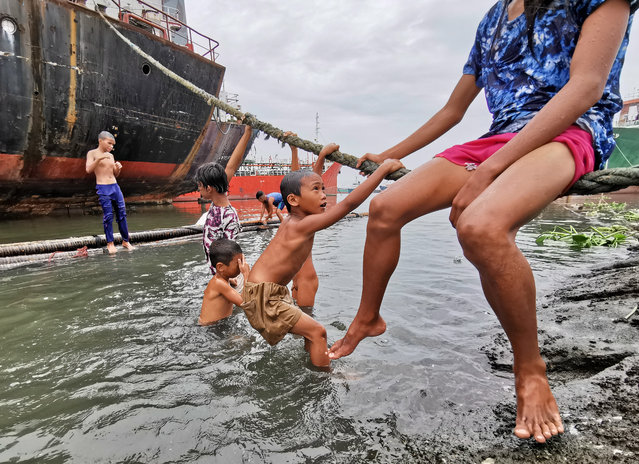
Filipino children frolic next to ships taking shelter inside a seaport in Navotas city, north of Manila, Philippines, 27 August 2019. According to the latest advisory from Philippine Atmospheric Geophysical and Astronomical Services Administration (PAGASA), Tropical Storm Podul intensified from a tropical depression into a tropical storm on August 27, while moving toward Central Luzon with a maximum winds of 65 kilometers per hour and gustiness of up to 80 km/h. (Photo by Francis R. Malasig/EPA/EFE)

Filipino children frolic next to ships taking shelter inside a seaport in Navotas city, north of Manila, Philippines, 27 August 2019. According to the latest advisory from Philippine Atmospheric Geophysical and Astronomical Services Administration (PAGASA), Tropical Storm Podul intensified from a tropical depression into a tropical storm on August 27, while moving toward Central Luzon with a maximum winds of 65 kilometers per hour and gustiness of up to 80 km/h. (Photo by Francis R. Malasig/EPA/EFE)
Details
14 Jan 2020 00:01:00