Loading...
Done
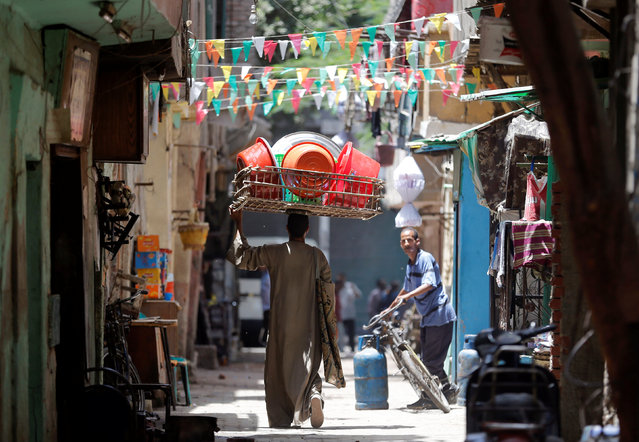
An Egyptian street vendor carries plastic dishes on a street decorated for the holy month of Ramadan in old Cairo, Egypt June 1, 2016. (Photo by Amr Abdallah Dalsh/Reuters)

An Egyptian street vendor carries plastic dishes on a street decorated for the holy month of Ramadan in old Cairo, Egypt June 1, 2016. (Photo by Amr Abdallah Dalsh/Reuters)
Details
15 Jul 2016 12:20:00
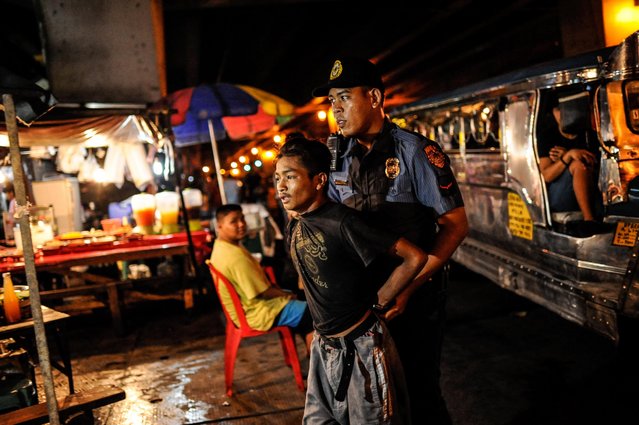
A suspected street robber is arrested by a policeman after a brief chase in the streets, June 20, 2016, in Manila, Philippines. (Photo by Dondi Tawatao/Getty Images)

A suspected street robber is arrested by a policeman after a brief chase in the streets, June 20, 2016, in Manila, Philippines. The president-elect of the Philippines, Rodrigo Duterte, declared a war on crime and drugs after sweeping an election on May 9 and has been living up to his nickname, “the punisher”. Philippine police have been conducting night raids almost on a daily basis and revived a curfew for minors that had not been enforced for years, rounding up minors drinking on the streets. (Photo by Dondi Tawatao/Getty Images)
Details
30 Jun 2016 11:38:00
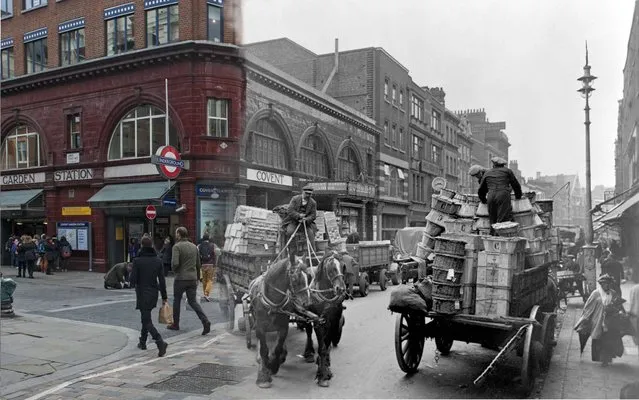
A street scene in London’s Covent Garden with the underground station and a horse and cart in the background in c.1930 and the same street in 2014. (Photo by Museum of London/Streetmuseum app)

“For most Londoners, the most common view they enjoy as they trudge to work is the back of another commuter's head. But now, thanks to the Streetmuseum app, anyone traipsing through the capital's streets can step back in time to see what London looked like in the 19th and 20th century compared with today – all in the same image”. – Joe Krishnan via The Independent. Photo: A street scene in London’s Covent Garden with the underground station and a horse and cart in the background in c.1930 and the same street in 2014. (Photo by Museum of London/Streetmuseum app)
Details
27 Feb 2014 06:48:00
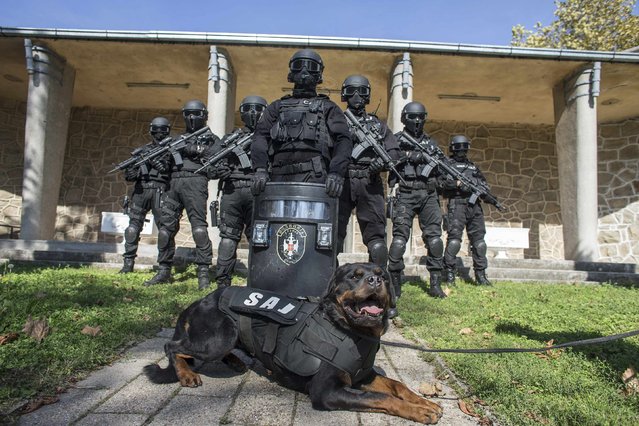
Serbian police officers of the Special Anti-Terrorist Unit pose for a picture in their base outside Belgrade October 8, 2014. (Photo by Marko Djurica/Reuters)

Serbian police officers of the Special Anti-Terrorist Unit pose for a picture in their base outside Belgrade October 8, 2014. When the killing of an unarmed black teenager by a white policeman in Ferguson, Missouri, in August sparked sometimes violent protests, the response of police in camouflage gear and armoured vehicles wielding stun grenades and assault rifles seemed more like a combat operation than a public order measure. Some U.S. police departments have recently acquired U.S. military-surplus hardware from wars abroad, but there are many law enforcers around the world whose rules of engagement also allow the use of lethal force with relatively few restrictions. But for every regulation that gives police wide scope to use firearms, there is another code that sharply limits their use. In Serbia, police may use measures ranging from batons to special vehicles, water cannon and tear gas on groups of people who have gathered illegally and are behaving in a way that is violent or could cause violence, but they may use firearms only when life is endangered. (Photo by Marko Djurica/Reuters)
Details
27 Nov 2014 14:53:00
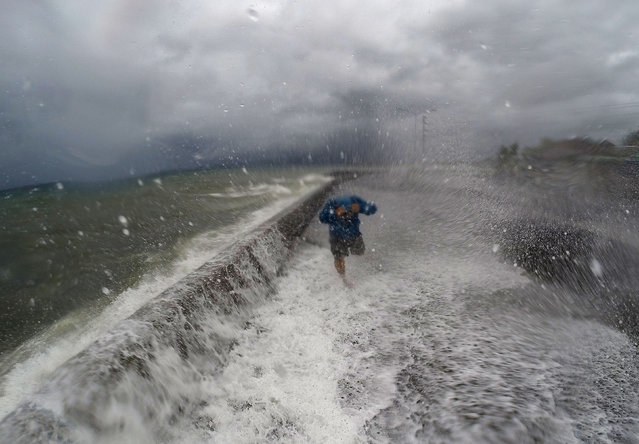
A resident walks past big waves spilling over a wall onto a coastal road in the city of Legaspi in Albay province, south of Manila on December 14, 2015, as typhoon Melor approaches the city. More than 700,000 people fled the central Philippines amid threats of giant waves, floods and landslides as powerful Typhoon Melor approached the archipelago nation, officials said December 14. (Photo by Charism Sayat/AFP Photo)

A resident walks past big waves spilling over a wall onto a coastal road in the city of Legaspi in Albay province, south of Manila on December 14, 2015, as typhoon Melor approaches the city. More than 700,000 people fled the central Philippines amid threats of giant waves, floods and landslides as powerful Typhoon Melor approached the archipelago nation, officials said December 14. (Photo by Charism Sayat/AFP Photo)
Details
15 Dec 2015 11:34:00
A woman poses for a picture as bunches of paprika hang on the walls of her house to dry in the village of Donja Lakosnica, Serbia October 6, 2016. Donja Lokosnica is the Serbian “capital of paprika”, since almost all of the 1300 inhabitants are involved in growing paprika. As autumn approaches, the whole village turns red, because of many threads of dried peppers, that hang around Lokosnica, waiting for their winter use. Each of these paprika threads is handmade, still dried according to traditional techniques, assisted solely by the sun and fresh air. (Photo by Marko Djurica/Reuters)

A woman poses for a picture as bunches of paprika hang on the walls of her house to dry in the village of Donja Lakosnica, Serbia October 6, 2016. Donja Lokosnica is the Serbian “capital of paprika”, since almost all of the 1300 inhabitants are involved in growing paprika. As autumn approaches, the whole village turns red, because of many threads of dried peppers, that hang around Lokosnica, waiting for their winter use. Each of these paprika threads is handmade, still dried according to traditional techniques, assisted solely by the sun and fresh air. (Photo by Marko Djurica/Reuters)
Details
08 Oct 2016 12:04:00
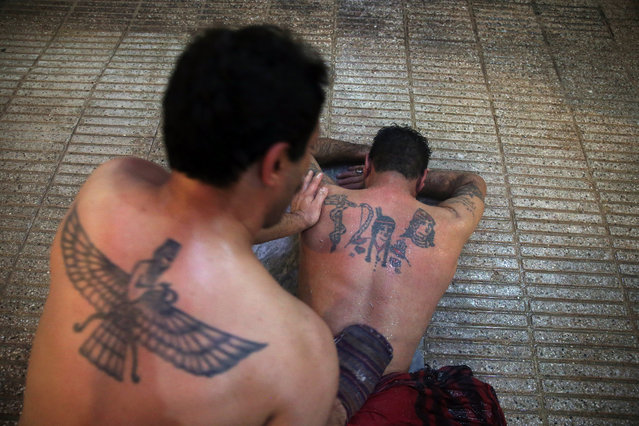
In this Friday, January 9, 2015 photo, bathhouse worker Omid Riahi, 39, scrubs a man to remove dead skin, at the Ghebleh public bathhouse, in Tehran, Iran. The steamy air and curved tiled walls of Iran's famed public bathhouses, some rinsing and massaging patrons for hundreds of years, slowly may wash away as interest in them wanes. (Photo by Ebrahim Noroozi/AP Photo)

In this Friday, January 9, 2015 photo, bathhouse worker Omid Riahi, 39, scrubs a man to remove dead skin, at the Ghebleh public bathhouse, in Tehran, Iran. The steamy air and curved tiled walls of Iran's famed public bathhouses, some rinsing and massaging patrons for hundreds of years, slowly may wash away as interest in them wanes. The bathhouses, known as “hammams” in Persian, find themselves in rough financial times as modern conveniences now allow showers and baths in most homes across the Islamic Republic. (Photo by Ebrahim Noroozi/AP Photo)
Details
03 Apr 2015 12:40:00
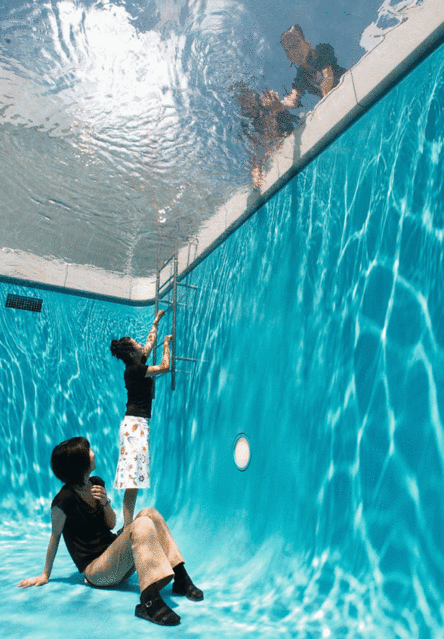
Swimming Pool Art Installation by Leandro Erlich

In one of the Museum’s courtyards is a swimming pool framed by a limestone deck. When seen from the deck, the pool appears to be filled with deep, shimmering water. In fact, however, a layer of water only some 10 centimeters deep is suspended over transparent glass. Below the glass is an empty space with aquamarine walls that viewers can enter. The work sets up an unfolding sequence of experiences—we view the pool through the glass wall enclosing the courtyard; from the deck, looking down into the pool; and from the interior of the pool, looking up. The Swimming Pool might hence be considered a place where, slowly, with time, different perspectives and perceptions of self and others all come to intersect.
Details
25 Aug 2012 07:31:00