Loading...
Done
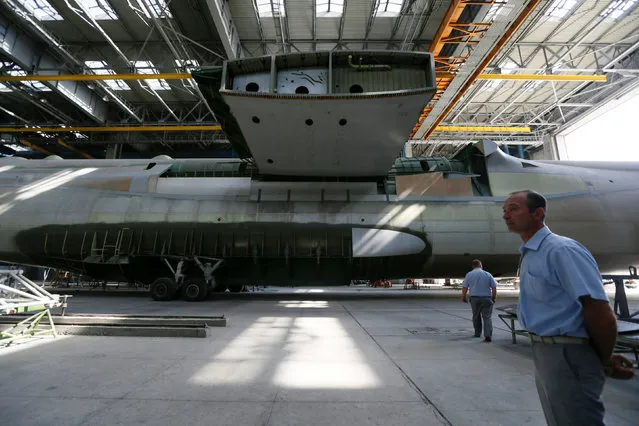
Employees stand near an airframe for the second Antonov-225 Mriya plane at Antonov aircraft plant in Kiev, Ukraine, September 7, 2016. Ukraine hopes to attract $500 million of investment from China to complete an updated version of the world's biggest aircraft, the Antonov-225 Mriya, the president of manufacturer Antonov said on Wednesday. The Antonov-225 is a cargo plane designed as part of the former Soviet Union's space programme. The only one completed is still in use and can carry up to 250 tonnes up to 4,000 km (2,485 miles). Work to manufacture a second plane was started in 1988 and never completed, but Antonov has now found a potential investor in the Aerospace Industry Corporation of China (AICC). (Photo by Valentyn Ogirenko/Reuters)

Employees stand near an airframe for the second Antonov-225 Mriya plane at Antonov aircraft plant in Kiev, Ukraine, September 7, 2016. Ukraine hopes to attract $500 million of investment from China to complete an updated version of the world's biggest aircraft, the Antonov-225 Mriya, the president of manufacturer Antonov said on Wednesday. (Photo by Valentyn Ogirenko/Reuters)
Details
08 Sep 2016 10:07:00
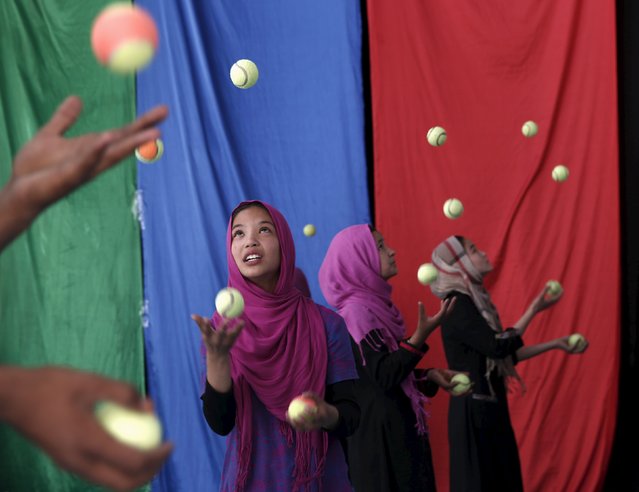
Girls, who are part of Afghan Mobile Mini Circus for Children (MMCC), participate in a juggling competition in Kabul, Afghanistan August 12, 2015. (Photo by Ahmad Masood/Reuters)

Girls, who are part of Afghan Mobile Mini Circus for Children (MMCC), participate in a juggling competition in Kabul, Afghanistan August 12, 2015. The MMCC, founded by David Mason from Denmark, teaches cooperation and creativity to children scarred by years of war in Afghanistan. Despite the dangers, the project has grown so popular that it now runs centres in ten provinces and has hundreds of regular students. The circus makes visits to internally displaced persons' camps, schools, orphanages, and holds annual festivals. The children are taught the skills of juggling clubs, walking on stilts and acrobatics. (Photo by Ahmad Masood/Reuters)
Details
01 Sep 2015 12:47:00
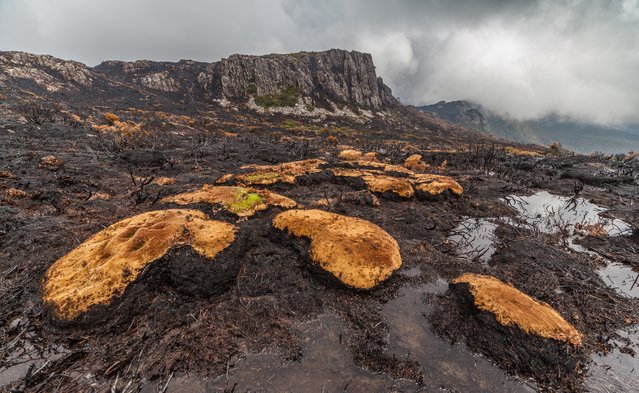
Pictures from Tasmania’s central plateau, shot by wilderness photographer Dan Broun, show the extraordinary damage wrought by more than a week of bushfires following lightning strikes in Australia’s southernmost state on January 13. 2016. The world heritage area was home to a range of unique alpine flora including pencil pines, king billy pines and cushion plants, some more than 1,000 years old. (Photo by Dan Broun)

Pictures from Tasmania’s central plateau, shot by wilderness photographer Dan Broun, show the extraordinary damage wrought by more than a week of bushfires following lightning strikes in Australia’s southernmost state on January 13. 2016. The world heritage area was home to a range of unique alpine flora including pencil pines, king billy pines and cushion plants, some more than 1,000 years old. Now more than 10,000ha of land has been incinerated, and ecologist say that, unlike eucalyptus trees, the ancient flora will not recover. (Photo by Dan Broun)
Details
02 Feb 2016 13:56:00


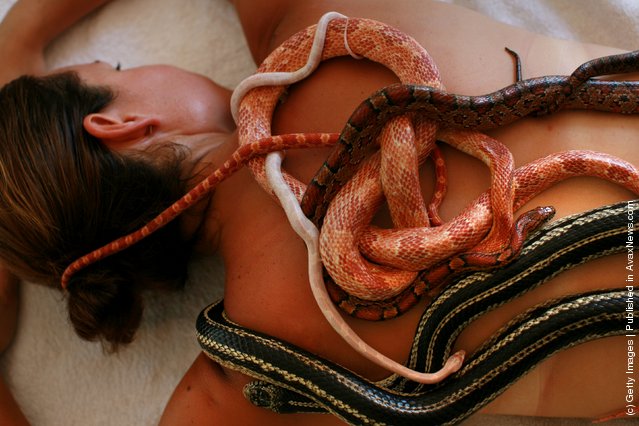
Meirav Stardinner receives a snake massage from Ada Barak at Barak's snake spa on September 11, 2008 in Talmei Elazar, Israel. Barack's income comes mostly from exhibiting her plants which eat everything from insects to small mammals. She discovered snakes' therapeutic value after letting people hold them after her act “Some people said that holding the snakes made them feel better, relaxed”, she says. “One old lady said it was soothing, like a cold compress”. Now she uses a combination of big snakes for deep massage and little ones for light massage, though all are non-venemous. (Photo by Uriel Sinai/Getty Images)
Details
07 May 2011 11:58:00


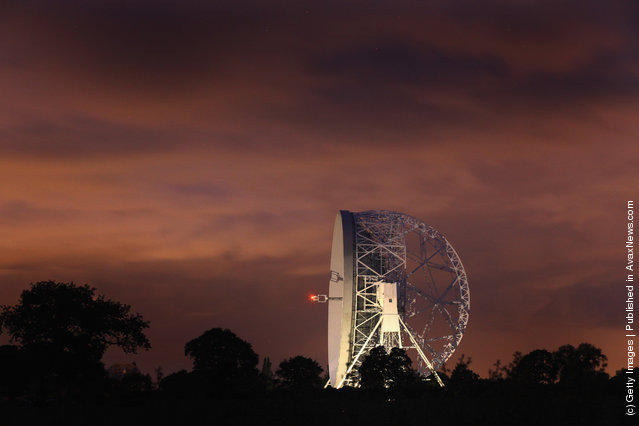
“The Lovell Telescope is a radio telescope at Jodrell Bank Observatory, near Goostrey, Cheshire in the north-west of England. When it was constructed in 1955, the telescope was the largest steerable dish radio telescope in the world at 76.2 m (250 ft) in diameter; it is now the third largest, after the Green Bank telescope in West Virginia, USA, and the Effelsberg telescope in Germany. It was originally known as the 250 ft (76 m) telescope or the Radio Telescope at Jodrell Bank, before becoming the Mark I telescope around 1961 when future telescopes (the Mark II, III, and IV) were being discussed. It was renamed to the Lovell Telescope in 1987 after Bernard Lovell, and became a Grade I listed building in 1988. The telescope forms part of the MERLIN and European VLBI Network arrays of radio telescopes”. – Wikipedia

Photo: The Lovell Telescope listens to the night sky for radio signals from space at Jodrell Bank on June 22, 2011 in Holmes Chapel, England. Jodrell Bank Centre for Astrophysics and it's world famous Lovell Telescope is on the shortlist of Britain's submission for Unesco World Heritage Site status. (Photo by Christopher Furlong/Getty Images)
Details
24 Jun 2011 09:34:00


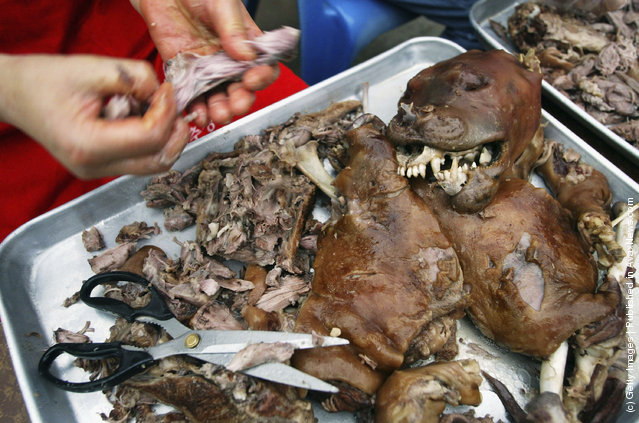
“Dog meat refers to edible parts and the flesh derived from (predominantly domestic) dogs. Human consumption of dog meat has been recorded in many parts of the world, including ancient China, ancient Mexico, and ancient Rome. According to contemporary reports, dog meat is consumed in a variety of countries such as Switzerland, China, Vietnam, the Philippines, and Korea. In addition, dog meat has also been used as survival food in times of war and/or other hardships”. – Wikipedia

Photo: A chef prepares dog meat at a restaurant on July 4, 2005 in Gwacheon, South Korea. Dog meat is a traditional dish in Korea dating back to the Samkuk period (period of the three kingdoms BC 57 – AD 668). Although many recipes existed historically for dog meat, now chefs only make soups, or dishes using boiled or roasted meat. Koreans traditionally eat dog meat on the hottest day of the summer, for it's reputed benefits of virility, invigoration and health. (Photo by Chung Sung-Jun/Getty Images)

Details
24 Jul 2011 13:21:00
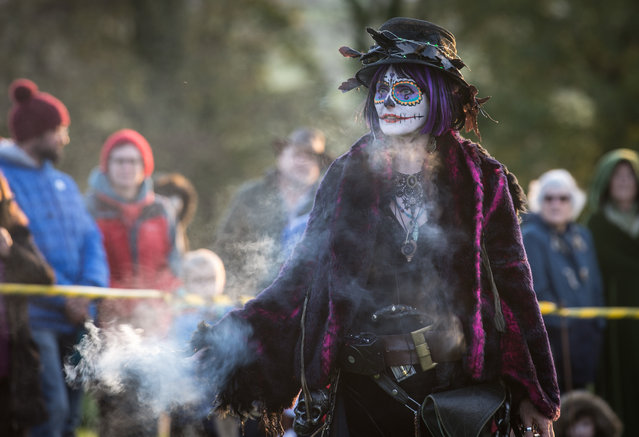
People take part in a sunset ceremony on the lower slopes of Glastonbury Tor as they celebrate Samhain at the Glastonbury Dragons Samhain Wild Hunt 2017 in Glastonbury on November 4, 2017 in Somerset, England. To celebrate Samhain, the Glastonbury Dragons, alongside Gwythyr Ap Greidal, the Summer King and the Winter King, Gwyn Ap Nudd, were paraded through the town to the lower slopes of Glastonbury Tor where the event was marked with ritual theatre, dancing and a fire to honour the dead. The Celtic festival of Samhain, which was later adopted by Christians and became Halloween, is a very important date in the Pagan calendar as it marks the division of the year between the lighter half (summer) and the darker half (winter). Pagans believe at Samhain, the division between this world and the otherworld was at its thinnest, allowing spirits to pass through. Many of the traditions of this ancient Celtic feast of the dead were later incorporated into the Christian calendar and Irish immigrants to America in the 19th century carried their customs, such as the wearing of costumes and masks to ward of harmful spirits and the harvest tradition of carving pumpkins, which have now blended into modern day Hallowee. (Photo by Matt Cardy/Getty Images)

People take part in a sunset ceremony on the lower slopes of Glastonbury Tor as they celebrate Samhain at the Glastonbury Dragons Samhain Wild Hunt 2017 in Glastonbury on November 4, 2017 in Somerset, England. To celebrate Samhain, the Glastonbury Dragons, alongside Gwythyr Ap Greidal, the Summer King and the Winter King, (Photo by Matt Cardy/Getty Images)
Details
07 Nov 2017 07:50:00
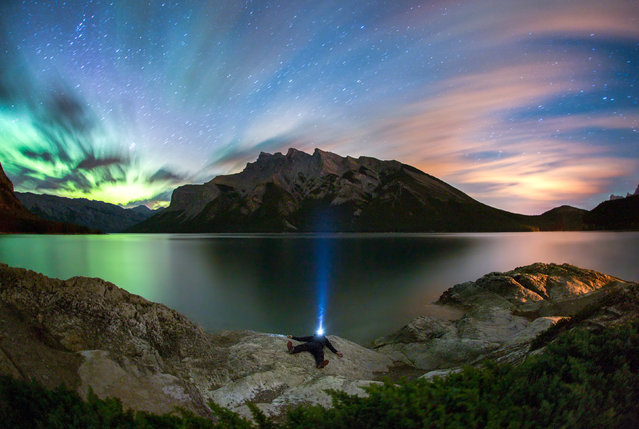
A photographer has shot this series of scenic selfies – scaling freezing mountain tops to snap himself in front of stunning scenery. Paul Zizkas breath-taking work features himself in front of beautiful backdrops such as shimmering lakes, snowy mountains and vibrant auroras. He has travelled to a number of different locations worldwide including Canada, New Zealand, Niue the South Pacific and French Polynesia. (Photo by Paul Zizkas/Caters News)

A photographer has shot this series of scenic selfies – scaling freezing mountain tops to snap himself in front of stunning scenery. Paul Zizkas breath-taking work features himself in front of beautiful backdrops such as shimmering lakes, snowy mountains and vibrant auroras. He has travelled to a number of different locations worldwide including Canada, New Zealand, Niue the South Pacific and French Polynesia. Explorer Paul, from Banff, Alberta, Canada, saw his selfies go viral early in 2014 – and has now unveiled his latest work. He said: I find that sometimes including a person in a landscape scene adds to the photograph – that it conveys a different story. Here: lake Minnewanka, Banff National Park, Alberta, Canada. (Photo by Paul Zizkas/Caters News)
Details
14 Dec 2014 12:18:00