Loading...
Done
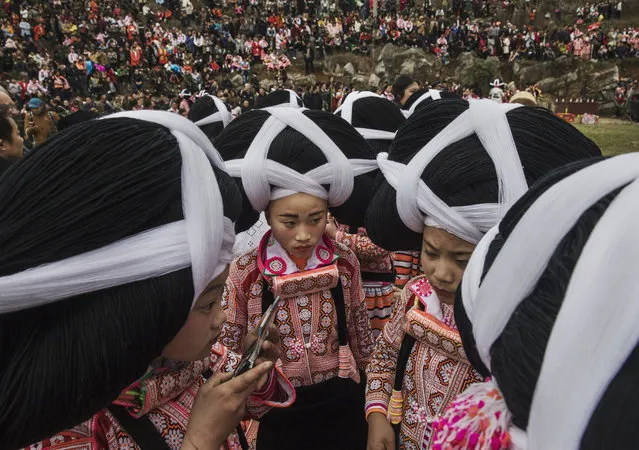
Girls of the Long Horn Miao ethnic minority group wear headdresses as they prepare gather for Tiaohua or Flower Festival as part of the Lunar New Year on February 6, 2017 in Longga village, Guizhou province, southern China. The Long Horn Miao are recognized for their declining practice of wrapping a blend of linen, wool, and the hair of their ancestors around animal horns or a wooden clip to make headdresses. Many young women say they now wear the headdresses only for special occasions and festivals, as the ornaments, which are attached by the horns to their real hair, have proved impractical for modern daily life in a fast changing world. China officially recognizes 56 different ethnic minorities, and statistics show over 7 million Chinese identifying themselves as Miao. But the small Long Horn Miao community counts only around 5000 people living in 12 villages, whose age-old traditions, language, and culture are fading. It is increasingly difficult in a modernizing China, as young people are drawn from remote rural villages to opportunities in bigger cities amongst wide-scale urbanization. Farming and labour remain the mainstays of life for the Long Horn Miao, leaving the area relatively poor in comparison with many parts of China. The government has invested significant amounts into local infrastructure and the tourism industry to try to bolster the local economy. (Photo by Kevin Frayer/Getty Images)

Girls of the Long Horn Miao ethnic minority group wear headdresses as they prepare gather for Tiaohua or Flower Festival as part of the Lunar New Year on February 6, 2017 in Longga village, Guizhou province, southern China. (Photo by Kevin Frayer/Getty Images)
Details
13 Feb 2017 00:01:00
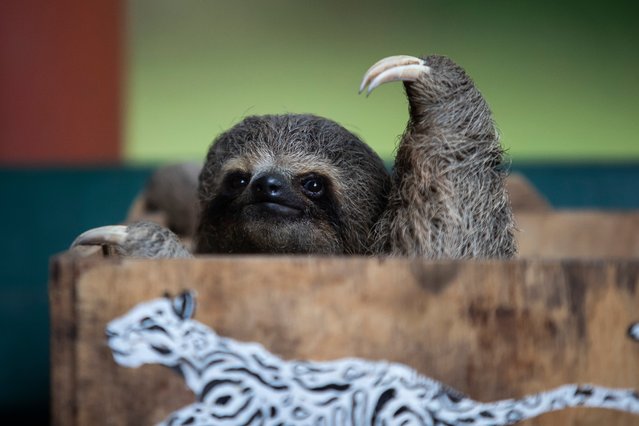
A young sloth named Gloria, that was rescued after being stolen from the wild destined for trafficking, peeks out of the box it is being taken to be released at the city's Botanical Garden in Rio de Janeiro, Brazil, Monday, March 13, 2023. Gloria was cared for by the Free Life Institute NGO that rehabilitates injured wildlife found in the surrounding Rio area and returns them, when possible, back to the wild. Those that are too injured to be released are sent to other rehab centers or sanctuaries to live out their lives in protected environments. (Photo by Bruna Prado/AP Photo)

A young sloth named Gloria, that was rescued after being stolen from the wild destined for trafficking, peeks out of the box it is being taken to be released at the city's Botanical Garden in Rio de Janeiro, Brazil, Monday, March 13, 2023. Gloria was cared for by the Free Life Institute NGO that rehabilitates injured wildlife found in the surrounding Rio area and returns them, when possible, back to the wild. Those that are too injured to be released are sent to other rehab centers or sanctuaries to live out their lives in protected environments. (Photo by Bruna Prado/AP Photo)
Details
16 Jul 2024 04:01:00
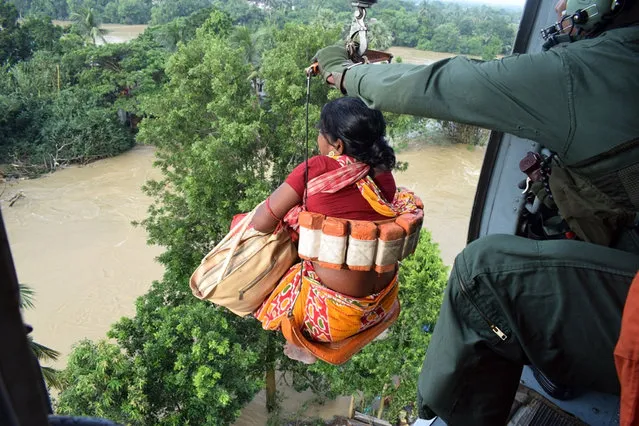
A handout photo made available by the Indian Air Force (IAF) showing an IAF helicopters during the rescue operation in flood affected areas of Dhanyaghari of Khanakul in West Bengal, India, 02 August 2021. According to the IAF, helicopters of Indian Air Force rescued 31 people from rooftops and brought them to safety to Arambaug. The helicopters also dropped emergency food supplies in the affected areas after the torrential rain in the state has thrown life out of gear and created flood like situation in many districts. (Photo by Indian Air Force/Handout via EPA/EFE)

A handout photo made available by the Indian Air Force (IAF) showing an IAF helicopters during the rescue operation in flood affected areas of Dhanyaghari of Khanakul in West Bengal, India, 02 August 2021. According to the IAF, helicopters of Indian Air Force rescued 31 people from rooftops and brought them to safety to Arambaug. The helicopters also dropped emergency food supplies in the affected areas after the torrential rain in the state has thrown life out of gear and created flood like situation in many districts. (Photo by Indian Air Force/Handout via EPA/EFE)
Details
10 Aug 2021 09:44:00
Miss Universe contestant Carolina Duran of Costa Rica, center, reacts to a TV network's drone as others prepare to pose from the deck of the yacht Happy Life prior to cruising to a beach resort in Batangas province Thursday, January 19, 2017 at the Philippine Navy headquarters in Manila, Philippines. Eighty-six candidates from around the world are vying for the title to succeed Pia Wurtzbach from the Philippines. The competition takes place on Jan. 30. They are, from left, Cherell Williamson of Bahamas, Rebecca Rath of Belize, Hildur Maria of Iceland, and Chanelle de Lau of Curacao. (Photo by Bullit Marquez/AP Photo)

Miss Universe contestant Carolina Duran of Costa Rica, center, reacts to a TV network's drone as others prepare to pose from the deck of the yacht Happy Life prior to cruising to a beach resort in Batangas province Thursday, January 19, 2017 at the Philippine Navy headquarters in Manila, Philippines. Eighty-six candidates from around the world are vying for the title to succeed Pia Wurtzbach from the Philippines. The competition takes place on Jan. 30. They are, from left, Cherell Williamson of Bahamas, Rebecca Rath of Belize, Hildur Maria of Iceland, and Chanelle de Lau of Curacao. (Photo by Bullit Marquez/AP Photo)
Details
20 Jan 2017 07:53:00
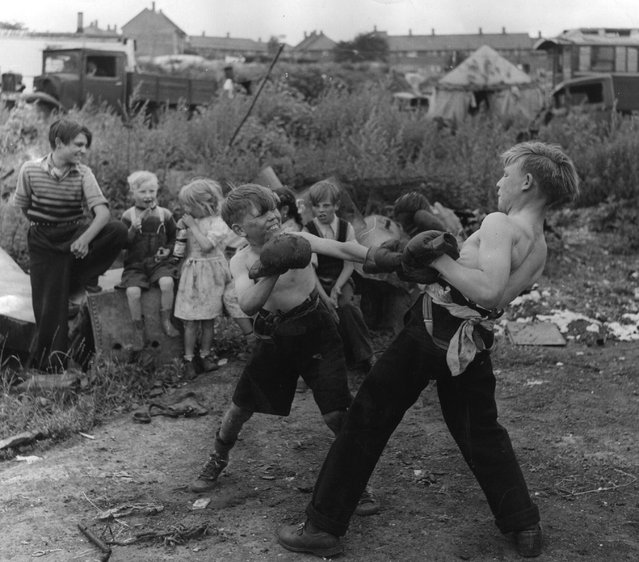
The unromantic gypsies. Children boxing in a gypsy camp in Kent, England on July 1, 1951. Like all boys these gypsy lads like to try their hand at boxing. Encouraged by their friends they fight it out on Corke's Meadow. Few Romanies now live a life of wandering romance. Most are like the three hundred squatters of Corke's Meadow, Kent, which is part of a “gypsy problem” that involves about 100,000 today. Of those about 25,000 can be rightly called gypsies, the rest are Mumpers and Posh-rats and Hobos. Corke's Meadow has both kinds. “Picture Post” cameraman Bert Hardy photographs the Corke's Meadow gypsies in their encampment. (Photo by Hulton-Deutsch Collection/Corbis via Getty Images)

The unromantic gypsies. Children boxing in a gypsy camp in Kent, England on July 1, 1951. Like all boys these gypsy lads like to try their hand at boxing. Encouraged by their friends they fight it out on Corke's Meadow. Few Romanies now live a life of wandering romance. Most are like the three hundred squatters of Corke's Meadow, Kent, which is part of a “gypsy problem” that involves about 100,000 today. Of those about 25,000 can be rightly called gypsies, the rest are Mumpers and Posh-rats and Hobos. Corke's Meadow has both kinds. “Picture Post” cameraman Bert Hardy photographs the Corke's Meadow gypsies in their encampment. (Photo by Hulton-Deutsch Collection/Corbis via Getty Images)
Details
12 Mar 2017 00:01:00
Roof-topping enthusiast Daniel Lau takes a selfie with high-rise buildings down below as he stands on the top of a skyscraper in Hong Kong, China on August 15, 2017. Welcome to “roof-topping”, where daredevils take pictures of themselves standing on the tops of tall buildings, or in some cases even dangling from them, without any safety equipment. A craze that began in Russia has now taken hold in Hong Kong, one of the world's most vertical cities, with dramatic results. “I'm an explorer”, said Daniel Lau, one of the three who climbed to the top of The Center. A student, he said roof-topping was “a getaway from my structured life”. “Before doing this, I lived like an ordinary person, having a boring life”, he said. “I wanted to do something special, something memorable. I want to let people see Hong Kong, the place they are living, from a new perspective”. Mr Lau said he had been inspired by Russian climbers and that he was unafraid of the vertiginous heights he scales. (Photo by ImagineChina/Rex Features/Shutterstock)

Roof-topping enthusiast Daniel Lau takes a selfie with high-rise buildings down below as he stands on the top of a skyscraper in Hong Kong, China on August 15, 2017. A craze that began in Russia has now taken hold in Hong Kong, one of the world's most vertical cities. Mr Lau said he had been inspired by Russian climbers and that he was unafraid of the vertiginous heights he scales. (Photo by ImagineChina/Rex Features/Shutterstock)
Details
16 Aug 2017 07:23:00
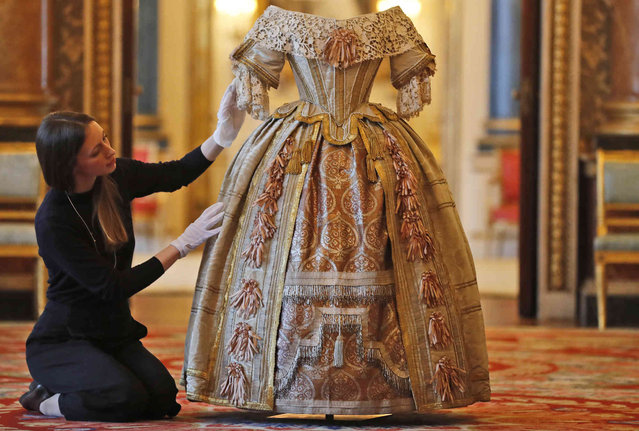
A member of the Palace staff arranges Queen Victoria's Stuart Ball costume which is part of an exhibition to mark the 200th anniversary of the birth of Queen Victoria (1819–1901) this year at Buckingham Palace in London, Tuesday, April 2, 2019. The exhibition, Queen Victoria's Palace at the Summer Opening of Buckingham Palace from 20 July – 29 September 2019, will tell the story of her 62-year reign and her life at Buckingham Palace, which began when she ascended to the throne in June 1837. (Photo by Frank Augstein/AP Photo)

A member of the Palace staff arranges Queen Victoria's Stuart Ball costume which is part of an exhibition to mark the 200th anniversary of the birth of Queen Victoria (1819–1901) this year at Buckingham Palace in London, Tuesday, April 2, 2019. The exhibition, Queen Victoria's Palace at the Summer Opening of Buckingham Palace from 20 July – 29 September 2019, will tell the story of her 62-year reign and her life at Buckingham Palace, which began when she ascended to the throne in June 1837. (Photo by Frank Augstein/AP Photo)
Details
04 Apr 2019 00:05:00
People drink in the street in the Soho area of London, on April 12, 2021 as coronavirus restrictions are eased across the country in step two of the government's roadmap out of England's third national lockdown. Britons on Monday toasted a significant easing of coronavirus restrictions, with early morning pints – and much-needed haircuts – as the country took a tentative step towards the resumption of normal life. Businesses including non-essential retail, gyms, salons and outdoor hospitality were all able to open for the first time in months in the second step of the government's roadmap out of lockdown. (Photo by Tolga Akmen/AFP Photo)

People drink in the street in the Soho area of London, on April 12, 2021 as coronavirus restrictions are eased across the country in step two of the government's roadmap out of England's third national lockdown. Britons on Monday toasted a significant easing of coronavirus restrictions, with early morning pints – and much-needed haircuts – as the country took a tentative step towards the resumption of normal life. Businesses including non-essential retail, gyms, salons and outdoor hospitality were all able to open for the first time in months in the second step of the government's roadmap out of lockdown. (Photo by Tolga Akmen/AFP Photo)
Details
13 Apr 2021 08:02:00