Loading...
Done
Serbian police officers of the Special Anti-Terrorist Unit pose for a picture in their base outside Belgrade October 8, 2014. (Photo by Marko Djurica/Reuters)

Serbian police officers of the Special Anti-Terrorist Unit pose for a picture in their base outside Belgrade October 8, 2014. When the killing of an unarmed black teenager by a white policeman in Ferguson, Missouri, in August sparked sometimes violent protests, the response of police in camouflage gear and armoured vehicles wielding stun grenades and assault rifles seemed more like a combat operation than a public order measure. Some U.S. police departments have recently acquired U.S. military-surplus hardware from wars abroad, but there are many law enforcers around the world whose rules of engagement also allow the use of lethal force with relatively few restrictions. But for every regulation that gives police wide scope to use firearms, there is another code that sharply limits their use. In Serbia, police may use measures ranging from batons to special vehicles, water cannon and tear gas on groups of people who have gathered illegally and are behaving in a way that is violent or could cause violence, but they may use firearms only when life is endangered. (Photo by Marko Djurica/Reuters)
Details
27 Nov 2014 14:53:00
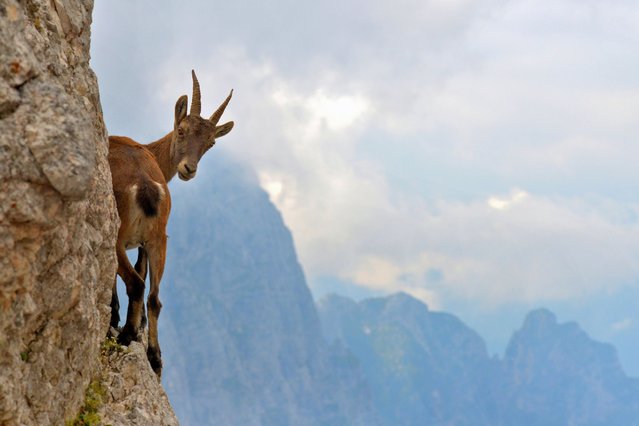
Young female Ibex on the fork of Disteis (2,200 m), near the top of the Jof di Montasio (Friuli, Italy). (Photo by Stefano Zocca)

Young female Ibex on the fork of Disteis (2,200 m), near the top of the Jof di Montasio (Friuli, Italy). (Photo by Stefano Zocca)
Details
17 Jan 2014 11:12:00
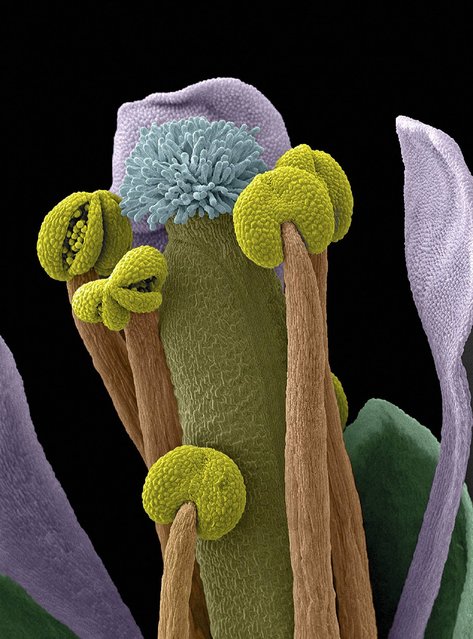
Scanning electron micrograph (SEM) of an Arabidopsis thaliana flower, also commonly known as thale cress. Some of the anthers are open, revealing pollen grains ready for dispersal. Arabidopsis was the first plant to have its entire genome sequenced and is widely used as a model organism in molecular and plant biology. Horizontal width of image is 1200 microns. Magnification 100x. (Photo by Stefan Eberhard/Wellcome Images)

Beautiful, strange and occasionally alarming pictures from the shortlist for this year’s Wellcome image awards – which celebrate the very best in science photography and imaging – from an x-ray of a bat to a micrograph of a kidney stone. The exhibition opens on 12 March at three science centres and the Museum of Science and Industry in Manchester. Photo: Scanning electron micrograph (SEM) of an Arabidopsis thaliana flower, also commonly known as thale cress. Some of the anthers are open, revealing pollen grains ready for dispersal. Arabidopsis was the first plant to have its entire genome sequenced and is widely used as a model organism in molecular and plant biology. Horizontal width of image is 1200 microns. Magnification 100x. (Photo by Stefan Eberhard/Wellcome Images)
Details
11 Mar 2014 05:58:00
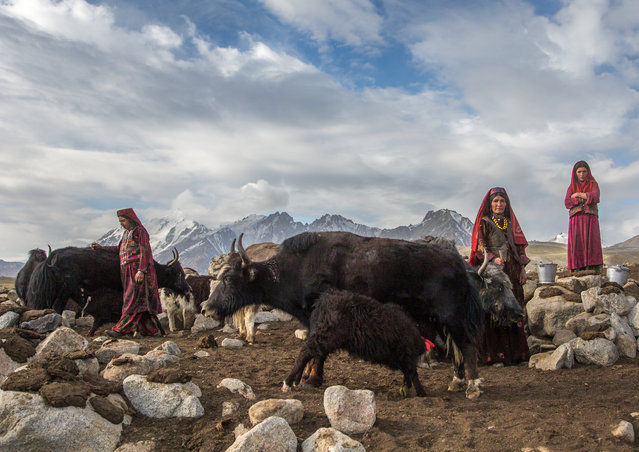
Wakhi nomad women milk yaks in Wakhan, Afghanistan. About 12,000 villagers live at an altitude of 4,500 metres in the harsh, desolate terrain. The Wakhi people live a simple, relaxed life with their livestock. (Photo by Eric Lafforgue/Barcroft Images)

Wakhi nomad women milk yaks in Wakhan, Afghanistan. About 12,000 villagers live at an altitude of 4,500 metres in the harsh, desolate terrain. The Wakhi people live a simple, relaxed life with their livestock. (Photo by Eric Lafforgue/Barcroft Images)
Details
12 Oct 2016 10:13:00
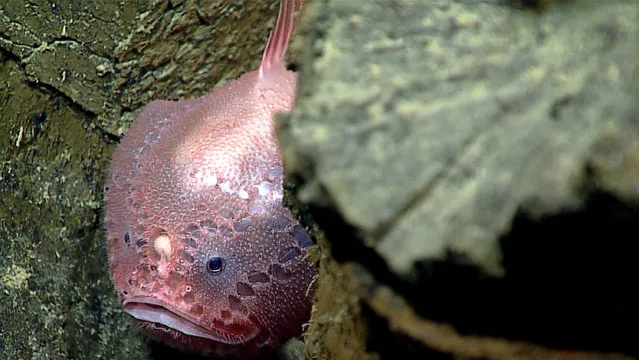
This April 30, 2016 image made available by NOAA shows a deep sea anglerfish living between pillow basalt rock formations, during a deepwater exploration of the Marianas Trench Marine National Monument area in the Pacific Ocean near Guam and Saipan. The ambush predator waits for prey to be attracted by its lure, located between its eyes, and gulps it with its large mouth. (Photo by NOAA Office of Ocean Exploration and Research via AP Photo)

This April 30, 2016 image made available by NOAA shows a deep sea anglerfish living between pillow basalt rock formations, during a deepwater exploration of the Marianas Trench Marine National Monument area in the Pacific Ocean near Guam and Saipan. The ambush predator waits for prey to be attracted by its lure, located between its eyes, and gulps it with its large mouth. (Photo by NOAA Office of Ocean Exploration and Research via AP Photo)
Details
21 Oct 2016 12:30:00
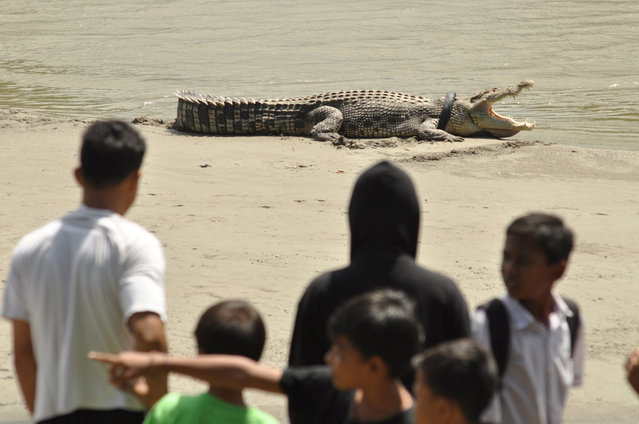
People watch a crocodile with a used motorcycle tyre around its neck on a river in Palu, Central Sulawesi province, Indonesia September 20, 2016 in this picture taken by Antara Foto. Residents suspect the tyre was garbage thrown into the river before it became trapped around the crocodile's neck, reported Antara. (Photo by Mohamad Hamzah/Reuters/Antara Foto)

People watch a crocodile with a used motorcycle tyre around its neck on a river in Palu, Central Sulawesi province, Indonesia September 20, 2016 in this picture taken by Antara Foto. Residents suspect the tyre was garbage thrown into the river before it became trapped around the crocodile's neck, reported Antara. (Photo by Mohamad Hamzah/Reuters/Antara Foto)
Details
29 Oct 2016 11:28:00
The moon rises behind the skyline and financial district in Toronto, November 25, 2015. (Photo by Mark Blinch/Reuters)

The moon rises behind the skyline and financial district in Toronto, November 25, 2015. (Photo by Mark Blinch/Reuters)
Details
21 Nov 2016 10:23:00
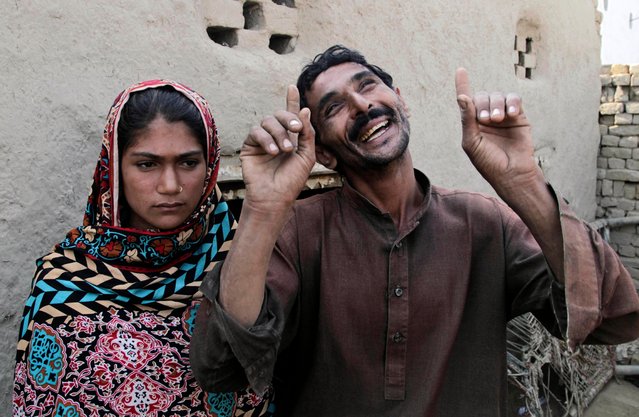
In this Tuesday, December 20, 2016 photo, Mohammad Ramzan, right, reacts while talking to The Associated Press with his young bride Saima in Jampur, Pakistan. Saima was given as a bride to the older man by her father so he could marry the groom’s sister, a practice of exchanging girls that is entrenched in conservative regions of Pakistan. It even has its own name in Urdu: Watta Satta, “give and take”. A mix of interests – family obligations, desire for sons, a wish to hand off a girl to a husband – can lead to a young teen in an a marriage she never sought. (Photo by K.M. Chaudhry/AP Photo)

In this Tuesday, December 20, 2016 photo, Mohammad Ramzan, right, reacts while talking to The Associated Press with his young bride Saima in Jampur, Pakistan. Saima was given as a bride to the older man by her father so he could marry the groom’s sister, a practice of exchanging girls that is entrenched in conservative regions of Pakistan. It even has its own name in Urdu: Watta Satta, “give and take”. A mix of interests – family obligations, desire for sons, a wish to hand off a girl to a husband – can lead to a young teen in an a marriage she never sought. (Photo by K.M. Chaudhry/AP Photo)
Details
31 Dec 2016 10:08:00