Loading...
Done
FIFA World Cup Fever In India

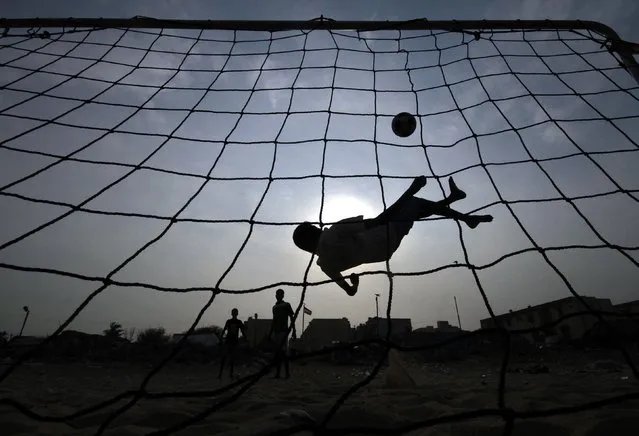
A boy does a bicycle kick as he practises on the Marina beach ahead of the World Cup soccer tournament in Brazil, in Chennai June 4, 2014. REUTERS/Babu
Details
05 Jun 2014 11:16:00
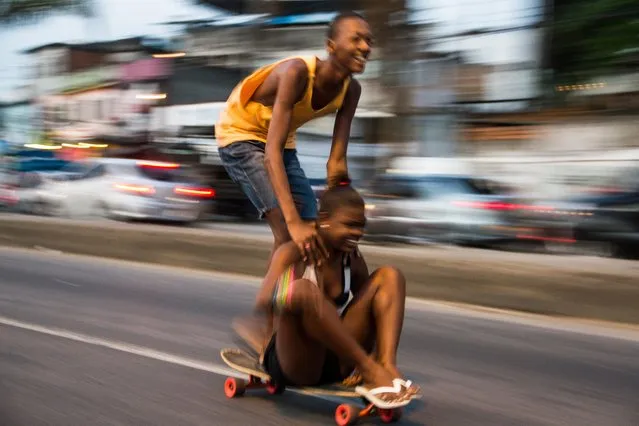
Leisure day on the Avenida Brasil. (Photo by Elisângela Leite/Horniman Museum)

An exhibition at London’s Horniman Museum by three photographers from Brazil’s largest favela, Maré, shows us their unique vision of Rio de Janeiro. Here: Leisure day on the Avenida Brasil. (Photo by Elisângela Leite/Horniman Museum)
Details
03 May 2016 13:13:00
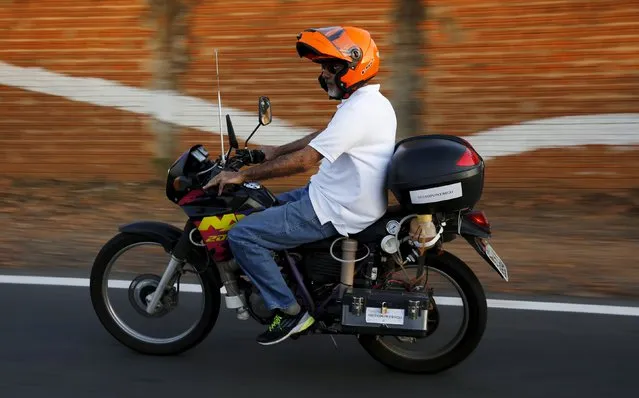
Ricardo Azevedo rides his Honda NX 200 motorbike, which he converted to be powered by water, in Salto, northwest of Sao Paulo, Brazil, August 6, 2015. The Sao Paulo civil servant built the motorbike which can cover up to 500 kilometres (311 miles) fueled by just one liter of water. Dubbed "Moto Power H2O", the bike is powered by a process of electrolysis by which the water molecule is broken down into its constituent elements. (Photo by Nacho Doce/Reuters)

Ricardo Azevedo rides his Honda NX 200 motorbike, which he converted to be powered by water, in Salto, northwest of Sao Paulo, Brazil, August 6, 2015. The Sao Paulo civil servant built the motorbike, which can cover up to 500 kilometres (311 miles) fuelled by just one litre of water. Dubbed “Moto Power H2O” the bike is powered by the process of electrolysis, which breaks the water molecule down into its constituent elements. (Photo by Nacho Doce/Reuters)
Details
13 Aug 2015 12:00:00
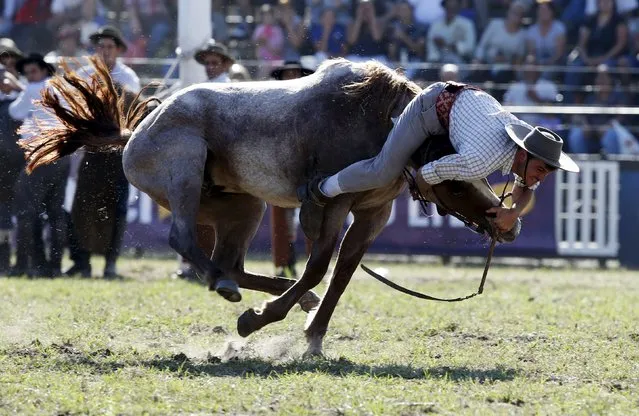
A gaucho is unseat by a wild horse during the annual celebration of Criolla Week in Montevideo, March 30, 2015. Throughout Easter Week, “gauchos”, the Latin American equivalent of the North American cowboy, from all over Uruguay and neighboring Argentina and Brazil will visit Montevideo to participate in the Criolla Week to win the best rider award. The competition is held from March 29 to April 5 this year. (Photo by Andres Stapff/Reuters)

A gaucho is unseat by a wild horse during the annual celebration of Criolla Week in Montevideo, March 30, 2015. Throughout Easter Week, “gauchos”, the Latin American equivalent of the North American cowboy, from all over Uruguay and neighboring Argentina and Brazil will visit Montevideo to participate in the Criolla Week to win the best rider award. The competition is held from March 29 to April 5 this year. (Photo by Andres Stapff/Reuters)
Details
01 Apr 2015 12:22:00
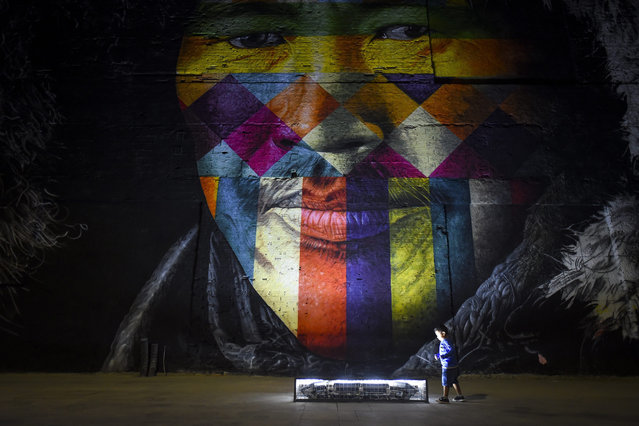
A child plays in front of “Etnias”, a large graffiti wall by Brazilian graffiti artist Eduardo Kobra created ahead of the Rio 2016 Olympic Games at Porto Maravilha in Rio de Janeiro, Brazil, 30 July 2016. The Olympics start on 05 August. Eduardo Kobra hopes to set a Guinness World Record for the largest graffiti created by a single artist. (Photo by Lukas Coch/EPA)

A child plays in front of “Etnias”, a large graffiti wall by Brazilian graffiti artist Eduardo Kobra created ahead of the Rio 2016 Olympic Games at Porto Maravilha in Rio de Janeiro, Brazil, 30 July 2016. The Olympics start on 05 August. Eduardo Kobra hopes to set a Guinness World Record for the largest graffiti created by a single artist. (Photo by Lukas Coch/EPA)
Details
01 Aug 2016 10:35:00
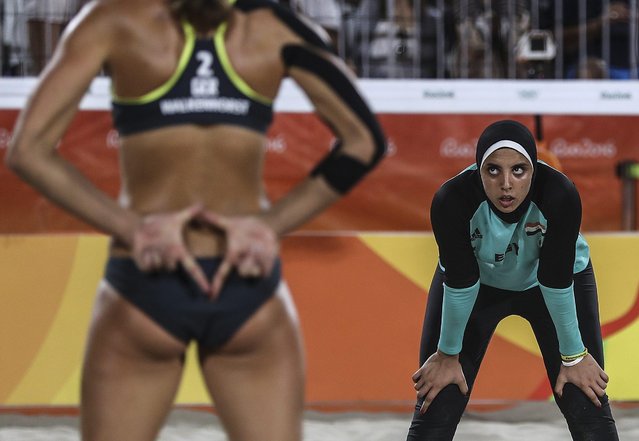
Kira Walkenhorst of Germany (L) signals as Doaa Elghobashy of Egypt (R) watches during the women's Beach Volleyball preliminary pool D game between Ludwig/Walkenhors of Germany and Elghobashy/Nada of Egypt the Rio 2016 Olympic Games at the Beach Volleyball Arena on Copacabana Beach in Rio de Janeiro, Brazil, 07 August 2016. (Photo by Antonio Lacerda/ANSA)

Kira Walkenhorst of Germany (L) signals as Doaa Elghobashy of Egypt (R) watches during the women's Beach Volleyball preliminary pool D game between Ludwig/Walkenhors of Germany and Elghobashy/Nada of Egypt the Rio 2016 Olympic Games at the Beach Volleyball Arena on Copacabana Beach in Rio de Janeiro, Brazil, 07 August 2016. (Photo by Antonio Lacerda/ANSA)
Details
09 Aug 2016 12:54:00
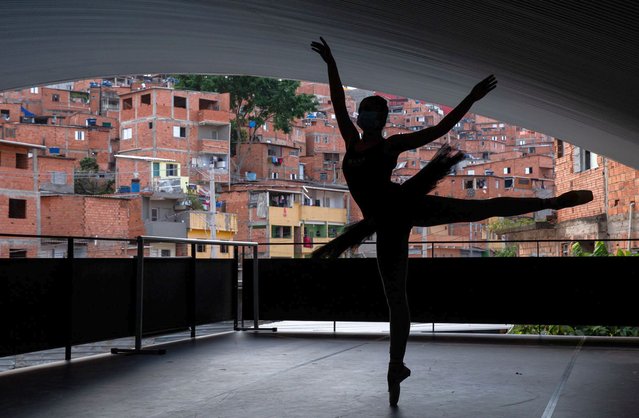
A Ballet Paraisópolis student wearing a face mask rehearses amidst the coronavirus (COVID-19) pandemic on August 13, 2020 in Sao Paulo, Brazil. The Ballet Paraisópolis is a project that teaches dance to children and young people in the Paraisópolis community in order to encourage them to seek better life opportunities. Founded in 2012 by ballerina, teacher and choreographer, Monica Tarragó, Ballet Paraisópolis has a total of 200 students and another 2,000 on the waiting list. (Photo by Alexandre Schneider/Getty Images)

A Ballet Paraisópolis student wearing a face mask rehearses amidst the coronavirus (COVID-19) pandemic on August 13, 2020 in Sao Paulo, Brazil. The Ballet Paraisópolis is a project that teaches dance to children and young people in the Paraisópolis community in order to encourage them to seek better life opportunities. Founded in 2012 by ballerina, teacher and choreographer, Monica Tarragó, Ballet Paraisópolis has a total of 200 students and another 2,000 on the waiting list. (Photo by Alexandre Schneider/Getty Images)
Details
02 Sep 2020 00:01:00
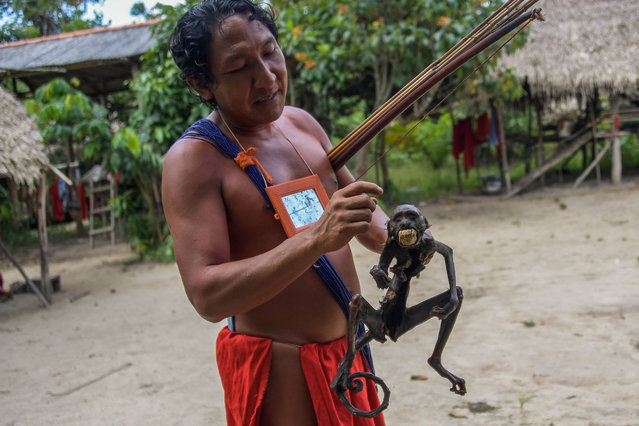
Chieftain Japarupi Waiapi shows a roasted monkey -part of Waiapi's diet, also based in Manioc and fruits- at the reserve in Amapa state in Brazil on October 13, 2017. When Waiapis walks into the Amazon forest surrounding their village, they do not see trees, but a kind of shopping mall providing medicine, food, shelter, tools and weapons  all under the eye of multiple spirits. (Photo by Apu Gomes/AFP Photo)

Chieftain Japarupi Waiapi shows a roasted monkey -part of Waiapi's diet, also based in Manioc and fruits- at the reserve in Amapa state in Brazil on October 13, 2017. When Waiapis walks into the Amazon forest surrounding their village, they do not see trees, but a kind of shopping mall providing medicine, food, shelter, tools and weapons all under the eye of multiple spirits. (Photo by Apu Gomes/AFP Photo)
Details
27 Oct 2017 08:39:00