Loading...
Done
Scared of Heights. “Taken from the highest residential building in Asia: the Zenith in Busan. This was taken with official permission (which took me months to get) and safety measures were taken. I had to hang myself over the edge to get this shot. Not for the faint of heart! But when you’re at a height like this, the world below you just seems different. It takes away the fear one would normally have, and gives a sense of peace instead”. (Photo by Albert Dros/NatGeo Cities Travel Photographer of the Year 2017)

Scared of Heights. “Taken from the highest residential building in Asia: the Zenith in Busan. This was taken with official permission (which took me months to get) and safety measures were taken. I had to hang myself over the edge to get this shot. Not for the faint of heart! But when you’re at a height like this, the world below you just seems different. It takes away the fear one would normally have, and gives a sense of peace instead”. (Photo by Albert Dros/NatGeo Cities Travel Photographer of the Year 2017)
Details
03 Jul 2017 08:55:00
American actress and singer Rachel Zegler sings “Don't Cry For Me Argentina” from the balcony of the London Palladium on June 17, 2025. The show sees Rachel come out onto the balcony to sing to the audience below, and by the third night of the show's limited run the streets have already had to be cordoned off with extra security brought in because the crowds are so big. (Photo by Raphael Pour-Hashemi/The Mega Agency)

American actress and singer Rachel Zegler sings “Don't Cry For Me Argentina” from the balcony of the London Palladium on June 17, 2025. The show sees Rachel come out onto the balcony to sing to the audience below, and by the third night of the show's limited run the streets have already had to be cordoned off with extra security brought in because the crowds are so big. (Photo by Raphael Pour-Hashemi/The Mega Agency)
Details
06 Jul 2025 03:29:00


A Haka is performed before the ceremonial departure of the 'vaka' or traditional canoes ahead of their cross-Pacific voyage from Viaduct Harbour on April 13, 2011 in Auckland, New Zealand. Powered by sun and wind only, the 15,000 nautical mile journey to Hawaii via French Polynesia will set off on April 15, aiming to raise awareness of environmental issues such as ocean noise pollution, acidification and anoxic waters, whilst recapturing traditional Pacific voyaging. The votyage is named “Te Mana o Te Moana” meaning “The Spirit of the Sea”. (Photo by Phil Walter/Getty Images)
Details
13 Apr 2011 07:45:00
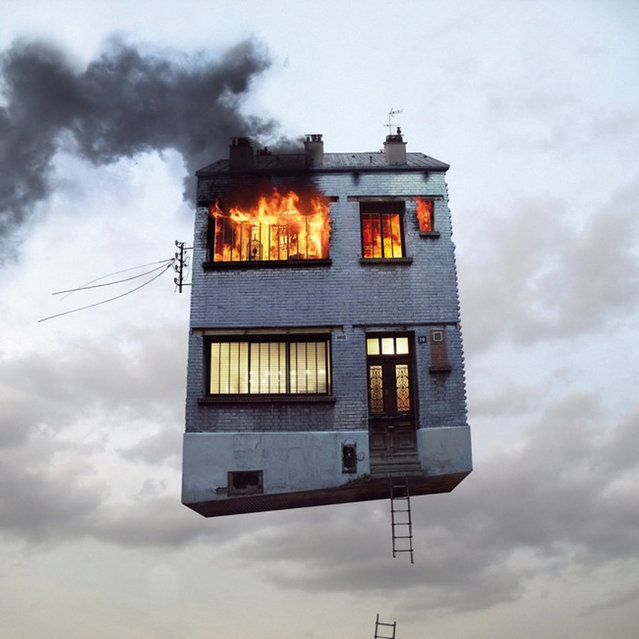
Laurent Chéhère by Flying Houses

One of the most creative photoseries I’ve seen so far is definitely this one from the French photographer Laurent Chéhère and his Flying Houses. The serie has a sur-real but still very realistic out-come, with ofcourse, some help of our great friend Photoshop.
Details
14 Jan 2013 14:42:00
Tunnel of love

Not far from the Ukrainian regional center Rivne there is a town known as Klevan. The main attraction of it is one of the most romantic places in the world called “The Tunnel of Love”. During the warm months of the year the trees planted next to each other form a fairy green tunnel along one kilometer long section of the railway.
Details
26 Jun 2012 09:11:00
Tardigrades (commonly known as waterbears or moss piglets). (Photo by SPL/East News)

“Tardigrades (commonly known as waterbears or moss piglets) are small, water-dwelling, segmented animals with eight legs. Tardigrades were first discovered in 1773 by Johann August Ephraim Goeze, who called them kleiner Wasserbär, meaning “little water bear” in German. The name Tardigrada means “slow walker” and was given by Lazzaro Spallanzani in 1777. The name water bear comes from the way they walk, reminiscent of a bear's gait. The biggest adults may reach a body length of 1.5 millimetres (0.059 in), the smallest below 0.1 mm. Freshly hatched tardigrades may be smaller than 0.05 mm”. – Wikipedia. Photo: Tardigrades. (Photo by SPL/East News)
Details
26 Sep 2012 09:55:00
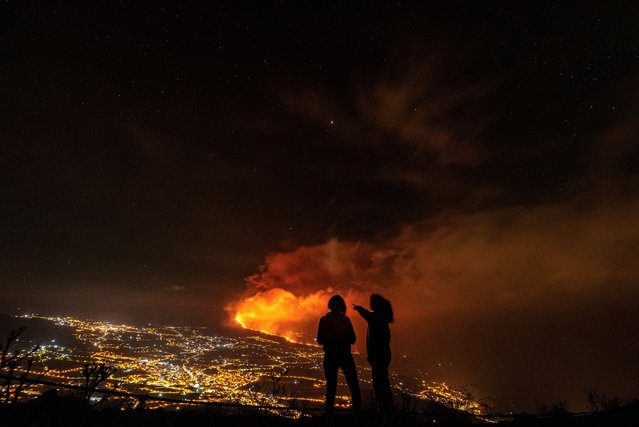
Two women look at the Cumbre Vieja volcanic eruption from the distance in Los Llanos de Ariadne in La Palma, Canary Islands, Spain, late 05 October 2021 (issued 06 October 2021). The main cone of the La Palma volcano suffered a partial collapse of its structure 03 October, while effusive activity has increased after 15 days of its beginning. According to experts the volcano is far from ending its volcanic activity. (Photo by Miguel Calero/EPA/EFE)

Two women look at the Cumbre Vieja volcanic eruption from the distance in Los Llanos de Ariadne in La Palma, Canary Islands, Spain, late 05 October 2021 (issued 06 October 2021). The main cone of the La Palma volcano suffered a partial collapse of its structure 03 October, while effusive activity has increased after 15 days of its beginning. According to experts the volcano is far from ending its volcanic activity. (Photo by Miguel Calero/EPA/EFE)
Details
07 Oct 2021 08:27:00
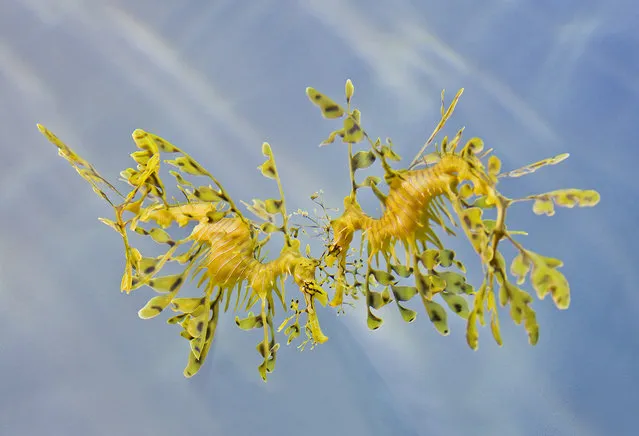
Leafy sea dragon

The leafy seadragon or Glauert's seadragon, Phycodurus eques, is a marine fish in the family Syngnathidae, which also includes the seahorses. It is the only member of the genus Phycodurus. It is found along the southern and western coasts of Australia. The name is derived from the appearance, with long leaf-like protrusions coming from all over the body. These protrusions are not used for propulsion; they serve only as camouflage. The leafy seadragon propels itself by means of a pectoral fin on the ridge of its neck and a dorsal fin on its back closer to the tail end. These small fins are almost completely transparent and difficult to see as they undulate minutely to move the creature sedately through the water, completing the illusion of floating seaweed.
Details
05 Sep 2012 08:51:00