Loading...
Done
Brtukan. “Being a girl of colour in a society where the majority of the people are white, I have had to get used to all the different ways people approach me. From being asked what kind of rap music you listen to and how you wash your hair, to getting told, “you don’t sound black”, “you’re pretty for a black girl” or “you’re not that black so it’s OK”, as if being black is such a bad thing”. (Photo by Lisa Minogue/The Guardian)

As part of FLAIR Melbourne – a Flinders Lane art festival – Melbourne’s Lisa Minogue presents stylised photographic portraits of Australian women of colour, their faces painted vibrantly to accentuate their individuality and encourage the viewer to study each face more closely. Minogue asked each woman the same question: “What do the words “coloured girl” mean to you?”. (Photo by Lisa Minogue/The Guardian)
Details
17 Aug 2016 11:16:00
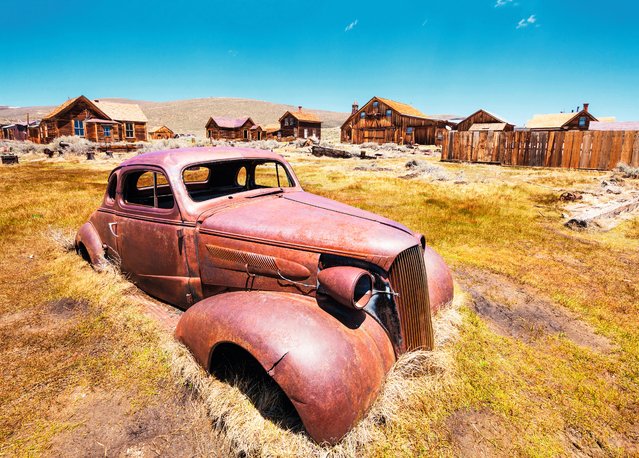
Bodie, Mono County, California. Gold was discovered at Bodie in 1859 (just after the initial California gold rush) and it went from mining camp to boomtown. Its decline began in 1880, when word spread of new boomtowns elsewhere. The Standard Consolidated Mine closed in 1913, and four years later the Bodie Railway was abandoned. By 1940 the population was down to 40. Today, Bodie is maintained in a state of arrested decay as a visitor attraction. (Photo by Alamy Stock Photo)

Kieron Connolly’s new book of photographs of more than 100 once-busy and often elegant buildings gives an idea of how the world might look if humankind disappeared. Here: Bodie, Mono County, California. Gold was discovered at Bodie in 1859 (just after the initial California gold rush) and it went from mining camp to boomtown. Its decline began in 1880, when word spread of new boomtowns elsewhere. The Standard Consolidated Mine closed in 1913, and four years later the Bodie Railway was abandoned. By 1940 the population was down to 40. Today, Bodie is maintained in a state of arrested decay as a visitor attraction. (Photo by Alamy Stock Photo)
Details
07 Sep 2016 09:50:00
Dan surrounded by seven days of her own rubbish in Pasadena, California. (Photo by Gregg Segal/Barcroft Media)

Dan surrounded by seven days of her own rubbish in Pasadena, California. If you've never thought about how much rubbish you throw away an honest photographic series will open your eyes. Men, women, couples and families with young children have been photographed lying on their backs surrounded by a week's worth of their own rubbish – from old cartons of milk, used nappies and even tampons. The startling series “Seven Days of Garbage” by Californian photographer Gregg Segal is an unforgettable reminder of the amount of waste a human collects in just seven days. (Photo by Gregg Segal/Barcroft Media)
Details
16 Jul 2014 14:41:00
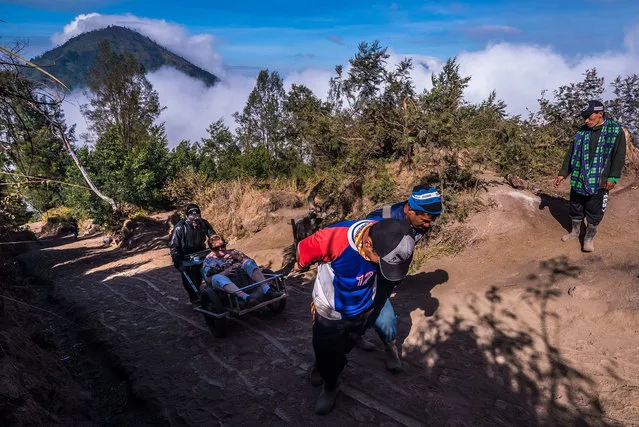
Miners pulling up lazy tourists to the rim of Kawah Ijen (Ijen Volcano), East Java, Indonesia on September 21, 2017. They will earn as much as they would bring down a load of sulfur. Nomadic Explorer, Cultural Lifestyle Photographer Claudio Sieber captured striking images of miners working at Ijen volcanic range in East Java, Indonesia. The sulphur miners risk their lives daily as they climb the active volcano carrying heavy loads, which they sell to sugar refineries. Shortly after midnight curious tourists are flocking in hundreds through the gate of Ijen's foothills to be right on time, driven by the images others took before them. Kawah Ijen is the one of the world's largest acidic volcanic crater lake; famous for its turquoise color as well as the unreal atmosphere it offers during darkness. A dusty path zigzags 3 kilometers up to the crater rim. This doesn't mean anything challenging; in particular, special sights have to be deserved anyway. The irritating smell of sulfur announces the near of the crater's existence. Arriving on the crater's rim the reward for the torture becomes visible. Blue fire darts its tongues through the fumes of sulfur dioxide. Somehow, the spectacle isn't as romantic as expected, since it is also the rough working space of approx. 150 sulfur miners who start their shift at 1 am. Lately, harvesting the abundance of devil's gold received international attention. This did obviously not really improve a miner's lifestyle; neither did it contribute to a better wage. (Photo by Claudio Sieber/Barcroft Images)

Miners pulling up lazy tourists to the rim of Kawah Ijen (Ijen Volcano), East Java, Indonesia on September 21, 2017. They will earn as much as they would bring down a load of sulfur. Nomadic Explorer, Cultural Lifestyle Photographer Claudio Sieber captured striking images of miners working at Ijen volcanic range in East Java, Indonesia. The sulphur miners risk their lives daily as they climb the active volcano carrying heavy loads, which they sell to sugar refineries. (Photo by Claudio Sieber/Barcroft Images)
Details
02 Oct 2017 08:31:00
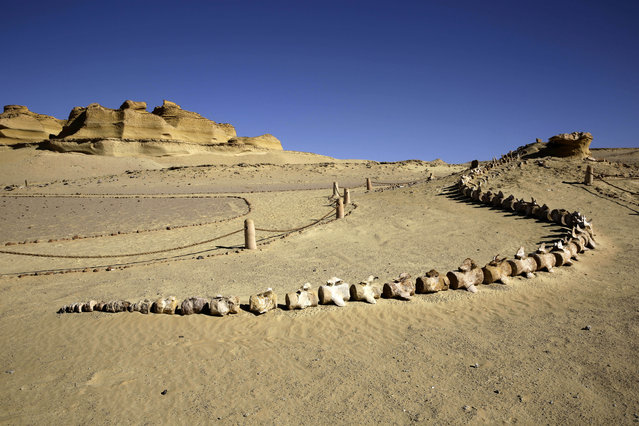
Fossilized whale bones are on display  outside the Wati El Hitan Fossils and Climate Change Museum, a UNESCO natural World Heritage site, on the opening day, in the Fayoum oasis, Egypt, Thursday, January 14, 2016. Egypt has cut the ribbon on the Middle East's first fossil museum housing the world's largest intact skeleton of a "walking whale" in an attempt to attract much-needed tourists driven off by recent militant attacks. The construction of the much-hyped Fossils and Climate Change Museum was covered a 2 billion euros (2. 17 billion dollars) grant from Italy, according to Italian Ambassador Maurizio Massari. (Photo by Thomas Hartwell/AP Photo)

Fossilized whale bones are on display outside the Wati El Hitan Fossils and Climate Change Museum, a UNESCO natural World Heritage site, on the opening day, in the Fayoum oasis, Egypt, Thursday, January 14, 2016. Egypt has cut the ribbon on the Middle East's first fossil museum housing the world's largest intact skeleton of a "walking whale" in an attempt to attract much-needed tourists driven off by recent militant attacks. The construction of the much-hyped Fossils and Climate Change Museum was covered a 2 billion euros (2. 17 billion dollars) grant from Italy, according to Italian Ambassador Maurizio Massari. Its centerpiece is an intact, 37-million-year-old and 20-meter-long skeleton of a legged form of whale that testifies to how modern-day whales evolved from land mammals. The sand-colored, dome-shaped museum is barely discernible in the breathtaking desert landscape that stretches all around. (Photo by Thomas Hartwell/AP Photo)
Details
16 Jan 2016 08:06:00
Ocean voyage

Do you think that history is a science? Well, not exactly. First, and foremost, history is the state's “legend of wars”, it’s official regalia. Of course, public historians are not interested in scientific truth – quite the opposite. In this respect, any attempt to present a state’s history as altruistic and benevolent as possible is welcomed and encouraged – as opposed to any revisionism attempts that may be more accurate. In this matter, Chinese have surpassed us all – they revised in highly creative manner (but rather shamelessly) the technology already invented by Europeans, a process that resulted in oldest state on the planet. Here is an interesting paradox: ask any sinologist about the Middle Kingdom during second century B.C., and he will describe it to you in such a vivid manner as if he has been living there all his life – but as soon as you will ask him to describe Chinese history in the 19-20th centuries… let's say, his eagerness will be greatly diminished. However, we will discuss China in a different article, and in the meantime we will try to understand how exactly historic “legend of wars” is formed and functions – based on a specific and well-known example. A great example is Ferdinand Magellan's first voyage around the world.

Details
14 Nov 2011 09:11:00
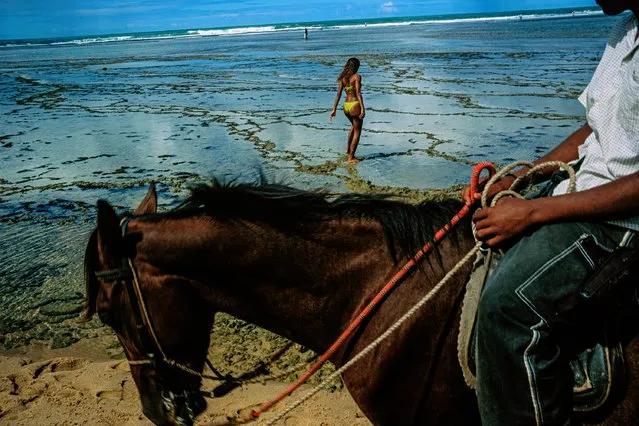
Praia du Forte, Bahia. “This was the lead picture for a National Geographic story on Bahia, because it was both mysterious as well as a “geography” picture showing where the slaves arrived from Nigeria. Beach pictures seem like they should be easy to take, but for me they are actually quite difficult. Too easy to fall into cliche. When I saw the kid coming on the horse, I quickly ran to see if I could make something with a woman in a bikini that was not a bikini shot”. (Photo by David Alan Harvey/The Guardian)

Praia du Forte, Bahia. “This was the lead picture for a National Geographic story on Bahia, because it was both mysterious as well as a “geography” picture showing where the slaves arrived from Nigeria. Beach pictures seem like they should be easy to take, but for me they are actually quite difficult. Too easy to fall into cliche. When I saw the kid coming on the horse, I quickly ran to see if I could make something with a woman in a bikini that was not a bikini shot”. (Photo by David Alan Harvey/The Guardian)
Details
20 Aug 2016 11:35:00
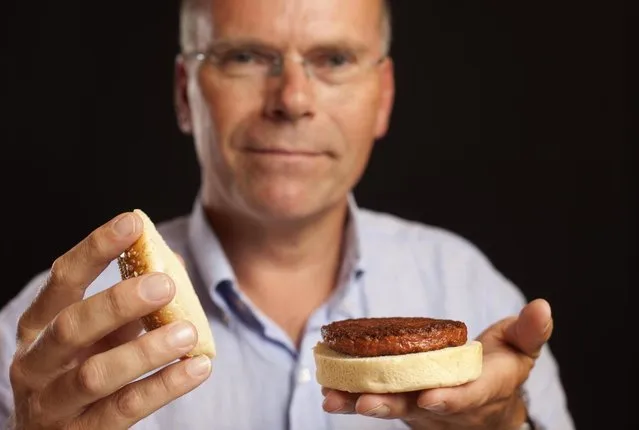
In this handout image provided by Ogilvy, a burger made from cultured beef, which has been developed by Professor Mark Post of Maastricht University in the Netherlands (pictured) is shown to the media during a press conference on August 5, 2013 in London, England. Cultured Beef could help solve the coming food crisis and combat climate change with commercial production of Cultured Beef beginning within ten to twenty years. (Photo by David Parry via Getty Images)

In this handout image provided by Ogilvy, a burger made from cultured beef, which has been developed by Professor Mark Post of Maastricht University in the Netherlands (pictured) is shown to the media during a press conference on August 5, 2013 in London, England. The in-vitro burger, cultured from cattle stem cells, the first example of what its creator says could provide an answer to global food shortages and help combat climate change, was fried in a pan and tasted by two volunteers. The burger is the result of years of research by Dutch scientist Mark Post, a vascular biologist at the University of Maastricht, who is working to show how meat grown in petri dishes might one day be a true alternative to meat from livestock.The meat in the burger has been made by knitting together around 20,000 strands of protein that has been cultured from cattle stem cells in Post's lab. (Photo by David Parry)
Details
06 Aug 2013 08:48:00