Loading...
Done
Dead sperm whales are seen washed up on a beach on Texel Island, The Netherlands, January 13, 2016. The five sperm whales that beached on the Dutch lsland of Texel on Tuesday have died overnight, Dutch media reported. It is extremely unusual for so many whales to be in Dutch waters, a spokesman for the Ecomare marine centre told local paper Noordhollands Dagblad. (Photo by Cris Toala Olivares/Reuters)

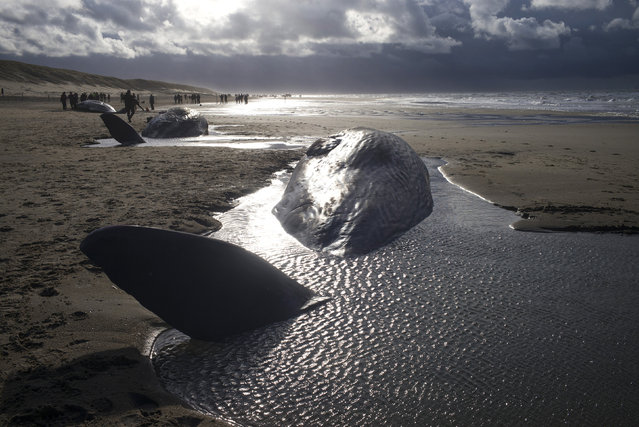
Dead sperm whales are seen washed up on a beach on Texel Island, The Netherlands, January 13, 2016. The five sperm whales that beached on the Dutch lsland of Texel on Tuesday have died overnight, Dutch media reported. It is extremely unusual for so many whales to be in Dutch waters, a spokesman for the Ecomare marine centre told local paper Noordhollands Dagblad. Efforts to get the whales back into open water on Tuesday evening failed and rescuers finally withdrew from the beach at around midnight. The area of beach where the whales are has been closed to the public, to minimise the distress to the animals. (Photo by Cris Toala Olivares/Reuters)
Details
15 Jan 2016 08:04:00
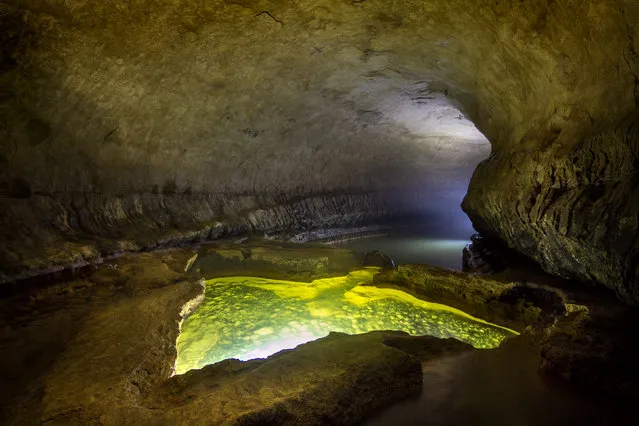
A large pool of water inside one of the tunnels. (Photo by Vladimir Mulde/Caters News)

These otherworldly images give a rare glimpse inside caves barely ever seen by the human eye. With its peculiar pools of water and strange colored sediments, the bizarre looking tunnels of the Shakuranskaya cave could be a set straight out of a science fiction film. Found in the disputed region of Abkhazia, around 75 miles outside of Sochi, Russia, it is rumored the incredible underground chambers were formed after a huge earthquake struck the area in 1892. After causing part of a nearby mountain to collapse into the Amtkel River, it is thought the dam-like affect has created a series of interconnecting underground tunnels. Here: a large pool of water inside one of the tunnels. (Photo by Vladimir Mulde/Caters News)
Details
07 Nov 2014 12:45:00
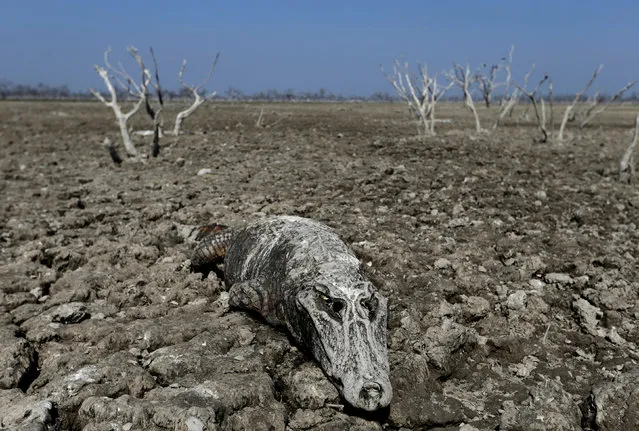
The carcass of a yacare caiman lies in the dried-up river bed of the Pilcomayo river in Boqueron, Paraguay, August 14, 2016. In Paraguay, alongside the Pilcomayo River, black vultures flew over a shrinking pond where a group of crocodilian reptiles known as yacare caimans sought refuge. Water from the river, which divides Paraguay and Argentina in the area of the Gran Chaco, was scarce. This is not an uncommon sight in the region of General Diaz, about 700 kilometres (435 miles) northwest of the country's capital Asuncion, where the Pilcomayo's waters form lakes and streams that give life to capybaras, birds and caimans. “The river's situation is critical. No water is forecast to enter the basin until December, as happens every year”, said Alcides Gonzalez, a resident of the area. (Photo by Jorge Adorno/Reuters)

The carcass of a yacare caiman lies in the dried-up river bed of the Pilcomayo river in Boqueron, Paraguay, August 14, 2016. In Paraguay, alongside the Pilcomayo River, black vultures flew over a shrinking pond where a group of crocodilian reptiles known as yacare caimans sought refuge. Water from the river, which divides Paraguay and Argentina in the area of the Gran Chaco, was scarce. This is not an uncommon sight in the region of General Diaz, about 700 kilometres (435 miles) northwest of the country's capital Asuncion, where the Pilcomayo's waters form lakes and streams that give life to capybaras, birds and caimans. (Photo by Jorge Adorno/Reuters)
Details
03 Nov 2016 12:40:00
Victoria amazonica

The species has very large leaves, up to 3 m in diameter, that float on the water's surface on a submerged stalk, 7–8 m in length. The species was once called Victoria regia after Queen Victoria, but the name was superseded. V. amazonica is native to the shallow waters of the Amazon River basin, such as oxbow lakes and bayous. It is depicted in the Guyanese coat of arms. The flowers are white the first night they are open and become pink the second night. They are up to 40 cm in diameter, and are pollinated by beetles.
Details
03 Sep 2012 06:58:00


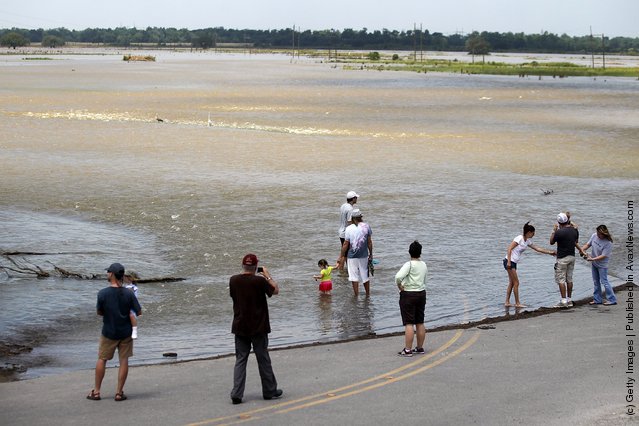
People look on as water from the rising Mississippi River is released through the Bonnet Carre Spillway while washing out a road May 9, 2011 in Norco, Louisiana. The Army Corps of Engineers began redirecting part of the Mississippi River through the spillway today to lower river levels and reduce pressure on levees in order to avoid a catastrophic failure. The water will flow nearly 6 miles north before emptying into Lake Pontchartrain as the Mississippi rises close to the highest level ever upriver in Memphis. (Photo by Mario Tama/Getty Images)
Details
11 May 2011 10:11:00
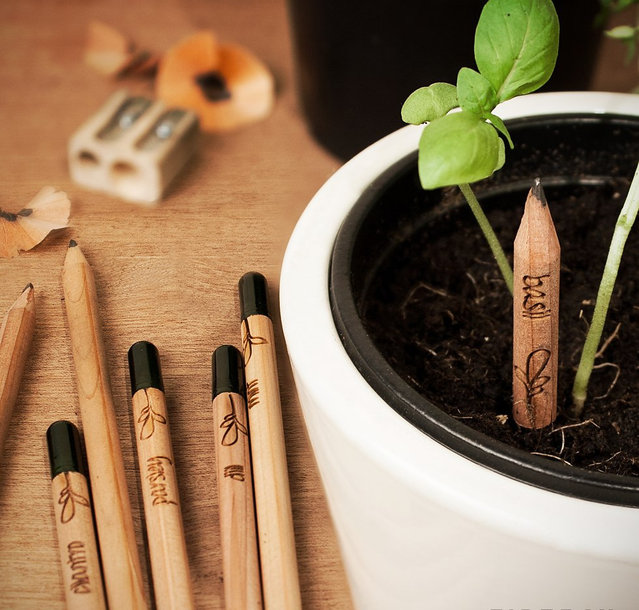
Sprout A Pencil That Grows

Sprout A Pencil That Grows is a very simple but excellent concept. We all know that as soon as a pencil gets down to the point where there’s only an inch or so left it’s pretty much useless. The Sprout lets you put that little stub to get use. The end of the Sprout has a seed capsule that is water activated, after you plant your pencil and water it a few times the capsule dissolves and the seed’s start germinating. The plants usually take about a week to sprout. The Sprout pencils come in a number of varieties including vegetables, herbs and flowers like rosemary, tomato, marigold, and many more.
Details
23 Mar 2014 10:59:00
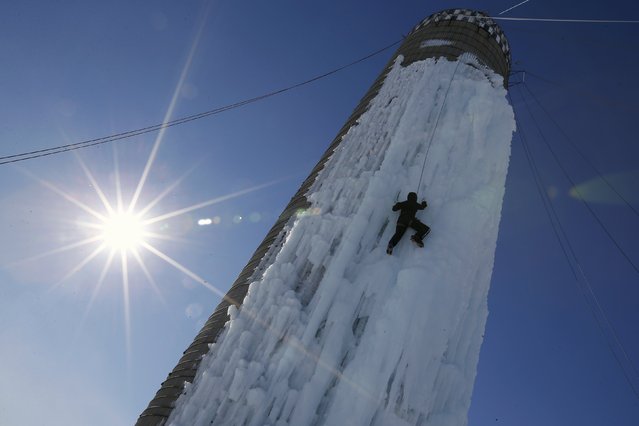
An climber ascends a silo covered in ice in Cedar Falls, Iowa, United States, January 17, 2016. The owners have connected hoses to the top of the silo and spray it with water in winter months to freeze the exterior for climbing. (Photo by Jim Young/Reuters)

An climber ascends a silo covered in ice in Cedar Falls, Iowa, United States, January 17, 2016. The owners have connected hoses to the top of the silo and spray it with water in winter months to freeze the exterior for climbing. (Photo by Jim Young/Reuters)
Details
20 Jan 2016 08:07:00
A woman carries water during during a visit by a European Union delegation, at an IDP camp in Azaza, east of Ad Damazin, capital of Blue Nile state, October 21, 2015. (Photo by Mohamed Nureldin Abdallah/Reuters)

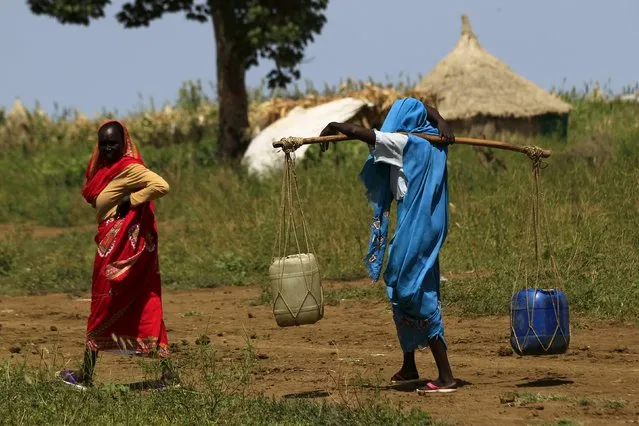
A woman carries water during during a visit by a European Union delegation, at an IDP camp in Azaza, east of Ad Damazin, capital of Blue Nile state, October 21, 2015. The camp houses people displaced by war between the Sudan People's Liberation Movement-North (SPLM-N) rebels and the Sudanese government. (Photo by Mohamed Nureldin Abdallah/Reuters)
Details
24 Oct 2015 08:04:00