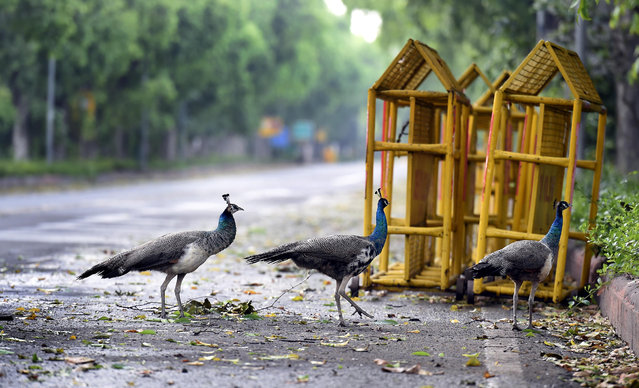
Peahens seen at Motilal Nehru Marg during lockdown to curb the spread of coronavirus, on April 19, 2020 in New Delhi, India. (Photo by Arvind Yadav/Hindustan Times via Getty Images)
A girl wears a mask to help protect herself from the new coronavirus jogs as the sun sets over the Mediterranean Sea coastline, in Beirut, Lebanon, Tuesday, April 14, 2020. (Photo by Hassan Ammar/AP Photo)
Visitors take photos of the fluorescent sea in the waters of Paishi Village, Dalian City, Liaoning Province, China, May 24, 2020, from the night of May 24 to the early morning of May 25, 2020. The fluorescent sea in dalian is caused by noctilucent algae in the sea water. (Photo by Costfoto/Barcroft Media via Getty Images)
People gather outside Red Square and the Kremlin for the New Year celebrations in downtown Moscow late on December 31, 2023. (Photo by Tatyana Makeyeva/AFP Photo)
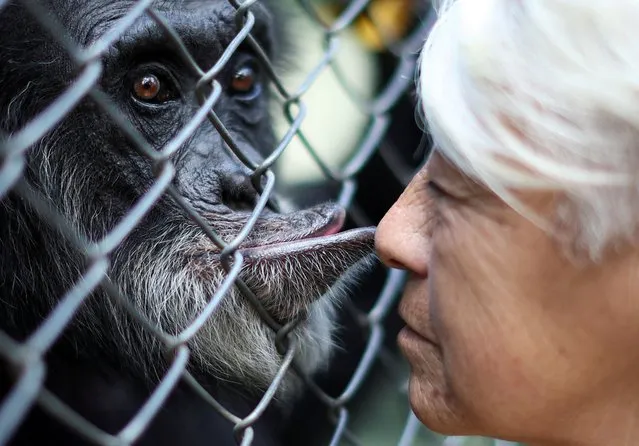
Keeper Silvia Salvatierra, 59, is kissed by a chimp named “Jony”, 54, who was rescued from a circus, at the Lujan Zoo from where felines, including tigers and lions, will be transferred to a wildlife sanctuary in India, in Lujan, on the outskirts of Buenos Aires, Argentina on April 8, 2024. (Photo by Agustin Marcarian/Reuters)
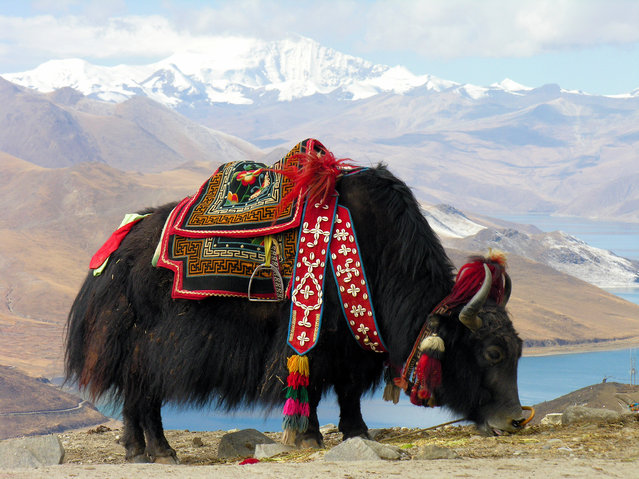
Yak near Yamdrok lake, Tibet. It is a long-haired bovinae found throughout the Himalayan region of south Central Asia, the Tibetan Plateau and as far north as Mongolia and Russia. The Tibetan economy is dominated by subsistence agriculture. Due to limited arable land, the primary occupation of the Tibetan Plateau is raising livestock, such as sheep, cattle, goats, camels, yaks, dzo, and horses. The Tibetan yak is an integral part of Tibetan life. (Photo by Dennis Jarvis)