Loading...
Done
Takeoka Chisaka, Hiroshima, Japan. “One morning in August 1945, I was walking home from the night shift at a factory in Hiroshima. As I reached my door, there was a huge explosion. When I came to, my head was bleeding and I had been blasted 30m away”. (Photo and caption by Sasha Maslov)

Takeoka Chisaka, Hiroshima, Japan. “One morning in August 1945, I was walking home from the night shift at a factory in Hiroshima. As I reached my door, there was a huge explosion. When I came to, my head was bleeding and I had been blasted 30m away. The atomic bomb had detonated. When I found my mother, her eyes were badly burned. A doctor said they had to come out, but he didn’t have the proper tools so used a knife instead. It was hellish. I became a peace-worker after the war. In the 1960s, at a meeting at the UN, I met one of the people who created the atomic bomb. He apologised”. (Photo and caption by Sasha Maslov)
Details
11 May 2015 11:56:00
In this photo provided by Mickey Nuttall, members of an international team of skydivers join hands, flying head-down to build their world record skydiving formation, Friday, July 31, 2015, over Ottawa, Ill. (Photo by Jason Peters via AP Photo)

In this photo provided by Mickey Nuttall, members of an international team of skydivers join hands, flying head-down to build their world record skydiving formation, Friday, July 31, 2015, over Ottawa, Ill. (Photo by Jason Peters via AP Photo)
Details
01 Aug 2015 12:45:00
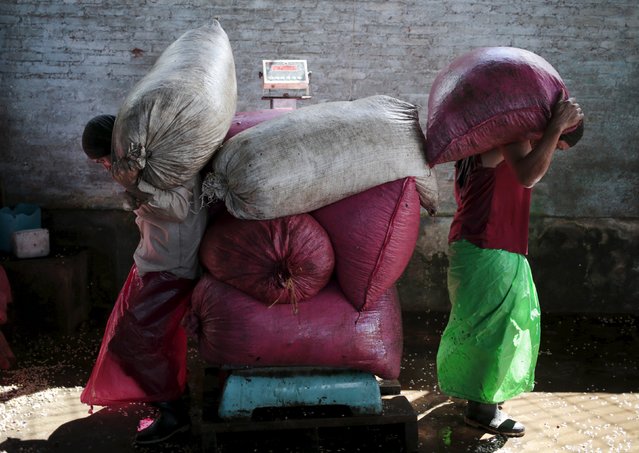
Workers carry sacks of coffee beans at a warehouse at the Nogales farm in Jinotega, Nicaragua January 7, 2016. (Photo by Oswaldo Rivas/Reuters)

Workers carry sacks of coffee beans at a warehouse at the Nogales farm in Jinotega, Nicaragua January 7, 2016. Soaring temperatures in Central America due to climate change are forcing farmers to pull up coffee trees and replace them with cocoa, spurring a revival in the cultivation of a crop once so essential to the region's economy. (Photo by Oswaldo Rivas/Reuters)
Details
20 Jan 2016 08:00:00
Yang Juan, an employee at Goopal Group, takes a nap in her seat after lunch, in Beijing, China, April 21, 2016. (Photo by Jason Lee/Reuters)

Yang Juan, an employee at Goopal Group, takes a nap in her seat after lunch, in Beijing, China, April 21, 2016. Office workers sleeping on the job is a common sight in China, where a surplus of cheap labour can lead to downtime at work. But in China's technology sector, where business is growing faster than many start-up firms can hire new staff, workers burn the midnight oil to meet deadlines and compete with their rivals. Some companies provide sleeping areas and beds for workers to rest during late nights. (Photo by Jason Lee/Reuters)
Details
12 May 2016 14:53:00
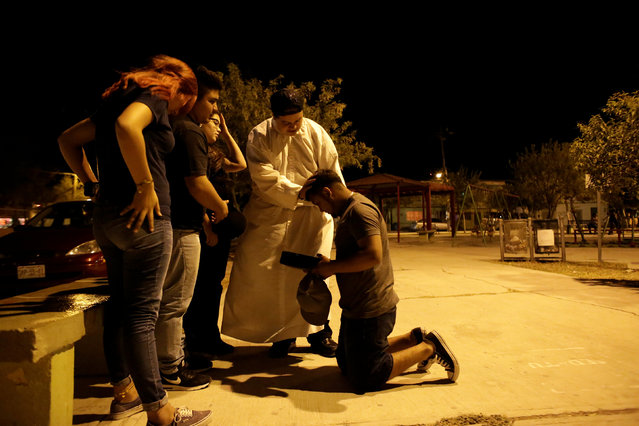
An aspiring Catholic priest Jose Luis Guerra, a member of Raza Nueva in Christ, a project of the archdiocese of Monterrey, and other missionaries hand out a Bible to Angel Castillo, who wants to become a missionary with Raza Nueva, in the municipality of Garcia, outskirts of Monterrey, Mexico, July 12, 2016. (Photo by Daniel Becerril/Reuters)

An aspiring Catholic priest Jose Luis Guerra, a member of Raza Nueva in Christ, a project of the archdiocese of Monterrey, and other missionaries hand out a Bible to Angel Castillo, who wants to become a missionary with Raza Nueva, in the municipality of Garcia, outskirts of Monterrey, Mexico, July 12, 2016. In the troubled fringes of the northern Mexican city of Monterrey, an aspiring priest is using his faith to reach out to young gang members and at-risk youth, and bring them into his “Gang of Christ”. (Photo by Daniel Becerril/Reuters)
Details
28 Jul 2016 13:22:00
David Pena poses for a photograph with his Lada 2101 built in 1979 on a street in Havana February 9, 2015. Getting parts from the United States is cheaper than in Cuba, where state-run stores sell them at four times the cost, said Pena, a mechanic and president of the Russian Car Club in Havana who drives a souped-up, sporty red 1972 Lada 2101 that he fixed himself. His own Lada has a Fiat engine and an extra Alfa Romeo carburetor. (Photo by Enrique De La Osa/Reuters)

David Pena poses for a photograph with his Lada 2101 built in 1979 on a street in Havana February 9, 2015. Getting parts from the United States is cheaper than in Cuba, where state-run stores sell them at four times the cost, said Pena, a mechanic and president of the Russian Car Club in Havana who drives a souped-up, sporty red 1972 Lada 2101 that he fixed himself. His own Lada has a Fiat engine and an extra Alfa Romeo carburetor. (Photo by Enrique De La Osa/Reuters)
Details
12 Feb 2015 12:55:00
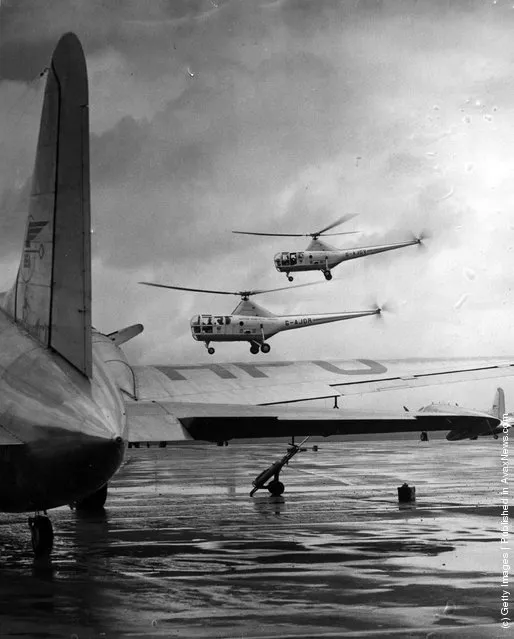
Sikorsky H-5 helicopters

“Igor Sikorsky (May 25, 1889 – October 26, 1972), born Igor Ivanovich Sikorsky was a Russian American pioneer of aviation in both helicopters and fixed-wing aircraft. He designed and flew the world's first multi-engine fixed-wing aircraft, the Russky Vityaz in 1913, and the first airliner, Ilya Muromets, in 1914. After immigrating to the United States in 1919, Sikorsky founded the Sikorsky Aircraft Corporation in 1923, and developed the first of Pan American Airways' ocean-conquering flying boats in the 1930s. In 1939 Sikorsky designed and flew the Vought-Sikorsky VS-300, the first viable American helicopter, which pioneered the rotor configuration used by most helicopters today. Sikorsky would modify the design into the Sikorsky R-4, which became the world's first mass-produced helicopter in 1942”. – Wikipedia

Photo: Westland Sikorsky H-5's, used by British European Airways Helicopters, which fly between London and Birmingham. The Sikorsky H-5, (aka R-5, S-51, HO3S-1, or Horse) (R-5 until 1948; company designation VS-327) is a helicopter built by Sikorsky Aircraft Corporation, formerly used by the United States Air Force, and its predecessor, the United States Army Air Forces, as well as the United States Navy and United States Coast Guard (with the designations HO2S and HO3S). (Photo by Harrison /Topical Press Agency/Getty Images). 22nd May 1951

Details
06 Sep 2011 10:18:00
A man dressed as a  “Trapajon”, representing entities of nature, poses for a picture after taking part in the Vijanera Festival in Silio, northern Spain, Sunday, Jan. 6, 2013. The Vijanera masquerade, of pre-Roman origin, is the first carnival of the year in Europe symbolizing the triumph of good over evil and involving the participation of crowds of residents wearing different masks, animal skins and brightly colored clothing with its own complex function and symbolism and becoming the living example of the survival of archaic cults to nature. (Photo by Daniel Ochoa de Olza/AP Photo)

A man dressed as a “Trapajon”, representing entities of nature, poses for a picture after taking part in the Vijanera Festival in Silio, northern Spain, Sunday, Jan. 6, 2013. The Vijanera masquerade, of pre-Roman origin, is the first carnival of the year in Europe symbolizing the triumph of good over evil and involving the participation of crowds of residents wearing different masks, animal skins and brightly colored clothing with its own complex function and symbolism and becoming the living example of the survival of archaic cults to nature. (Photo by Daniel Ochoa de Olza/AP Photo)
Details
19 Jan 2013 13:01:00