Loading...
Done
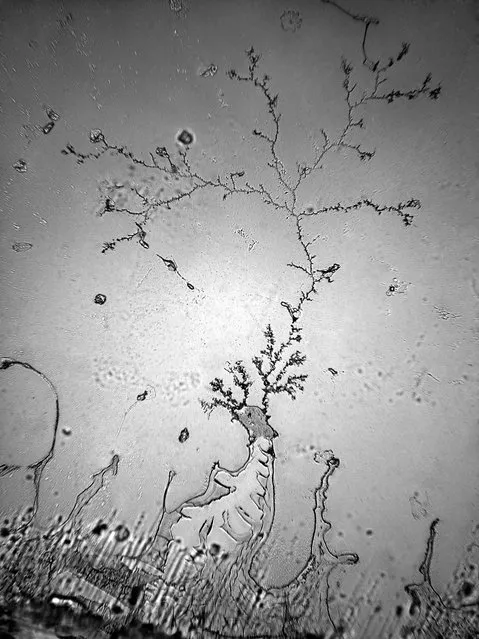
The Topography Of Tears By Rose-Lynn Fisher

Do tears of joy look the same as ones of woe—or ones from chopping onions? In “The Topography of Tears,” the Los Angeles-based photographer Rose-Lynn Fisher explores the physical terrain of one hundred tears emitted during a range of emotional states and physical reactions. Using a Zeiss microscope with an attached digital camera, she captures the composition of tears enclosed in glass slides, magnified between 10x and 40x. “There are many factors that determine the look of each tear image, including the viscosity of the tear, the chemistry of the weeper, the settings of the microscope, and the way I process the images afterwards,” she says.
Details
21 May 2014 17:46:00
Glass Paintings By Loren Stump

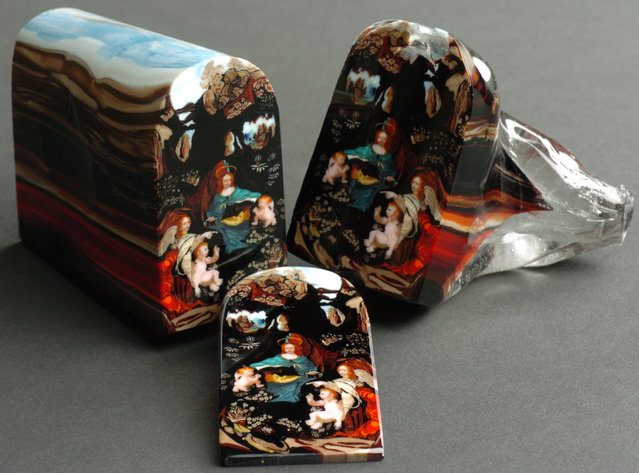
California-based glass artist Loren Stump specializes in a form of glasswork called murrine, where rods of glass are melted together and then sliced to reveal elaborate patterns and forms. While the murrina process appeared in the Mideast some 4,000 years ago, Stump has perfected his own technique over the past 35 years to the point where he can now layer entire portraits and paintings in glass before slicing them to see the final results. His most complex piece to date is a detailed interpretation of Leonardo da Vinci’s Virgin of the Rocks, which involved hundreds of glass components that were melted into a final piece.
Details
11 Jun 2014 14:11:00
Fat Pop Culture Characters By Alex Solis Part 2

Chicago-based illustrator Alex Solis created fat versions of famous pop culture characters in this funny illustration series entitled “Famous Chunkies”.


See also: Part 1 _ Part 3 _ Part 4
Details
19 Jun 2014 11:54:00
Fat Pop Culture Characters By Alex Solis Part 4

Chicago-based illustrator Alex Solis created fat versions of famous pop culture characters in this funny illustration series entitled “Famous Chunkies”.

See also: Part 1 _ Part 2 _ Part 3
Details
28 Jun 2014 09:56:00
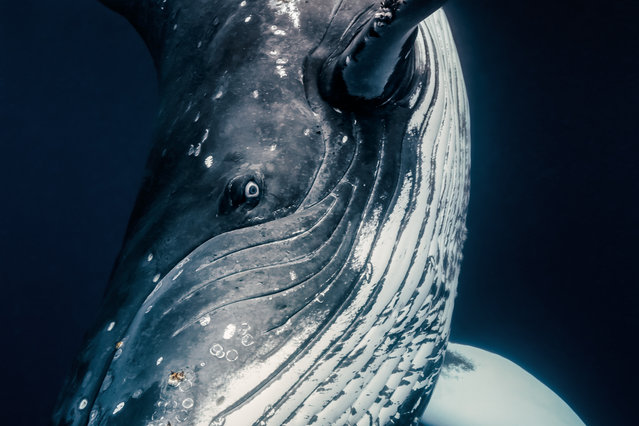
“To look into a whale’s eye is life-changing and humbling. Well, it’s the same with dolphins but they are mostly very fast in the water. A whale’s eye is unexpectedly looking, just like a human eye, kinda checking you out”. (Photo by Rita Kluge/The Guardian)

With the humpback calving season drawing to a close, here’s a look at some of Rita Kluge’s distinctive marine photos from the south Pacific. The Sydney-based photographer fell in love with whales after witnessing southern rights from the New South Wales coastline as they travelled to and from their feeding grounds in the Antarctic. She has since been to Tonga, where humpbacks breed and calf in winter months, to photograph them in the water. (Photo by Rita Kluge/The Guardian)
Details
26 Oct 2016 11:09:00
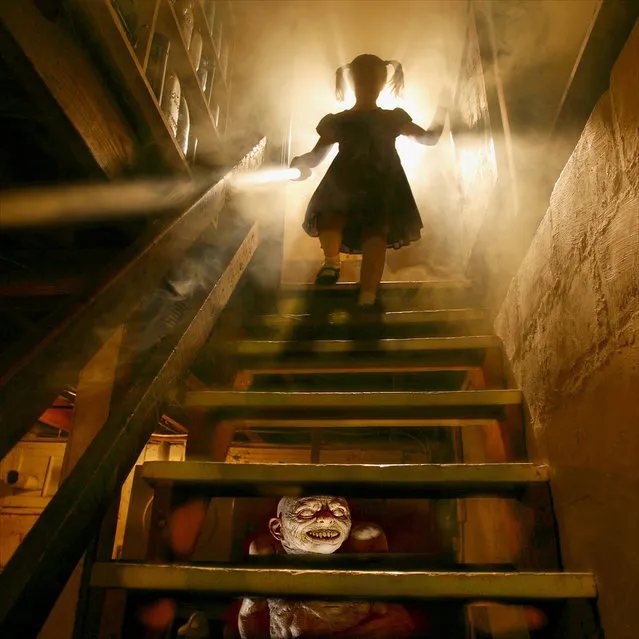
“Basement”. (Photo by Joshua Hoffine/The Washington Post)

Joshua Hoffine, based in Kansas City, Mo., and a self-proclaimed “Horror Photographer”, is interested in the psychology of fear. In his project “After Dark, My Sweet”, Hoffine’s surreal and staged images render these fears visible with the “visual grammar of a child”. Through elaborate sets, costumes, makeup and fog machines, Hoffine’s children act out these terrifying scenes in front of his camera. Here: “Basement”. (Photo by Joshua Hoffine/The Washington Post)
Details
29 Oct 2016 11:47:00
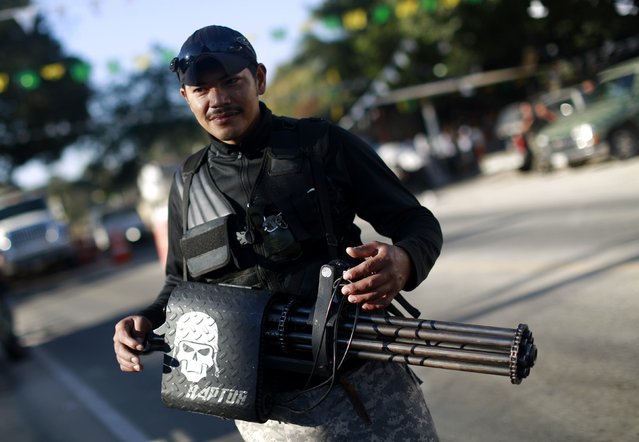
A member of the Community Police of the FUSDEG (United Front for the Security and Development of the State of Guerrero) poses with a weapon during events to mark the first anniversary of the force's operations in Ocotito, January 23, 2015. (Photo by Jorge Dan Lopez/Reuters)

A member of the Community Police of the FUSDEG (United Front for the Security and Development of the State of Guerrero) poses with a weapon during events to mark the first anniversary of the force's operations in Ocotito, January 23, 2015. Based on the traditional indigenous justice system, the Community Police is made up of volunteers from different communities of Guerrero, and was created in response to the spate of violence in several locations in the state. (Photo by Jorge Dan Lopez/Reuters)
Details
25 Jan 2015 09:19:00
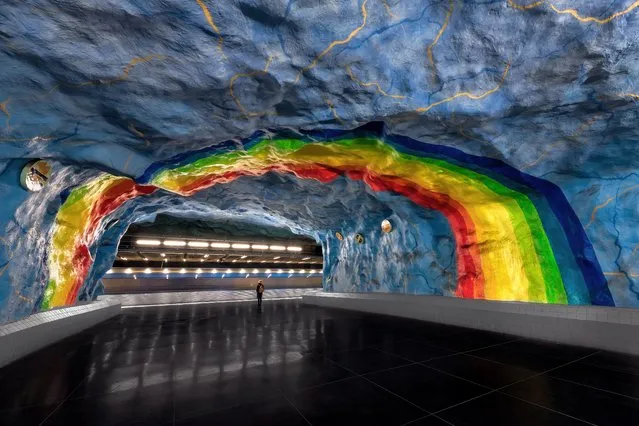
A rainbow arcs over a girl on the platform of Stadion station. (Photo by Conor MacNeill/The Observer)

Beneath the Swedish capital lies an intricate web of underground train lines. More than 90 of the 100 stations in the 110km tunnel system, sometimes referred to as “the world’s longest art gallery”, have been decorated with paintings, installations, mosaics and sculptures by 150 artists since the 1950s. After spending a couple of weeks exploring arctic Norway and Sweden, London-based travel photographer Conor MacNeill headed underground to capture images of the metro stations. Here: A rainbow arcs over a girl on the platform of Stadion station. (Photo by Conor MacNeill/The Observer)
Details
05 Jun 2016 13:21:00