Loading...
Done
Guinness Rishi – The Human Flag

67-year-old Guinness Rishi constantly tries to make his family and the entire Indian people by constantly setting new records. He previously became father of the world’s oldest adoptee, after taking custody of his 61-year-old brother-in-law, and built the tallest sugar-cube tower in the world, which stood at 64 inches.
Details
09 Oct 2014 12:16:00
A general view of the ghost town of a former Soviet military radar station near Skrunda, Latvia, April 9, 2016. (Photo by Ints Kalnins/Reuters)

A general view of the ghost town of a former Soviet military radar station near Skrunda, Latvia, April 9, 2016. (Photo by Ints Kalnins/Reuters)
Details
10 Apr 2016 11:44:00
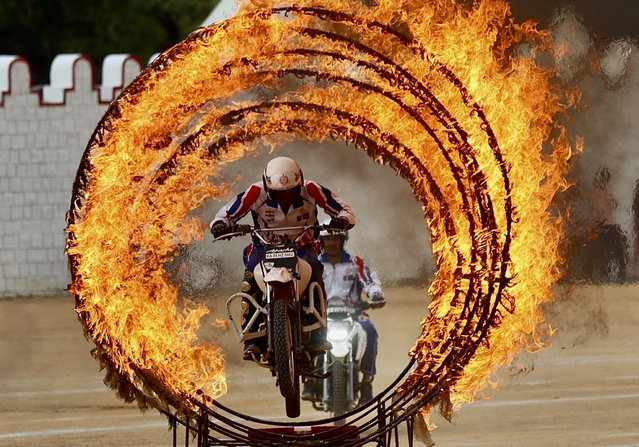
Indian Army Jawan (soldiers) of the “ASC Tornadoes” daredevil bike team perform during Independence Day celebrations in Bangalore, India, 15 August 2024. India celebrated its 78th Independence Day on 15 August. (Photo by Jagadeesh N.V./EPA)

Indian Army Jawan (soldiers) of the “ASC Tornadoes” daredevil bike team perform during Independence Day celebrations in Bangalore, India, 15 August 2024. India celebrated its 78th Independence Day on 15 August. (Photo by Jagadeesh N.V./EPA)
Details
22 Aug 2024 03:46:00
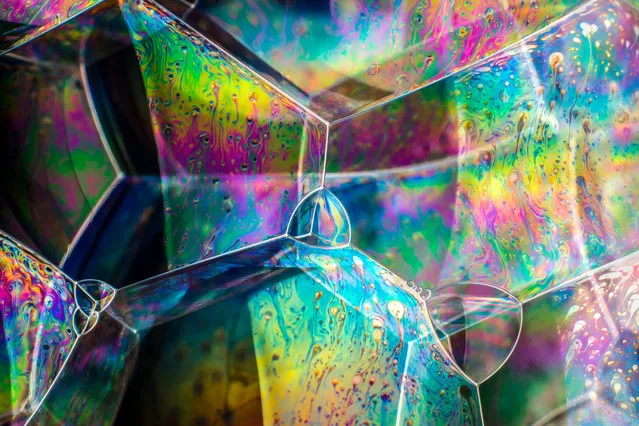
Soap Bubble Structures by Kym Cox. Bubbles optimise space and minimise their surface area for a given volume of air. This phenomenon makes them a useful tool in many areas of research, in particular, materials science and ‘packing’ – how things fit together. Bubble walls drain under gravity, thin at the top, thick at the bottom, which interferes with travelling lightwaves to create bands of colour. Black spots show the wall is too thin for interference colours, indicating the bubble is about to burst. (Photo by Kym Cox/2019 Science Photographer of the Year/RPS)

Soap Bubble Structures by Kym Cox. Bubbles optimise space and minimise their surface area for a given volume of air. This phenomenon makes them a useful tool in many areas of research, in particular, materials science and “packing” – how things fit together. Bubble walls drain under gravity, thin at the top, thick at the bottom, which interferes with travelling lightwaves to create bands of colour. Black spots show the wall is too thin for interference colours, indicating the bubble is about to burst. (Photo by Kym Cox/2019 Science Photographer of the Year/RPS)
Details
15 Aug 2019 00:03:00
Ocean voyage

Do you think that history is a science? Well, not exactly. First, and foremost, history is the state's “legend of wars”, it’s official regalia. Of course, public historians are not interested in scientific truth – quite the opposite. In this respect, any attempt to present a state’s history as altruistic and benevolent as possible is welcomed and encouraged – as opposed to any revisionism attempts that may be more accurate. In this matter, Chinese have surpassed us all – they revised in highly creative manner (but rather shamelessly) the technology already invented by Europeans, a process that resulted in oldest state on the planet. Here is an interesting paradox: ask any sinologist about the Middle Kingdom during second century B.C., and he will describe it to you in such a vivid manner as if he has been living there all his life – but as soon as you will ask him to describe Chinese history in the 19-20th centuries… let's say, his eagerness will be greatly diminished. However, we will discuss China in a different article, and in the meantime we will try to understand how exactly historic “legend of wars” is formed and functions – based on a specific and well-known example. A great example is Ferdinand Magellan's first voyage around the world.

Details
14 Nov 2011 09:11:00
Shi'ite fighters launch a rocket during clashes with Islamic State militants on the outskirts of al-Alam March 8, 2015. Thaier Al-Sudani: “It was me and a few other Iraqi journalists working for local outlets. (Photo by Thaier Al-Sudani/Reuters)

Shi'ite fighters launch a rocket during clashes with Islamic State militants on the outskirts of al-Alam March 8, 2015. Thaier Al-Sudani: “It was me and a few other Iraqi journalists working for local outlets. We went to the frontlines in coordination with the Iraqi government forces and supporting militias. The press officer would come in the morning and take us to the frontline in a convoy. Whenever an area was won from Islamic State, the fighters would chant and pray and show victory signs. Most of the areas we were in didn't have residents, so after the battle they would resemble ghost towns; nothing but burnt cars and charred bodies of Islamic State fighters. Al-Alam was an exception as it had some residents who chanted for the government forces after their victory”. (Photo by Thaier Al-Sudani/Reuters)
Details
14 Mar 2015 14:33:00
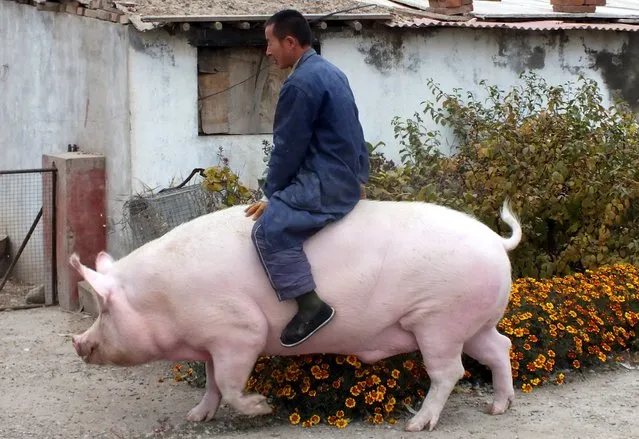
Farmer Zhang Xianping rides his pig "Big Precious" during an interview with the media, in Zhangjiakou, Hebei province, China, November 2, 2015. Zhang, a pig breeder, instead of killing it, decided to keep the two-year-old "Big Precious" as pet when its weight reached 600 kg, according to local media. (Photo by Reuters/China Daily)

Farmer Zhang Xianping rides his pig "Big Precious" during an interview with the media, in Zhangjiakou, Hebei province, China, November 2, 2015. Zhang, a pig breeder, instead of killing it, decided to keep the two-year-old "Big Precious" as pet when its weight reached 600 kg, according to local media. (Photo by Reuters/China Daily)
Details
06 Nov 2015 08:02:00
Wedges of an orange generate enough current and electrical juice – 3.5 volts – to power an LED. The fruit’s citric acid helps electrons flow from galvanized nails to copper wire in this 14-hour exposure. This image was published in September’s Visions of Earth, a trio of photos that appear in each issue of National Geographic. (Photo by Caleb Charland/National Geographic)

Wedges of an orange generate enough current and electrical juice – 3.5 volts – to power an LED. The fruit’s citric acid helps electrons flow from galvanized nails to copper wire in this 14-hour exposure. This image was published in September’s Visions of Earth, a trio of photos that appear in each issue of National Geographic. (Photo by Caleb Charland/National Geographic)
Details
06 Jan 2014 12:09:00