Loading...
Done
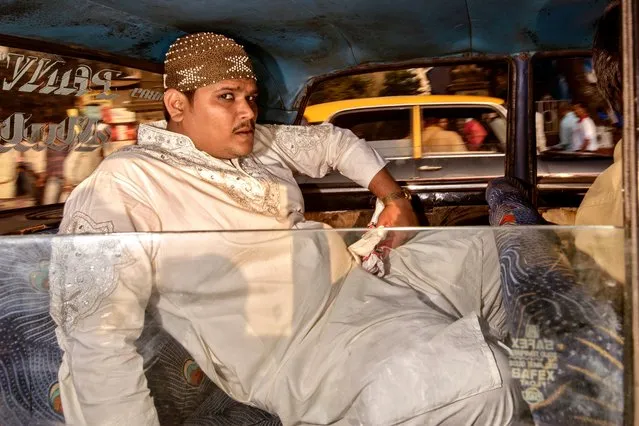
“I’m not scared of breaking the fourth wall”, Wallace has said of the photos where the subject is clearly aware of him taking the shot. “If they are looking at you in a photograph most photographers will think, oh, that’s not a good image. (But) people like to be involved and in the picture. You can see what they are thinking, see them talking”. (Photo by Dougie Wallace/The Guardian)

In Dougie Wallace’s photos of Mumbai taxis, the chatter, yelling, and constant horns of the city are almost audible. A selection of his images is on show at Gayfield Creative Spaces, Edinburgh, as part of the Retina photography festival until 30 July. For four years, the Glasgow-born Wallace focused his photos on one kind of taxi in particular: the Premier Padmini, a 1960s workhorse painted in black and yellow. Locally known as “Kaali-Peeli”, there were once more than 60,000 of them in the Indian city. But thanks to laws restricting pollution, the cars now are fast disappearing from Mumbai’s streets. (Photo by Dougie Wallace/The Guardian)
Details
13 Jul 2016 13:50:00
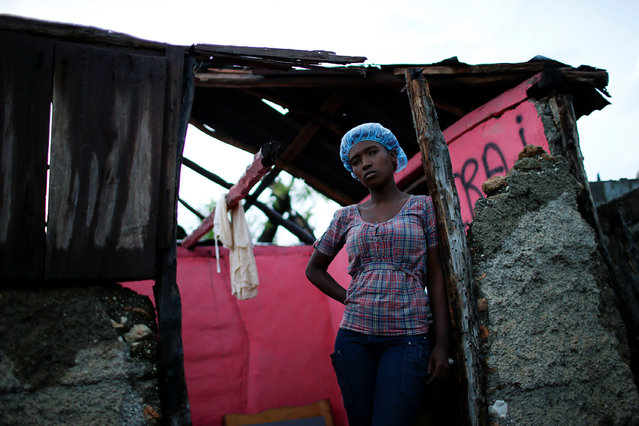
Carine Louis-Jean, 22, poses for a photograph in her destroyed house after Hurricane Matthew hit Jeremie, Haiti, October 17, 2016. “The roof of my house is completely gone and some of walls were destroyed. I have lost everything I had, but I thank God that I have a friend who is letting me stay at her house. I could say I'm lucky, because none of my family died during the hurricane, but I do not think I'm lucky”, said Louis-Jean. (Photo by Carlos Garcia Rawlins/Reuters)

Carine Louis-Jean, 22, poses for a photograph in her destroyed house after Hurricane Matthew hit Jeremie, Haiti, October 17, 2016. “The roof of my house is completely gone and some of walls were destroyed. I have lost everything I had, but I thank God that I have a friend who is letting me stay at her house. I could say I'm lucky, because none of my family died during the hurricane, but I do not think I'm lucky”, said Louis-Jean. (Photo by Carlos Garcia Rawlins/Reuters)
Details
11 Nov 2016 08:23:00
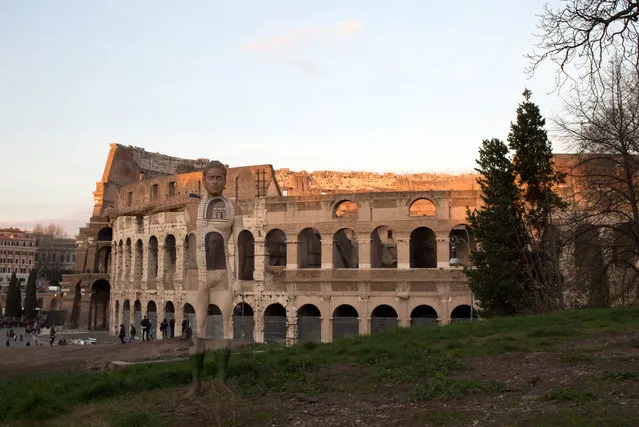
This artist has put together an amazing picture set of a man blending into the Seven Wonders of the World with her incredible body art. New York artist Trina Merry is known for her unique style that blends body art with photography but in her Lost in Wonder series shes painted a models body to blend into some of the worlds most iconic locations. She had her subject, UK model Kyle James, pose fully painted in front of the Great Pyramid of Giza, the Great Wall of China, Petra, The Colosseum, Machu Picchu, Stone Henge and Easter Island. Here: Colusseum. (Photo by Trina Merry/Caters News)

This artist has put together an amazing picture set of a man blending into the Seven Wonders of the World with her incredible body art. New York artist Trina Merry is known for her unique style that blends body art with photography but in her Lost in Wonder series shes painted a models body to blend into some of the worlds most iconic locations. She had her subject, UK model Kyle James, pose fully painted in front of the Great Pyramid of Giza, the Great Wall of China, Petra, The Colosseum, Machu Picchu, Stone Henge and Easter Island. Here: Colusseum. (Photo by Trina Merry/Caters News)
Details
10 Oct 2016 10:20:00


“The Six-Day War or June War, also known as the 1967 Arab-Israeli War or the Third Arab-Israeli War, was fought between June 5 and June 10, 1967, by Israel and the neighboring states of Egypt (known then as the United Arab Republic [UAR]), Jordan, and Syria. The war began with a large-scale surprise air strike by Israel on Egypt. The outcome was a swift and decisive Israeli victory. Israel took effective control of the Gaza Strip and the Sinai Peninsula from Egypt, the West Bank and East Jerusalem from Jordan, and the Golan Heights from Syria. Opinions are divided on whether Israel's attack was an act of aggression or a preemptive strike of a defensive nature”. – Wikipedia

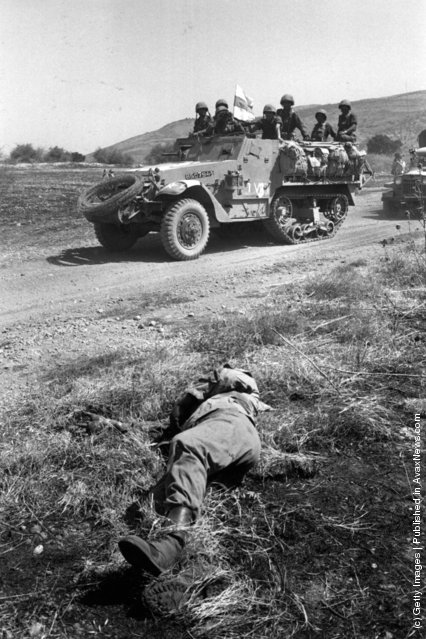
Photo: The corpse of a soldier lying on the line of the Israeli advance into Syria during the Six-Day War. (Photo by Terry Fincher/Getty Images). 1967
Details
21 May 2011 08:29:00
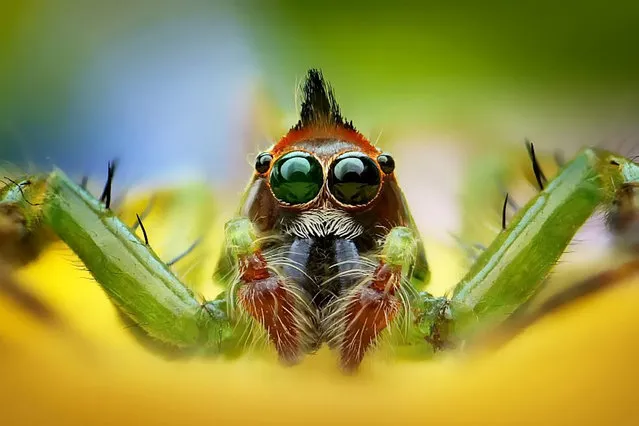
You might feel as if you are being watched when you look at these incredible pictures – revealing the close-up world of a spider's eyes. The intimidating creatures, which look like they should live in a horror film, star menacingly at the camera as every fleck of colour and hair are revealed. But despite their appearance the arachnids are actually jumping spiders, which measure a tiny six millimetres in length. (Photo by SWNS/ABACA Press)

You might feel as if you are being watched when you look at these incredible pictures – revealing the close-up world of a spider's eyes. The intimidating creatures, which look like they should live in a horror film, star menacingly at the camera as every fleck of colour and hair are revealed. But despite their appearance the arachnids are actually jumping spiders, which measure a tiny six millimetres in length. The harmless arachnids, which are capable of jumping up to six times their own height, can be found in grassy meadows and on the walls of houses on sunny days. (Photo by SWNS/ABACA Press)
Details
08 Sep 2014 10:58:00
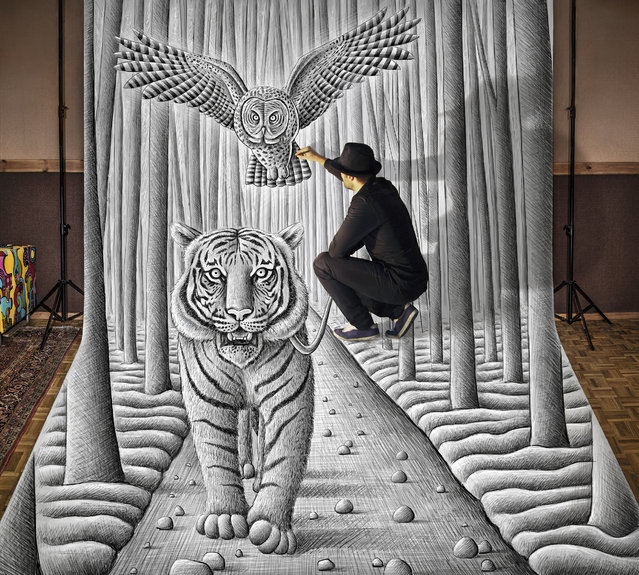
Visual artist Ben Heine at work in his studio while he creates one of his “anamorphic illusions” in Rochefort, Belgium

An arm holding a giant gun appears to explode through a wall, while elsewhere a man walks a tiger on a leash. These breathtaking pencil drawings are the work of 31-year-old artist Ben Heine, who lives and works in Rochefort, Belgium. The “anamorphic illusions”, part of the artist's “Pencil Vs Camera” series, appear slightly distorted unless viewed from the exact same perspective in which they were created. Photo: Visual artist Ben Heine at work in his studio while he creates one of his “anamorphic illusions” in Rochefort, Belgium. (Photo by Ben Heine/Barcroft Media)
Details
23 Mar 2014 11:00:00
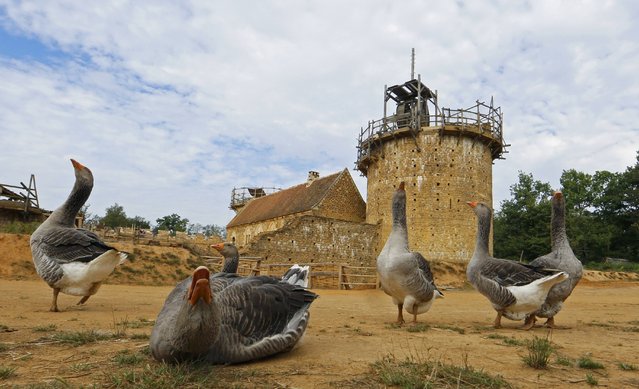
A view of the construction site of the Chateau de Guedelon near Treigny in the Burgundy region of France, September 13, 2016. Blacksmiths, stonemasons and quarry men are hard at work in a Burgundy forest building a 13th-century-style castle using the most basic tools and materials, replicating the methods used hundreds of years ago to better understand them. Forgoing all modern technology, workers use hammers to break stones and forge iron, operate wooden wheels to hoist their materials up to where they are needed, and rely on a quarry for stone, clay and sand as they build up a castle from scratch. Construction on Guedelon Castle in central France began in 1997 after an archaeological survey revealed a medieval fortress hidden inside the walls of nearby Chateau de Saint-Fargeau. Those behind the project hope to answer questions about medieval construction and provide lessons on sustainable building. (Photo by Jacky Naegelen/Reuters)

A view of the construction site of the Chateau de Guedelon near Treigny in the Burgundy region of France, September 13, 2016. Blacksmiths, stonemasons and quarry men are hard at work in a Burgundy forest building a 13th-century-style castle using the most basic tools and materials, replicating the methods used hundreds of years ago to better understand them. (Photo by Jacky Naegelen/Reuters)
Details
15 Sep 2016 09:43:00
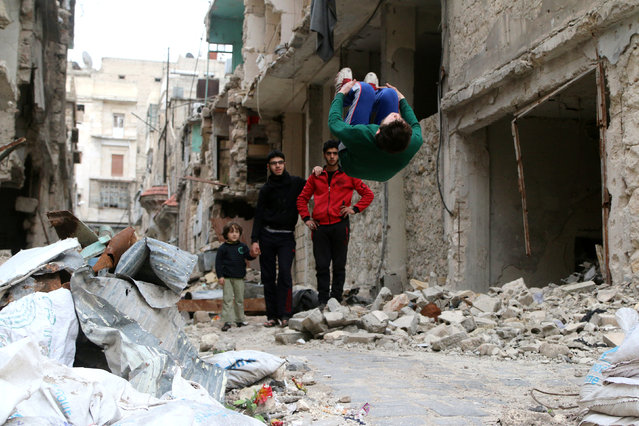
Gymnast Ahmad al-Sawas performs gymnastic moves near damaged buildings in the rebel-held Bustan al-Qasr neighbourhood of Aleppo, Syria March 26, 2016. As Syrian gymnast Ahmad al-Sawas watched his country fall apart, his Olympic dream collapsed too. The last national champion before the fighting began, he knew that supporting the anti-government side in the five-year-old civil war would prevent him from being selected for the Rio Games. “I chose to be an athlete who participates in the revolution”, said Ahmad, who trains where he can for two hours a day – be it on a mattress on a soccer field, in a local hall or somersaulting off a wall. (Photo by Abdalrhman Ismail/Reuters)

Gymnast Ahmad al-Sawas performs gymnastic moves near damaged buildings in the rebel-held Bustan al-Qasr neighbourhood of Aleppo, Syria March 26, 2016. As Syrian gymnast Ahmad al-Sawas watched his country fall apart, his Olympic dream collapsed too. The last national champion before the fighting began, he knew that supporting the anti-government side in the five-year-old civil war would prevent him from being selected for the Rio Games. (Photo by Abdalrhman Ismail/Reuters)
Details
05 Aug 2016 13:25:00