Loading...
Done
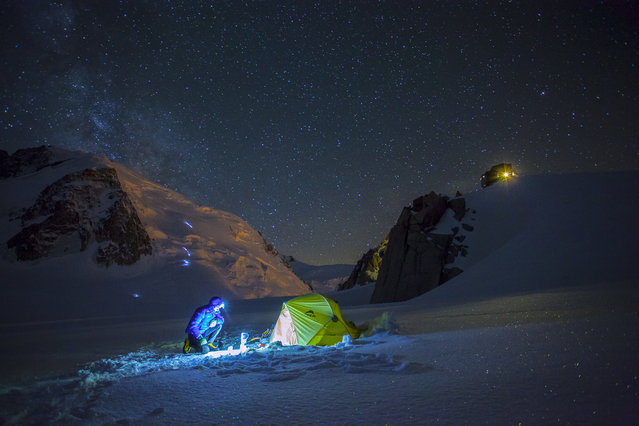
“A snapshot from mountaineer's life”. Have you ever wondered how does a mountaineer's day start? (Photo and caption by Kamil Tamiola/National Geographic Traveler Photo Contest)

“A snapshot from mountaineer's life”. Have you ever wondered how does a mountaineer's day start? I will give you a hint: you wake up at 3 am, set the stove, wake up your partner, pretend it is warm, quickly consume a high-calorie breakfast, watch your friends slowly ascending the icy slopes of your dream summit with their tiny head torches glimmering against perfectly blue ice, and hope for the good weather. One would ask: why all this trouble? The answer is easy: for the love of the adventure and the unknown. Location: Chamonix, Haute Savoye, France. (Photo and caption by Kamil Tamiola/National Geographic Traveler Photo Contest)

ATTENTION! All pictures are presented in high resolution. To see Hi-Res images – just TWICE click on any picture. In other words, click small picture – opens the BIG picture. Click BIG picture – opens VERY BIG picture.
Details
27 Jun 2013 12:47:00
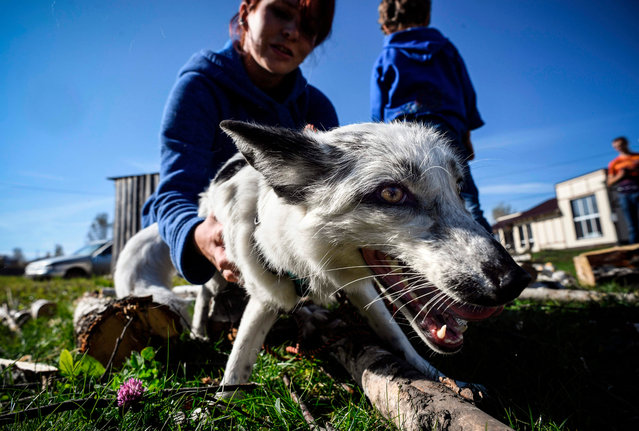
Tatyana Abramova, 33, plays with her home fox Plombir at her countryside house outside Siberian city of Novosibirsk on September 12, 2020. The official start of the Soviet experiment to better understand the domestication of animals by humans began in 1959, and was initiated by geneticists Dmitri Beliaiev and Lioudmila Trout on a farm in Akademgorodok, the scientific center of excellence in Siberia. Their primary objective was to domesticate foxes, to understand how the ancestor of wolves, another canine, evolved into a loyal and loving dog. And understand what this domestication tells us about the genetic evolution of species. (Photo by Alexander Nemenov/AFP Photo)

Tatyana Abramova, 33, plays with her home fox Plombir at her countryside house outside Siberian city of Novosibirsk on September 12, 2020. The official start of the Soviet experiment to better understand the domestication of animals by humans began in 1959, and was initiated by geneticists Dmitri Beliaiev and Lioudmila Trout on a farm in Akademgorodok, the scientific center of excellence in Siberia. Their primary objective was to domesticate foxes, to understand how the ancestor of wolves, another canine, evolved into a loyal and loving dog. And understand what this domestication tells us about the genetic evolution of species. (Photo by Alexander Nemenov/AFP Photo)
Details
25 Oct 2020 00:05:00
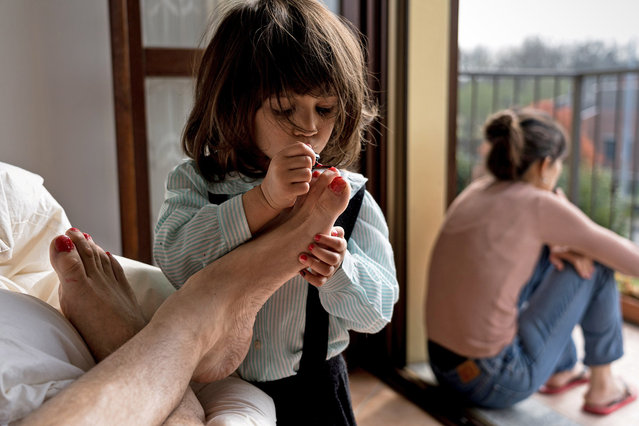
Life in lockdown: Schoolteacher Marzio Toniolo, 35, takes a picture of his two-year-old daughter Bianca painting his toenails as they while away time at home in San Fiorano, one of the original “red zone” towns in northern Italy that has now been extended to the whole country, as his wife, Bianca's mum Chiara Zuddas looks out from their balcony, March 20, 2020. Toniolo has been documenting how his family has dealt with being under quarantine since it began for them in February. (Photo by Marzio Toniolo via Reuters)

Life in lockdown: Schoolteacher Marzio Toniolo, 35, takes a picture of his two-year-old daughter Bianca painting his toenails as they while away time at home in San Fiorano, one of the original “red zone” towns in northern Italy that has now been extended to the whole country, as his wife, Bianca's mum Chiara Zuddas looks out from their balcony, March 20, 2020. Toniolo has been documenting how his family has dealt with being under quarantine since it began for them in February. (Photo by Marzio Toniolo via Reuters)
Details
09 Apr 2020 00:03:00
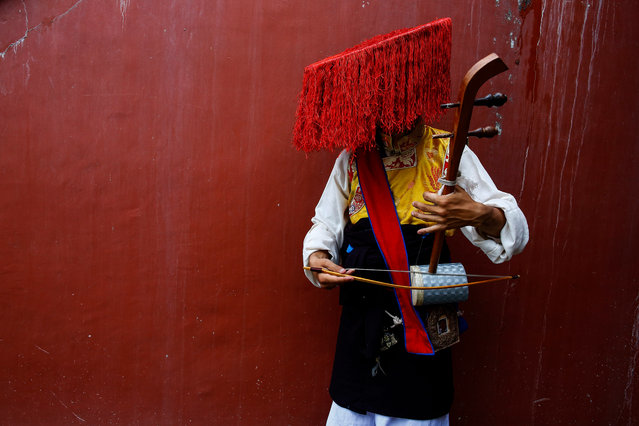
A Tibetan artists wearing a traditional costume waits before their performance during the 82nd pre-birthday celebration of Tibetan spiritual leader Dalai Lama at a Monastery in Kathmandu, Nepal, 05 July 2017. More than 1,000 monks and other Tibetans gathered at the Monastery compound to celebrate their spiritual leader's birthday. The Nepalese government has banned all kinds of Tibetan activities against the Chinese rule in Tibet so Tibetans have been changing the venue of the Dalai Lama's birthday celebration. The Dalai Lama will turn 82 on 06 July 2017. (Photo by Narendra Shrestha/EPA)

A Tibetan artists wearing a traditional costume waits before their performance during the 82nd pre-birthday celebration of Tibetan spiritual leader Dalai Lama at a Monastery in Kathmandu, Nepal, 05 July 2017. More than 1,000 monks and other Tibetans gathered at the Monastery compound to celebrate their spiritual leader's birthday. The Nepalese government has banned all kinds of Tibetan activities against the Chinese rule in Tibet so Tibetans have been changing the venue of the Dalai Lama's birthday celebration. The Dalai Lama will turn 82 on 06 July 2017. (Photo by Narendra Shrestha/EPA)
Details
10 Aug 2017 08:33:00
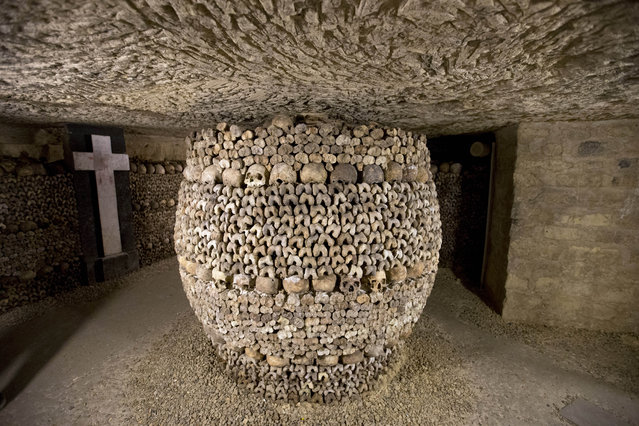
In this photo taken Tuesday, October 14, 2014, skulls and bones are stacked at the Catacombs in Paris, France. (Photo by Francois Mori/AP Photo)

In this photo taken Tuesday, October 14, 2014, skulls and bones are stacked at the Catacombs in Paris, France. The subterranean tunnels, stretching 2 kilometers (1.24 miles), cradle the bones of some 6 million Parisians from centuries past and once gave refuge to smugglers. The site used to close at 5 p.m., but is now staying open until 8 p.m. The change is mainly aimed at allowing more people to visit and reducing long lines, since it can only hold a limited number of people at a time and visits can't be reserved in advance. (Photo by Francois Mori/AP Photo)
Details
17 Oct 2014 13:27:00
Chicago: 35 photographs, 15 minutes. (Photo by Daniel Marker-Moors/Caters News)

A photographer is using a unique method to show the shift from day to night across famous cities in spectacular images. Daniel Marker-Moors' take on time-lapse photography – which he calls time slice – sees the photographer snap image after image, before combining them to create beautiful, vibrant works. His images usually focus on a point in the day with the most dramatic change in light, such as sunrise or sunset. Marker-Moors, from Los Angeles, begins by shooting hundreds and sometimes thousands of images from the same spot. Here: Chicago – 35 photographs, 15 minutes. (Photo by Daniel Marker-Moors/Caters News)
Details
21 Dec 2015 08:04:00


“Body blading (also known as buggy rollin') is an extreme sport that involves descending down a slope while wearing a flexible aerodynamic plastic roller suit that has wheels on the feet, knees, torso, and arms. This suit was created by Jean-Yves Blondeau, and he is one of the premier body bladers. Body blading is similar to roller blading, and in fact a body blader often starts out using the rollers on their feet in the same fashion as roller blades in order to gain initial speed, but then the rider generally assumes a position laying on the stomach facing down the hill. A body blader is capable of reaching very high speeds. Maneuverability is achieved by moving the body into various positions to change direction”. – Wikipedia

Photo: French designer Jean-Yves Blondeau demonstrates his “Buggy Rollin” suit during a performance on August 16, 2007 in Beijing, China. Blondeau is able to roll along in any position and can achieve high speeds wearing the suit. (Photo by China Photos/Getty Images)
Details
29 Jun 2011 11:00:00
Blind and visually impaired Palestinian students walk down the stairs at a school, where they are taught English through song and music, at a school in the West Bank city of Hebron March 2, 2016. (Photo by Ammar Awad/Reuters)

Blind and visually impaired Palestinian students walk down the stairs at a school, where they are taught English through song and music, at a school in the West Bank city of Hebron March 2, 2016. Palestinian students at a school for the blind in the West Bank are learning English through song, a welcome departure from using braille and memorising grammar rules. While students are delighted with the change, some parents in the religiously conservative town of Hebron are concerned that using music in the classroom jars with Islamic tradition. (Photo by Ammar Awad/Reuters)
Details
03 Mar 2016 11:20:00