Female members of police commando march during a ceremony on International Women's Day, at the police headquarters in Islamabad, Pakistan March 8, 2018. (Photo by Faisal Mahmood/Reuters)
A child puts his swimming goggles on before jumping in a public pool of spring water in Japakeh, Indonesia's Aceh province on March 22, 2024, during the World Water Day. (Photo by Chaideer Mahyuddin/AFP Photo)
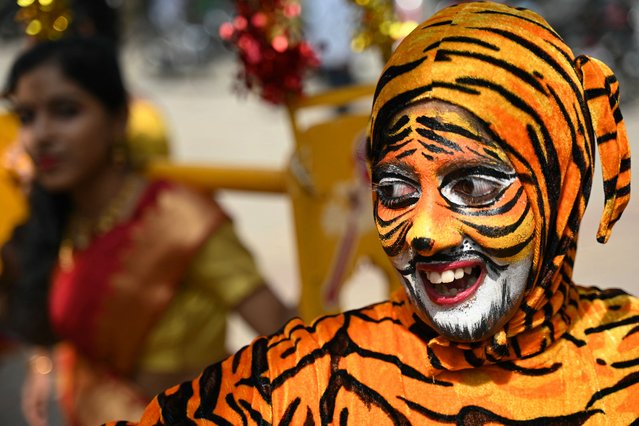
Students perform traditional dance as they take part in Pongal celebrations, the Tamil harvest festival, at a college in Chennai on January 10, 2024. (Photo by R. Satish Babu/AFP Photo)
“Michael Jackson, the performer, consistently transcended racial and gender perceptions; Michael Jackson tribute artists, impersonators and lookalikes reflect this in that they embody a wide span of inspiration and intention. The current crop of impersonators are people who take great care in their appearance – some spend a lot of money and time on their make up and clothing, while others are more concerned with the physical gestures associated with his dances while expressing very little concern in the creation of an illusion”. – Lorena Turner. (Photo and caption by Lorena Turner)
Locals dressed as “Perchten”, a traditional demonic creature in German and Austrian Alpine folklore, parade through the town center during the annual “Rauhnacht” gathering on January 5, 2017 in Waldkirchen, Germany. (Photo by Johannes Simon/Getty Images)
Japan's Naomi Osaka returns the ball during her match against Slovakia's Dominika Cibulkova during the Madrid Open tennis tournament, Sunday, May 5, 2019, in Madrid, Spain. (Photo by Andrea Comas/AP Photo)
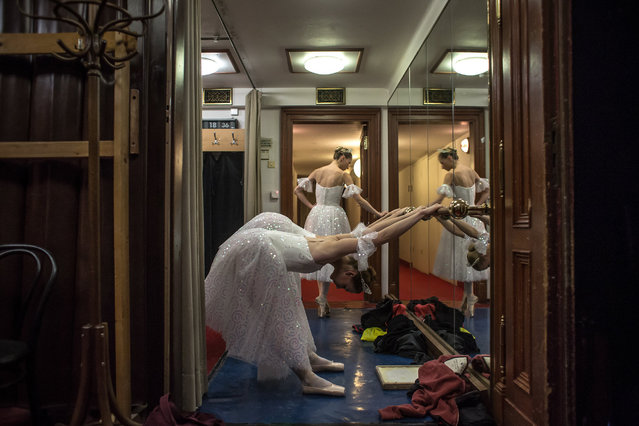
Dancers of the Czech National Ballet warm up backstage during a performance of “The Nutcracker – A Christmas Carol” at the National Theatre in Prague, Czech Republic, late 16 December 2017. Peter I. Tchaikovsky's “The Nutcracker”, one of his most famous compositions and seasonal ballets, premiered in St. Petersburg, Russia, on 18 December 1872, celebrates its 125th anniversary this year. (Photo by Martin Divisek/EPA/EFE)
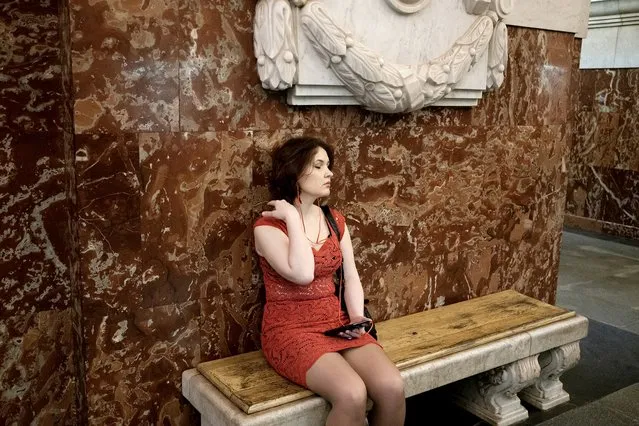
At the Krasnopresnenskaya station, the benches come from the Cathedral of Christ-Sauveur, which was built from 1839 to 1883 in memory of the victory of Russia against the army of Napoleon I. The cathedral was destroyed under Stalin in 1931, but the benches remained intact. Metro architects decided to install them in some stations. (Photo by Didier Bizet/The Washington Post)