Loading...
Done
Orthodox Christian pilgrims are baptized during Epiphany celebrations in the Jordan River

An Orthodox Christian child is baptized during Epiphany celebrations in the Jordan River January 19, 2012 at the Qasir al-Yahud baptismal site near Jericho, in the West Bank. Thousands of pilgrims gathered for the annual celebration at the site that the Eastern churches believes Jesus was baptised by John. (Photo by Uriel Sinai/Getty Images)
Details
23 Jan 2012 09:30:00
An iconic image of a younger Kate Moss. (Photo by Glen Luchford)

Over 160 photographs, costumes, illustrations and magazine covers will be displayed at Los Angeles' Getty Center, until October 21. The display features a century of art from 1911 through to 2011. The exhibition is free – with no tickets required – and will be displayed in the lower level of the museum's West Pavilion. Here: An iconic image of a younger Kate Moss. (Photo by Glen Luchford)
Details
29 Jun 2018 00:03:00
Israelis participate in a Zombie Walk during the Jewish holiday of Purim

Israelis participate in a “Zombie Walk” during the Jewish holiday of Purim on March 6, 2012 in Tel Aviv, Israel. The carnival-like Purim holiday is celebrated with parades and costume parties to commemorate the deliverance of the Jewish people from a plot to exterminate them in the ancient Persian empire 2,500 years ago, as described in the Book of Esther. (Photo by Uriel Sinai/Getty Images)
Details
07 Mar 2012 11:56:00


“The Trabant is a car that was produced by former East German auto maker VEB Sachsenring Automobilwerke Zwickau in Zwickau, Sachsen. It was the most common vehicle in East Germany, and was also exported to countries both inside and outside the communist bloc. The main selling points was that it had room for four adults and luggage in a compact, light and durable shell and that it was fast (when introduced) and durable. With its mediocre performance, smoky two-stroke engine, and production shortages, the Trabant is often cited as an example of the disadvantages of centralized planning; on the other hand, it is regarded with derisive affection as a symbol of the failed former East Germany and of the fall of communism (in former West Germany, as many East Germans streamed into West Berlin and West Germany in their Trabants after the opening of the Berlin Wall in 1989). It was in production without any significant changes for nearly 30 years with 3,096,099 Trabants produced in total”. – Wikipedia

Photo: Enthusiasts weared in uniforms of the former eastern german army trive in a military Trabant car as fans and owners of East German-era Trabant cars gather at the 2011 International Trabantfahrer Treffen (International Trabant Drivers Meeting) on June 26, 2011 in Zwickau, Germany. The Trabant, also known as the Trabi, was among the main cars produced in communist East Germany and built by VEB Sachsenring Automobilwerke in Zwickau for 30 years until 1989. Today the car has cult status for many followers and one company, IndiKar, is even seeking to revive the brand in a modern, electric version. (Photo by Carsten Koall/Getty Images)
Details
27 Jun 2011 12:21:00
Iraqi Kurds carry fire torches as they celebrate Nowruz Day, a festival marking the first day of spring, Kurdish and Persian New Year in Akre, Iraq on March 20, 2024. Newroz or Nowruz means “new day” in Persian, and is celebrated to mark the arrival of spring and the first day of the Iranian calendar. It is widely celebrated in Persian and neighboring regions and is recognized on UNESCO's Intangible Cultural Heritage of Human List. (Photo by Ismael Adnan/SOPA Images/Rex Features/Shutterstock)

Iraqi Kurds carry fire torches as they celebrate Nowruz Day, a festival marking the first day of spring, Kurdish and Persian New Year in Akre, Iraq on March 20, 2024. Newroz or Nowruz means “new day” in Persian, and is celebrated to mark the arrival of spring and the first day of the Iranian calendar. It is widely celebrated in Persian and neighboring regions and is recognized on UNESCO's Intangible Cultural Heritage of Human List. (Photo by Ismael Adnan/SOPA Images/Rex Features/Shutterstock)
Details
29 Mar 2024 05:30:00
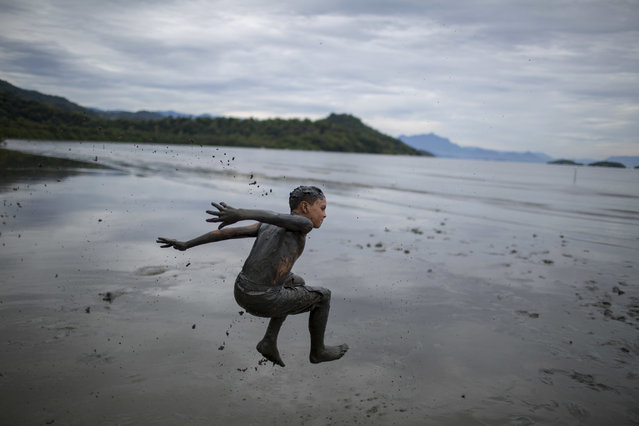
A boy jumps into a pool of mud during the traditional “Bloco da Lama” or “Mud Street” carnival party, in Paraty, Brazil, Saturday, February 25, 2017. Legend has it the “bloco” was born in 1986 after local teens hiking in a nearby mangrove forest smeared themselves with mud to discourage mosquitoes and then wandered through Paraty. The party grew year after year, but revelers eventually were banned from parading in the colonial downtown after shopkeepers complained pristine white walls were stained with the hard-to-remove mud. (Photo by Mauro Pimentel/AP Photo)

A boy jumps into a pool of mud during the traditional “Bloco da Lama” or “Mud Street” carnival party, in Paraty, Brazil, Saturday, February 25, 2017. Legend has it the “bloco” was born in 1986 after local teens hiking in a nearby mangrove forest smeared themselves with mud to discourage mosquitoes and then wandered through Paraty. The party grew year after year, but revelers eventually were banned from parading in the colonial downtown after shopkeepers complained pristine white walls were stained with the hard-to-remove mud. (Photo by Mauro Pimentel/AP Photo)
Details
28 Mar 2017 09:07:00
Vietnamese female traffic police officers march during a rehearsal for a military parade as part of the 40th anniversary of the fall of Saigon in southern Ho Chi Minh City (formerly Saigon City), Vietnam, on April 26, 2015. (Photo by Reuters/Kham)

Vietnamese female traffic police officers march during a rehearsal for a military parade as part of the 40th anniversary of the fall of Saigon in southern Ho Chi Minh City (formerly Saigon City), Vietnam, on April 26, 2015. Vietnam marks the 40th anniversary of the fall of Saigon on April 30, the event that ended a war that lasted over 30 years, killing up to four million Vietnamese, the Vietnamese government said, and more than 58,000 U.S troops, the U.S. Department of Defense has said. (Photo by Reuters/Kham)
Details
27 Apr 2015 10:11:00
Japanese craftsman Sumikazu Nakata writes the Chinese character of “victory”, which is a part of the phrase “Certain victory”, as he adds the final touches on a Daruma doll, which is believed to bring good luck, at his studio “Daimonya” in Takasaki, northwest of Tokyo November 23, 2014. (Photo by Yuya Shino/Reuters)

Japanese craftsman Sumikazu Nakata writes the Chinese character of “victory”, which is a part of the phrase “Certain victory”, as he adds the final touches on a Daruma doll, which is believed to bring good luck, at his studio “Daimonya” in Takasaki, northwest of Tokyo November 23, 2014. Daruma dolls, representing the Indian priest Bodhidharma, the founder of Zen Buddhism in China, is used to bring luck. It is also a favorite item of election candidates where they traditionally paint only one eye on the doll when they start their campaign and paint the other eye if they win in the election. (Photo by Yuya Shino/Reuters)
Details
24 Nov 2014 13:39:00