Loading...
Done
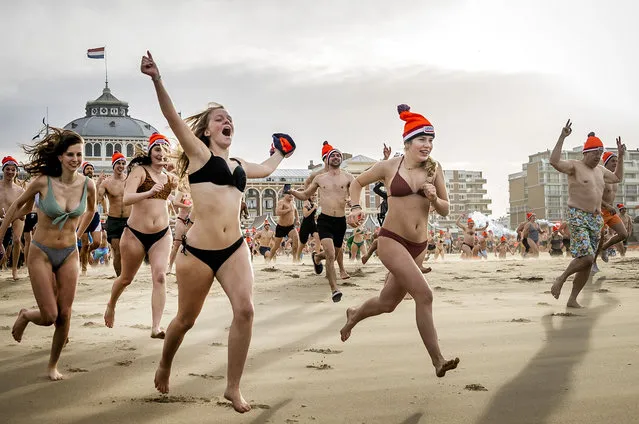
People run into the sea at the beach of Scheveningen on New Year's Day, Scheveningen, Netherlands, 01 January 2023. The traditional New Year's dive was resumed after the two previous editions were canceled due to the corona crisis. (Photo by Remko de Waal/EPA/EFE/Rex Features/Shutterstock)

People run into the sea at the beach of Scheveningen on New Year's Day, Scheveningen, Netherlands, 01 January 2023. The traditional New Year's dive was resumed after the two previous editions were canceled due to the corona crisis. (Photo by Remko de Waal/EPA/EFE/Rex Features/Shutterstock)
Details
08 Mar 2024 07:43:00
A People's Liberation Army (PLA) commando jumps through a fire hoop part of an exercise during an open day event at the Ngong Shuen Chau Barracks, the PLA navy base in the territory, in Hong Kong, China, 01 July 2015. Thousands of visitors attended the PLA open day yesterday and today to mark the 16th anniversary of the handover from British rule. (Photo by Jerome Favre/EPA)

A People's Liberation Army (PLA) commando jumps through a fire hoop part of an exercise during an open day event at the Ngong Shuen Chau Barracks, the PLA navy base in the territory, in Hong Kong, China, 01 July 2015. Thousands of visitors attended the PLA open day yesterday and today to mark the 16th anniversary of the handover from British rule. (Photo by Jerome Favre/EPA)
Details
02 Jul 2015 14:36:00
Migrants play soccer at makeshift camp in Via Cupa (Gloomy Street) in downtown Rome, Italy, August 2, 2016. Italy is taking in thousands of boat migrants every week for a third year in a row, and friction is common between them and those who live along the path many take on their journey towards northern Europe. Set up by volunteers, the Baobab centre, by Rome's Tiburtina train station, was shut down by police in December in the wake of the Paris attacks and because the European Union wants Italy to stop migrants from moving on, not help them to do so. B(Photo by Max Rossi/Reuters)

Migrants play soccer at makeshift camp in Via Cupa (Gloomy Street) in downtown Rome, Italy, August 2, 2016. Italy is taking in thousands of boat migrants every week for a third year in a row, and friction is common between them and those who live along the path many take on their journey towards northern Europe. (Photo by Max Rossi/Reuters)
Details
11 Aug 2016 14:31:00
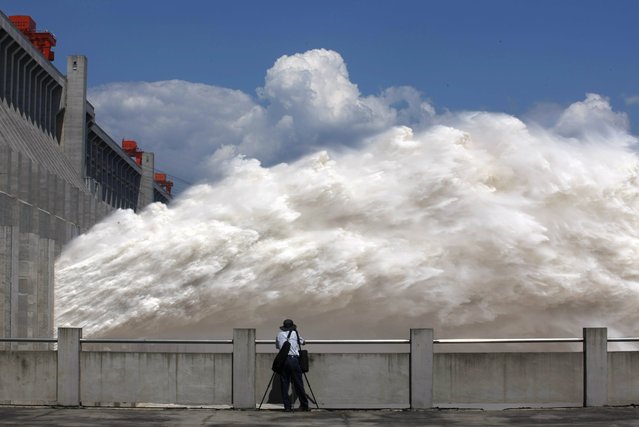
This picture taken on September 3, 2014 shows a man taking pictures of floodwater released from the Three Gorges Dam, a gigantic hydropower project on the Yangtze river, in Yichang, central China's Hubei province, after heavy downpours in the upper reaches of the dam caused the highest flood peak of the year. (Photo by AFP Photo/Stringer)

This picture taken on September 3, 2014 shows a man taking pictures of floodwater released from the Three Gorges Dam, a gigantic hydropower project on the Yangtze river, in Yichang, central China's Hubei province, after heavy downpours in the upper reaches of the dam caused the highest flood peak of the year. Eleven people died and 27 others are missing after torrential rains battered southwest China's Chongqing, a municipality in the upper reaches of the Three Gorges Dam, causing thousands of houses to collapse, state media said. (Photo by AFP Photo/Stringer)
Details
06 Sep 2014 12:02:00
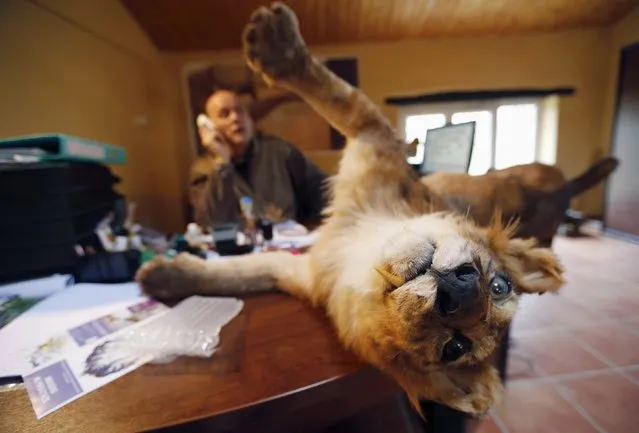
Belgian animal sculptor Emmanuel Janssens Casteels works at his desk next to a replica of a Smilodon, an extinct genus of machairodont felid, in his workshop in Prayssas December 3, 2014. Casteels' company OPHYS specializes in life-size reconstructions and the sculpting or moulding reproductions of animals and hyper-realist fossils. His reconstructions are exhibited in museums and theme parks. (Photo by Regis Duvignau/Reuters)

Belgian animal sculptor Emmanuel Janssens Casteels works at his desk next to a replica of a Smilodon, an extinct genus of machairodont felid, in his workshop in Prayssas December 3, 2014. Casteels' company OPHYS specializes in life-size reconstructions and the sculpting or moulding reproductions of animals and hyper-realist fossils. His reconstructions are exhibited in museums and theme parks. (Photo by Regis Duvignau/Reuters)
Details
05 Dec 2014 13:02:00
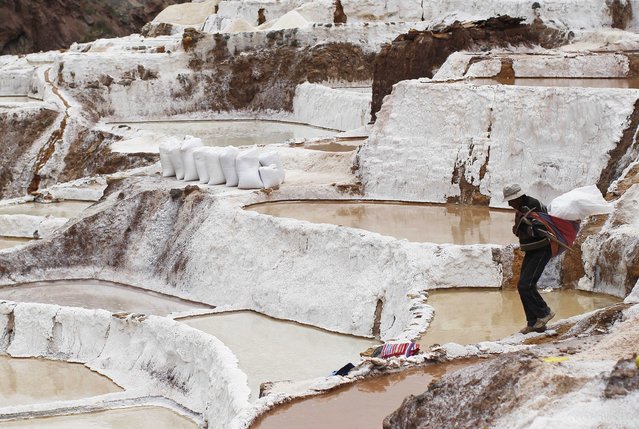
A worker carries a bag of salt after collecting it from a pond at the Maras mines in Cuzco December 3, 2014. Salt has been obtained in Maras since pre-Incan times by evaporating highly salty local subterranean stream water. The water is intricately channelled through constructions, flowing gradually down onto several hundred ancient terraced ponds. (Photo by Enrique Castro-Mendivil/Reuters)

A worker carries a bag of salt after collecting it from a pond at the Maras mines in Cuzco December 3, 2014. Salt has been obtained in Maras since pre-Incan times by evaporating highly salty local subterranean stream water. The water is intricately channelled through constructions, flowing gradually down onto several hundred ancient terraced ponds. From each pond, a local member of the mine cooperative can produce 150 to 200 kilos per month which can be sold in the markets at $0.34 per kilogram, according to miners. (Photo by Enrique Castro-Mendivil/Reuters)
Details
05 Dec 2014 13:36:00
A student attending a winter military camp reacts during a training session in Ansan, south of Seoul January 3, 2013. Hundreds of students between 11 and 17 years old attend winter boot camp training courses every year. The winter courses range from 4 to 14 days at the Blue Dragon Camp run by retired marines, which also offers summer boot camp for students

A student attending a winter military camp reacts during a training session in Ansan, south of Seoul January 3, 2013. Hundreds of students between 11 and 17 years old attend winter boot camp training courses every year. The winter courses range from 4 to 14 days at the Blue Dragon Camp run by retired marines, which also offers summer boot camp for students. (Photo by Kim Hong-Ji/Reuters)
Details
03 Jan 2013 12:28:00
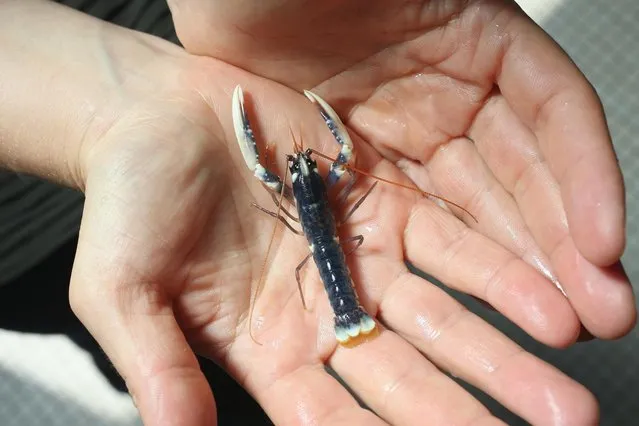
Isabel Schmalenbach, an environmental scientist with the Helgoland Biological Institute (Biologische Anstalt Helgoland), part of the Alfred Wegener Institute for Polar and Marine Research, holds a one-year old baby European lobster (Homarus gammarus) raised at the institute on August 3, 2013 on Helgoland Island, Germany. (Photo by Sean Gallup/Getty Images)

Isabel Schmalenbach, an environmental scientist with the Helgoland Biological Institute (Biologische Anstalt Helgoland), part of the Alfred Wegener Institute for Polar and Marine Research, holds a one-year old baby European lobster (Homarus gammarus) raised at the institute on August 3, 2013 on Helgoland Island, Germany. Later in the day Schmalenbach and her colleagues released a total of 415 one-year old lobsters into the North Sea as part of an effort to repopulate the lobster population around Helgoland (also called Heligoland). In the 19th century local fishermen caught up to 80,000 lobsters a year in the surrounding waters, combined with the heavy allied bombing of the island during and after World War II, as well as other environmental factors, decimated the lobster population. (Photo by Sean Gallup)

Details
05 Aug 2013 08:39:00