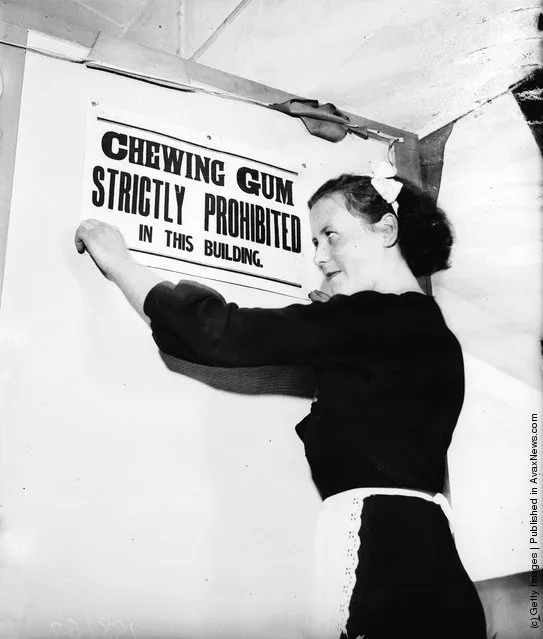
A Penarth dance hall has banned chewing gum on the premises because dancers have complained that their feet keep sticking to the floor. (Photo by Richards/Fox Photos/Getty Images). 16th July 1936
Sister Milly Wu (16) and Chloe Wu (18), both students from Manchester pose for photographs at the Hyper Japan 2012 Event at the Earls Court Exhibition Centre on February 24, 2012 in London, England. (Photo by Matthew Lloyd/Getty Images)
A girl carries her sibling as she walks through stranded flood water, following rains and floods during the monsoon season in Nowshera, Pakistan on September 4, 2022. (Photo by Fayaz Aziz/Reuters)
A person stands on a car while looking at Auroras, caused by a coronal mass ejection on the Sun, that illuminate the skies in the southwestern Siberian Omsk region, Russia on November 6, 2023. (Photo by Alexey Malgavko/Reuters)
“Tilt-shift photography” refers to the use of camera movements on small- and medium-format cameras, and sometimes specifically refers to the use of tilt for selective focus, often for simulating a miniature scene. Sometimes the term is used when the shallow depth of field is simulated with digital post processing; the name may derive from the tilt-shift lens normally required when the effect is produced optically.
Some artists want to convey some deep message through their art, while some are simply satisfied with shocking the audience. Roderique Arisiaman is the latter kind. Though his works do not play on the strings of our emotion, they can pique the interest with their flashy and sometimes humorous appearance. Many of his works have a zombie theme, and are surprisingly well done, especially the one where a man pushes his fingers through his cheek and into his eye. If given the chance, Roderique Arisiaman would probably do a great job of designing a poster for some zombie apocalypse movie. (Photo and caption by Roderique Arisiaman)
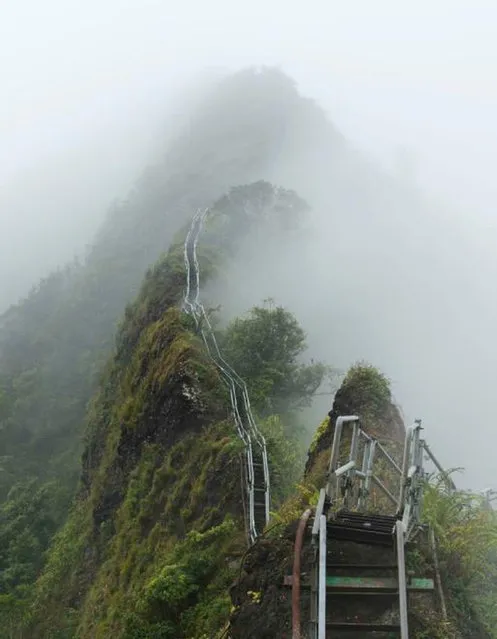
The Haʻikū Stairs, also known as the Stairway to Heaven or Haʻikū Ladder, is a steep hiking trail on the island of Oʻahu. The trail began as a wooden ladder spiked to the cliff on the south side of the Haʻikū Valley. It was installed in 1942 to enable antenna cables to be strung from one side of the cliffs above Haʻikū Valley to the other. A building to provide a continuous communication link between Wahiawā and Haʻikū Valley Naval Radio Station was constructed at the peak of Puʻukeahiakahoe, elevation about 2,800 feet (850 m). The antennae transmitted very low frequency radio signals from a 200,000-watt Alexanderson alternator in the center of Haʻikū valley. The signals could reach US Navy submarines as far away as Tokyo Bay while the submarines were submerged.
“These stunning ultra-high speed photos of water droplets were captured by photographer, Ronny Tertnes, 48, from Bergen, Norway. They show the water’s displacement as various liquids are being dropped in. Ronny, who works full time as an IT administrator, set up his camera and flash rigs to capture the exact moment a droplet hit the surface, sometimes causing several drops to collide into each other”. – TwoByTwoEditorial.co.uk. (Photo by Ronny Tertnes/TwoByTwoEditorial.co.uk)