Loading...
Done
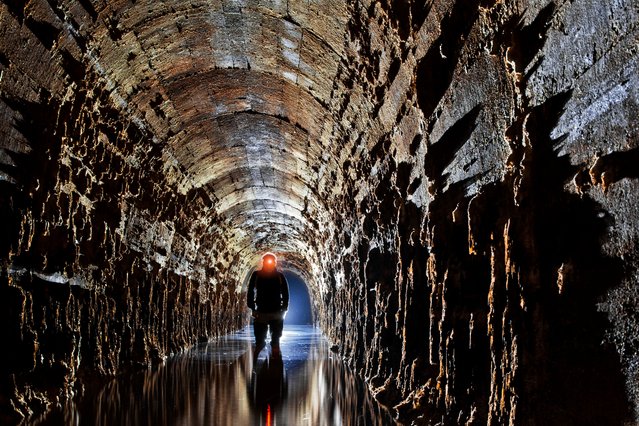
Regenwurmlager, Poland. The Regenwurmlager is an extensive underground fortification area constructed by Germany in 1920s-1940s, now in western Poland, near the city of Międzyrzecz. (Photo by Anna Arinova/Caters News)

Stunning silhouettes under European cities reveal the size and splendor of the continent’s urban foundations. Photographer and content-manager Anna Arinova, 28, from Moscow, captured the awe-inspiring labyrinths in Russia and Germany. Here: Regenwurmlager, Poland. The Regenwurmlager is an extensive underground fortification area constructed by Germany in 1920s-1940s, now in western Poland, near the city of Międzyrzecz. (Photo by Anna Arinova/Caters News)
Details
29 Dec 2016 07:53:00
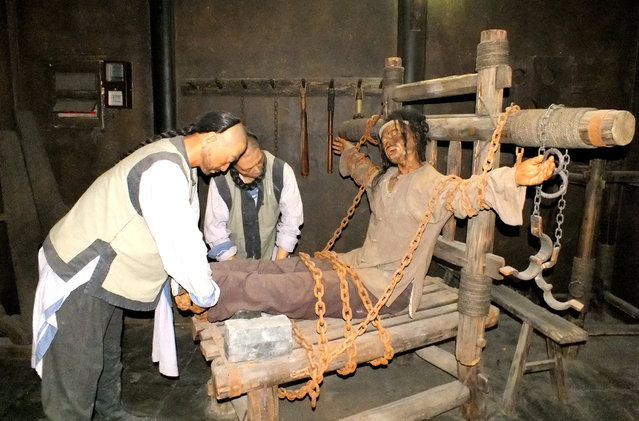
Wax figures with torture instrument named “torture-rack” are seen on October 25, 2014 in Huai'an, Jiangsu province of China. The exhibition, which opened last year at an educational center in the eastern city of Huai'an, includes reenactments of prisoners being hung over a fire, flayed and being tortured on what is known as a “Tiger Bench” – pictured above – a Qing dynasty (1644-1912) device that contorted victims' legs and arms in high pressure positions that could break bones or tear apart joints. (Photo by ChinaFotoPress)

Organizers of an exhibition of ancient instruments of torture in Huai'an, Jiangsu province, have suggested that children, heart disease patients and people with high blood pressure stay away because of the vivid depictions of shocking cruelty. The exhibition has more than 200 instruments of torture on display in the 50,000-square-meter exhibition halls of a restored ancient building. Wax figures, along with sound and light techniques, are incorporated for scary effect. The local government said the exhibition is for tourists and historians to research ancient torture practices. (Photo by ChinaFotoPress)
Details
29 Oct 2014 12:22:00
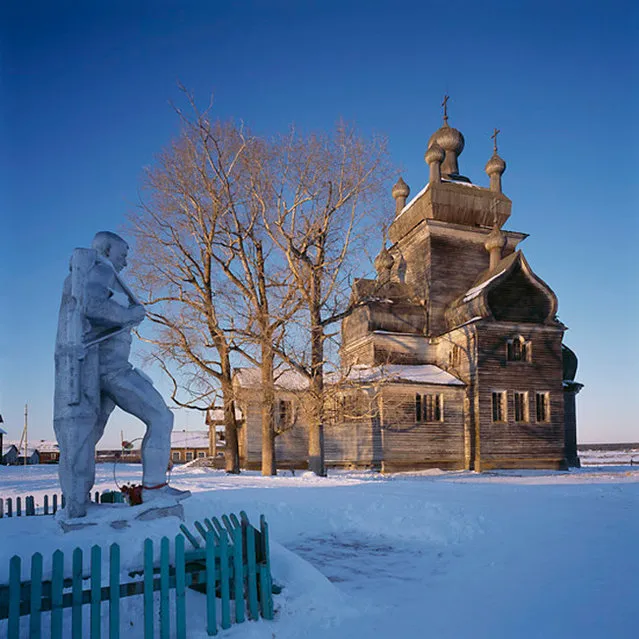
Wooden Churches - Travelling In The Russian North By Richard Davies Part 2

While communism, collectivism, worms, dry rot and casual looting failed to destroy the majestic wooden churches of Russia, it may be ordinary neglect that finally does them in. Dwindled now to several hundred remaining examples, these glories of vernacular architecture lie scattered amid the vastness of the world’s largest country. Just over a decade ago, Richard Davies, a British architectural photographer, struck out on a mission to record the fragile and poetic structures. Austerely beautiful and haunting, “Wooden Churches: Traveling in the Russian North” (White Sea Publishing; $132) is the result. Covering thousands of miles, Mr. Davies described how he and the writer Matilda Moreton tracked down the survivors from among the thousands of onion-domed structures built after Prince Vladimir converted to Christianity in 988.

See also: Wooden Churches Part1
Details
28 Nov 2013 12:13:00
Photo taken on September 19, 2015 shows a baby Brazilian opossum at the “Parque Estoril” zoo in Sao Bernardo do Campo of Sao Paulo, Brazil. According to local press, the “Parque Estoril” zoo houses currently 23 orphan cubs of wild animals rescued in the south region of Sao Paulo, victims of illegal wildlife trade or problems caused by urban growth. (Photo by Rahel Patrasso/Xinhua via ZUMA Wire)

Photo taken on September 19, 2015 shows a baby Brazilian opossum at the “Parque Estoril” zoo in Sao Bernardo do Campo of Sao Paulo, Brazil. According to local press, the “Parque Estoril” zoo houses currently 23 orphan cubs of wild animals rescued in the south region of Sao Paulo, victims of illegal wildlife trade or problems caused by urban growth. According to the zoo, all the animals arrived in the last three months, and many of them, not being able to be reintroduced to their natural habitat, will be used as examples in environmental education classes. (Photo by Rahel Patrasso/Xinhua via ZUMA Wire)
Details
26 Sep 2015 08:00:00

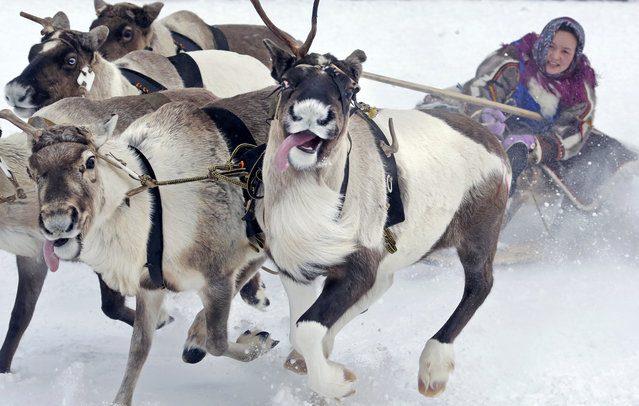
In this photo taken on Sunday, March 15, 2015, a Nenets woman rides steers a sled during a reindeer race at the Reindeer Herder's Day in the city of Nadym, in Yamal-Nenets Region, 2500 kilometers (about 1553 miles) northeast of Moscow, Russia. For the indigenous nomadic Nenets people, the Reindeer Herder's Day offers a chance to show their prowess in wrestling, high jumps and other traditional local sports, but, above all, reindeer races. (Photo by Dmitry Lovetsky/AP Photo)

In this photo taken on Sunday, March 15, 2015, a Nenets woman rides steers a sled during a reindeer race at the Reindeer Herder's Day in the city of Nadym, in Yamal-Nenets Region, 2500 kilometers (about 1553 miles) northeast of Moscow, Russia. For the indigenous nomadic Nenets people, the Reindeer Herder's Day offers a chance to show their prowess in wrestling, high jumps and other traditional local sports, but, above all, reindeer races. (Photo by Dmitry Lovetsky/AP Photo)
Details
24 Mar 2015 10:36:00
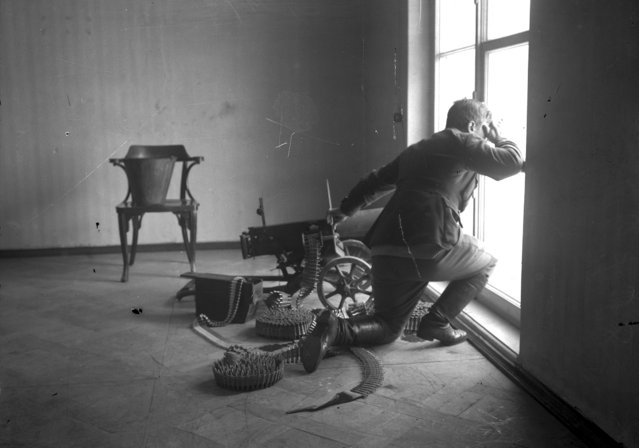
In this photo taken in October 1917, provided by Russian State Documentary Film and Photo Archive, a machine gunner looks through a window at his position near the Kremlin in Moscow, Russia. The 1917 Bolshevik Revolution was long before the digital revolution allowed anyone to instantly document events. But the clumsy cameras of the time still caught some images that capture the period's drama. (Photo by Russian State Documentary Film and Photo Archive via AP Photo)

In this photo taken in October 1917, provided by Russian State Documentary Film and Photo Archive, a machine gunner looks through a window at his position near the Kremlin in Moscow, Russia. The 1917 Bolshevik Revolution was long before the digital revolution allowed anyone to instantly document events. But the clumsy cameras of the time still caught some images that capture the period's drama. (Photo by Russian State Documentary Film and Photo Archive via AP Photo)
Details
06 Nov 2017 09:02:00
WWII veterans attend a ceremony to place tobacco pouches of soil from WWII mass graves of Red Army soldiers abroad, in the custody of the Central Armed Forces Museum in Moscow, Russia on March 6, 2020. The grave soil has been brought from Abkhazia, Germany, Kyrgyzstan, US, Ukraine, France, Estonia, Mongolia, Bulgaria, UK, Uzbekistan and South Ossetia. (Photo by Alexander Shcherbak/TASS)

WWII veterans attend a ceremony to place tobacco pouches of soil from WWII mass graves of Red Army soldiers abroad, in the custody of the Central Armed Forces Museum in Moscow, Russia on March 6, 2020. The grave soil has been brought from Abkhazia, Germany, Kyrgyzstan, US, Ukraine, France, Estonia, Mongolia, Bulgaria, UK, Uzbekistan and South Ossetia. (Photo by Alexander Shcherbak/TASS)
Details
02 Apr 2020 00:01:00
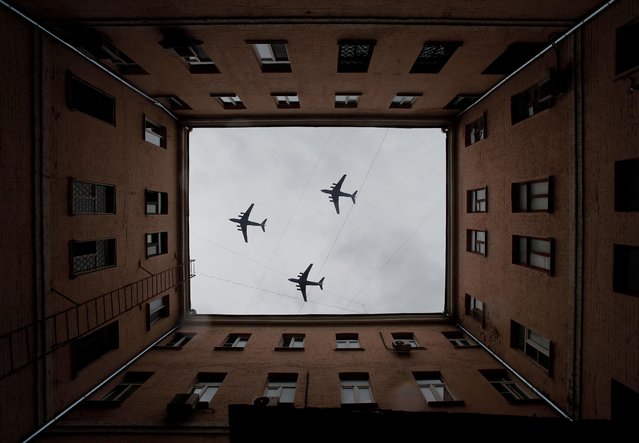
Russian Il-76 military transport aircrafts fly in formation during a rehearsal for the flypast, which marks the 75th anniversary of the victory over Nazi Germany in World War Two, in Moscow, Russia on May 4, 2020. The traditional large-scale Victory Day military parade across Red Square was postponed due to the outbreak of the coronavirus disease (COVID 19). (Photo by Maxim Shemetov/Reuters)

Russian Il-76 military transport aircrafts fly in formation during a rehearsal for the flypast, which marks the 75th anniversary of the victory over Nazi Germany in World War Two, in Moscow, Russia on May 4, 2020. The traditional large-scale Victory Day military parade across Red Square was postponed due to the outbreak of the coronavirus disease (COVID 19). (Photo by Maxim Shemetov/Reuters)
Details
22 May 2020 00:01:00