Loading...
Done
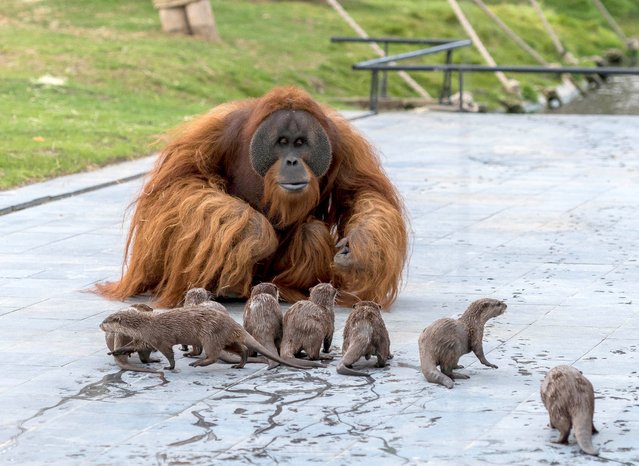
The three orangutans at Pairi Daiza zoo, Belgium, developed a “special bond” with the otters after their river was run through the ape enclosure on March 2020. The zoo said it enriched both species’ environments. An animal – and this is even more the case of orangutans, with whom humans share 97 per cent of their DNA – must be entertained, occupied, challenged and kept busy mentally, emotionally and physically at all times. (Photo by Pascale Jones/The Sun)

The three orangutans at Pairi Daiza zoo, Belgium, developed a “special bond” with the otters after their river was run through the ape enclosure on March 2020. The zoo said it enriched both species’ environments. An animal – and this is even more the case of orangutans, with whom humans share 97 per cent of their DNA – must be entertained, occupied, challenged and kept busy mentally, emotionally and physically at all times. (Photo by Pascale Jones/The Sun)
Details
05 Apr 2020 00:01:00
Syrian refugee boys play with toy guns at Eminonu district in Istanbul, Turkey, 08 January 2019. (Photo by Sedat Suna/EPA/EFE)

Syrian refugee boys play with toy guns at Eminonu district in Istanbul, Turkey, 08 January 2019. (Photo by Sedat Suna/EPA/EFE)
Details
22 Feb 2019 00:03:00
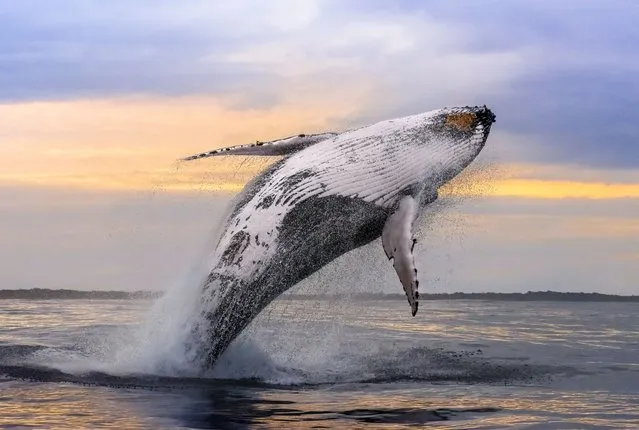
A 40-tonne humpback launching out of the water in an incredible breach in New South Wales, Australia on October 2022 in front of a sunset. The humpback whale can grow up to 56 feet long and typically covers 9,900 miles a year as it travels through the oceans of the world. Humpback whales are a species of Baleen whale, meaning they don't have teeth. Instead, they have baleen which helps them to filter feed. Their main source of food is krill or tiny bait fish. (Photo by Jodie Lowe/Media Drum Images)

A 40-tonne humpback launching out of the water in an incredible breach in New South Wales, Australia on October 2022 in front of a sunset. The humpback whale can grow up to 56 feet long and typically covers 9,900 miles a year as it travels through the oceans of the world. Humpback whales are a species of Baleen whale, meaning they don't have teeth. Instead, they have baleen which helps them to filter feed. Their main source of food is krill or tiny bait fish. (Photo by Jodie Lowe/Media Drum Images)
Details
30 Oct 2022 04:28:00
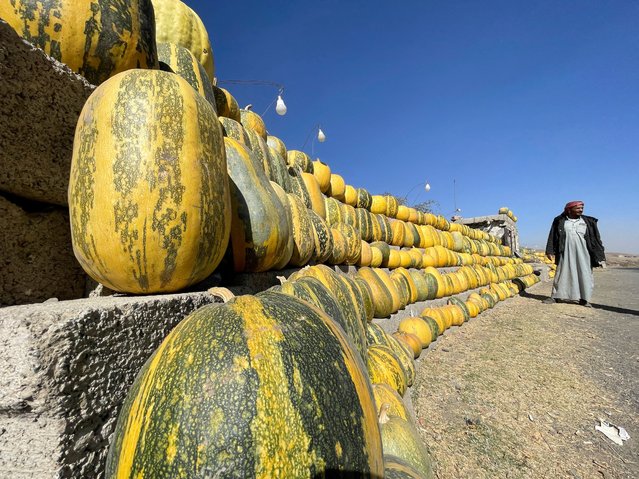
A farmer stands near pumpkins on display on the side of a road near Sanaa, Yemen on February 15, 2025. (Photo by Khaled Abdullah/Reuters)

A farmer stands near pumpkins on display on the side of a road near Sanaa, Yemen on February 15, 2025. (Photo by Khaled Abdullah/Reuters)
Details
24 Mar 2025 03:27:00
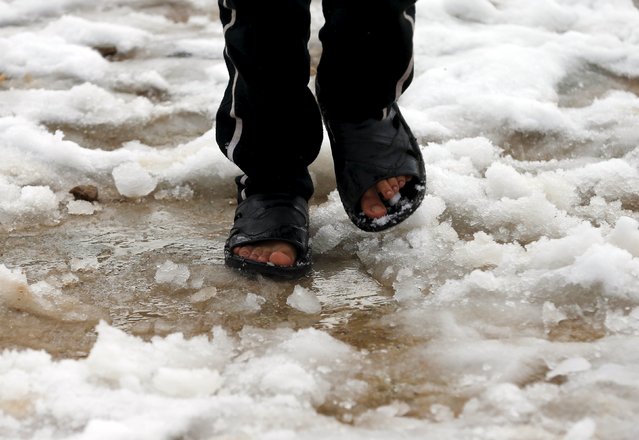
A Syrian youth Khaled from Raqqa walks on snow wearing slippers in the Bekaa Valley refugee camp in Lebanon after the first heavy snow storm hit Lebanon, January 3, 2016. (Photo by Jamal Saidi/Reuters)

A Syrian youth Khaled from Raqqa walks on snow wearing slippers in the Bekaa Valley refugee camp in Lebanon after the first heavy snow storm hit Lebanon, January 3, 2016. (Photo by Jamal Saidi/Reuters)
Details
05 Jan 2016 08:05:00
Russian Police academy female cadets march during a rehearsal for the Victory Day military parade at Dvortsovaya (Palace) Square in St Petersburg, Russia, Wednesday, May 7, 2014. Victory Day, marking the defeat of Nazi Germany, is Russia's most important secular holiday celebrated on May 9. (Photo by Dmitry Lovetsky/AP Photo)

Russian Police academy female cadets march during a rehearsal for the Victory Day military parade at Dvortsovaya (Palace) Square in St Petersburg, Russia, Wednesday, May 7, 2014. Victory Day, marking the defeat of Nazi Germany, is Russia's most important secular holiday celebrated on May 9. (Photo by Dmitry Lovetsky/AP Photo)
Details
10 May 2014 14:49:00
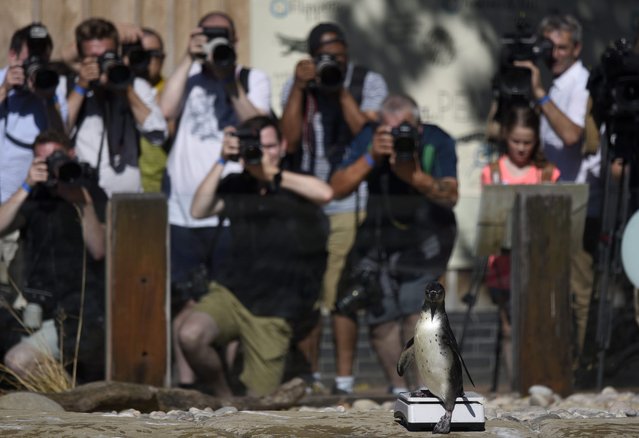
A Humboldt penguin stands on weighing scales whilst being photographed by members of the press during a photocall at the annual weigh-in at London Zoo in London, Britain, 24 August 2016. Every animal that is in the zoo is weighed and measured and the statistics recorded so the data can be shared with zoos across the world. (Photo by Hannah McKay/EPA)

A Humboldt penguin stands on weighing scales whilst being photographed by members of the press during a photocall at the annual weigh-in at London Zoo in London, Britain, 24 August 2016. Every animal that is in the zoo is weighed and measured and the statistics recorded so the data can be shared with zoos across the world. (Photo by Hannah McKay/EPA)
Details
25 Aug 2016 10:06:00
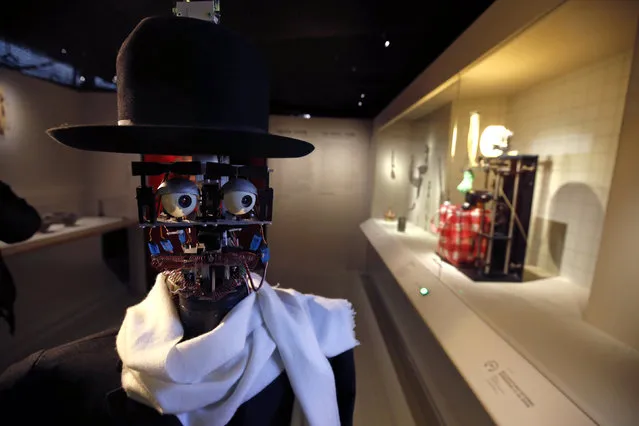
The Berenson robot strolls among visitors during the exhibition “Persona : Oddly Human” at the Quai Branly museum in Paris, France, February 23, 2016. The Berenson robot, developed in France in 2011, is the brainchild of anthropologist Denis Vidal and robotics engineer Philippe Gaussier. Its programming allows it to record reactions of museum visitors to certain pieces of art and then use the data to develop its own unique taste, which allows “Berenson” to judge whether or not it likes a certain work of art within an exhibition. (Photo by Philippe Wojazer/Reuters)

The Berenson robot strolls among visitors during the exhibition “Persona : Oddly Human” at the Quai Branly museum in Paris, France, February 23, 2016. The Berenson robot, developed in France in 2011, is the brainchild of anthropologist Denis Vidal and robotics engineer Philippe Gaussier. Its programming allows it to record reactions of museum visitors to certain pieces of art and then use the data to develop its own unique taste, which allows “Berenson” to judge whether or not it likes a certain work of art within an exhibition. (Photo by Philippe Wojazer/Reuters)
Details
25 Feb 2016 12:26:00