Loading...
Done
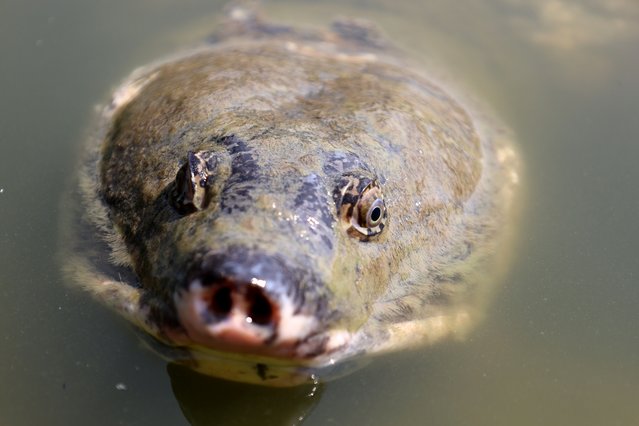
Black softshell turtle or Bostami turtle (Nilssonia nigricans), extremely rare and critically endangered species of tortoise is seen in a pond in Chittagong, Bangladesh on March 1, 2022. For decades, the breeding grounds have shrunk and their habitat has been threatened by habitat pollution. Through conservation methods and protection of the species, some of these turtles can be found today throughout the wild, and scientists and environmental biologists are continuing to work hard to preserve this endangered species and their natural habitat. (Photo by Mohammad Shajahan/Anadolu Agency via Getty Images)

Black softshell turtle or Bostami turtle (Nilssonia nigricans), extremely rare and critically endangered species of tortoise is seen in a pond in Chittagong, Bangladesh on March 1, 2022. For decades, the breeding grounds have shrunk and their habitat has been threatened by habitat pollution. (Photo by Mohammad Shajahan/Anadolu Agency via Getty Images)
Details
26 May 2024 04:02:00
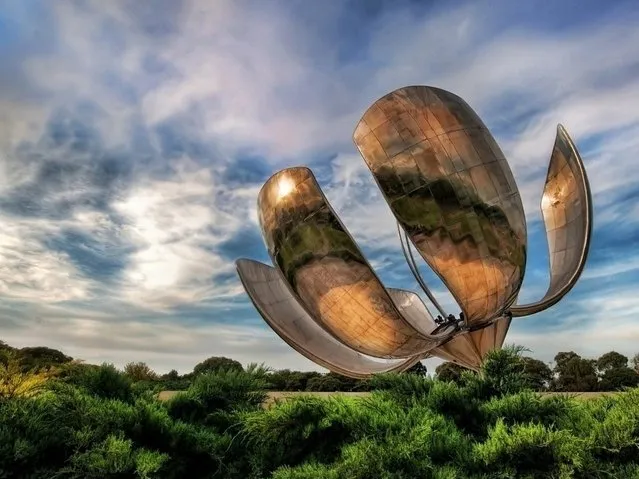
Floralis Generica - Buenos Aires

Floralis Genérica is a sculpture made of steel and aluminum located in Plaza de las Naciones Unidas, Avenida Figueroa Alcorta, Buenos Aires, a gift to the city by the Argentine architect Eduardo Catalano. Catalano once said that the flower "is a synthesis of all the flowers and is both a hope that is reborn every day to open." It was created in 2002. The sculpture moves closing its petals in the evening and opening them in the morning, although this mechanism is currently disabled. The sculpture is located in the center of a park of four acres of wooded boundaries, surrounded by paths that get closer and provide different perspectives of the monument, and placed above a reflecting pool, which apart from fulfilling its aesthetic function, protects it. It represents a large flower made of stainless steel with aluminum skeleton and reinforced concrete, which looks at the sky, extending to it its six petals. Weighs eighteen tons and is 23 meters high.
Details
20 Oct 2013 18:32:00
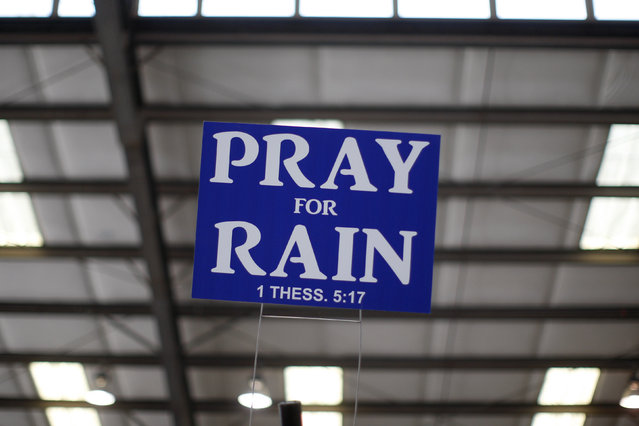
A sign advising to pray for rain hangs above an exhibit area at the 47th Annual World Ag Expo in Tulare, February 12, 2014. (Photo by David McNew/Reuters)

A sign advising to pray for rain hangs above an exhibit area at the 47th Annual World Ag Expo in Tulare, February 12, 2014. About a hundred years ago, when urban water systems were being developed throughout the state, the city of Sacramento wrote protections from metering into its charter, vowing that residents would always have the right to use as much water as they needed. But on Tuesday, the state's top water regulators released a framework for enforcing California's first statewide mandatory restrictions on urban water use – cuts of 25 percent for non-agricultural users ordered last week by Democratic Governor Jerry Brown as a devastating drought enters its fourth year. (Photo by David McNew/Reuters)
Details
09 Apr 2015 13:16:00
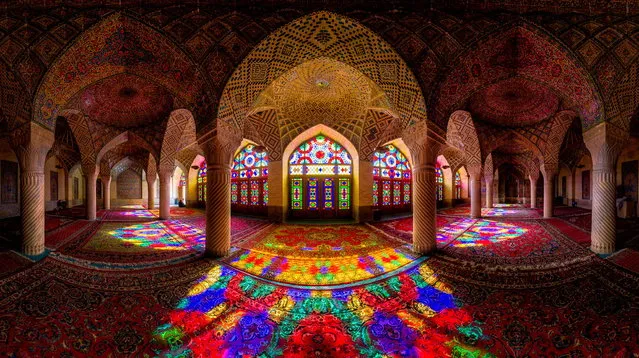
The Nasir Al-Mulk Mosque

The Nasīr al-Mulk Mosque or Pink Mosque is a traditional mosque in Shiraz, Iran, located in Goade-e-Araban place (near the famous Shah Cheragh mosque). The mosque was built during the Qājār era, and is still in use under protection by Nasir al Mulk's Endowment Foundation. It was built by the order of Mirza Hasan Ali Nasir al Molk, one of the lords of the Qajar Dynasty, in 1876 and was finished in 1888. The designers were Muhammad Hasan-e-Memar and Muhammad Reza Kashi Paz-e-Shirazi. The mosque extensively uses colored glass in its facade, and displays other traditional elements such as panj kāseh-i (five concaves) in its design, it is also named in popular culture as Pink Mosque due to the usage of beautiful pink color tiles for its interior design.
Details
26 Mar 2014 14:04:00
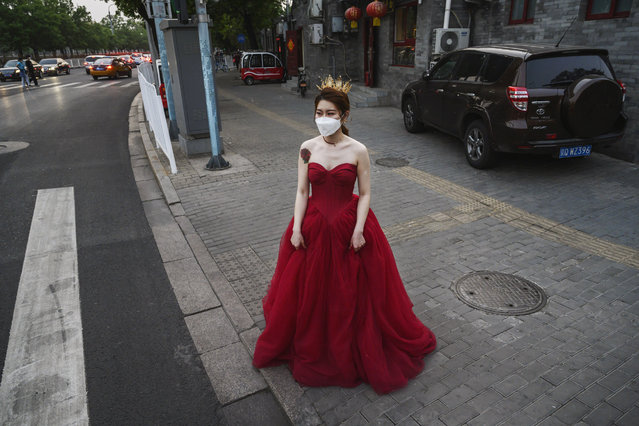
A Chinese woman wears her dress and a protective mask as she waits to change after taking pictures in advance of her wedding near the Forbidden City, on April 30, 2020 in Beijing, China. Beijing lowered its risk level after more than three months Thursday in advance of the May holiday, allowing most domestic travellers arriving in the city to do so without having to do 14 days of quarantine. The Forbidden City will open to a limited number of visitors as of Thursday morning. After decades of growth, officials said China's economy had shrunk in the latest quarter due to the impact of the coronavirus epidemic. The slump in the world's second largest economy is regarded as a sign of difficult times ahead for the global economy. While industrial sectors in China are showing signs of reviving production, a majority of private companies are operating at only 50% capacity, according to analysts. With the pandemic hitting hard across the world, officially the number of coronavirus cases in China is dwindling, ever since the government imposed sweeping measures to keep the disease from spreading. Officials believe the worst appears to be over in China, though there are concerns of another wave of infections as the government attempts to reboot the world's second largest economy. Since January, China has recorded more than 81,000 cases of COVID-19 and at least 3,200 deaths, mostly in and around the city of Wuhan, in central Hubei province, where the outbreak first started. (Photo by Kevin Frayer/Getty Images)

A Chinese woman wears her dress and a protective mask as she waits to change after taking pictures in advance of her wedding near the Forbidden City, on April 30, 2020 in Beijing, China. Beijing lowered its risk level after more than three months Thursday in advance of the May holiday, allowing most domestic travellers arriving in the city to do so without having to do 14 days of quarantine. (Photo by Kevin Frayer/Getty Images)
Details
03 May 2020 00:07:00
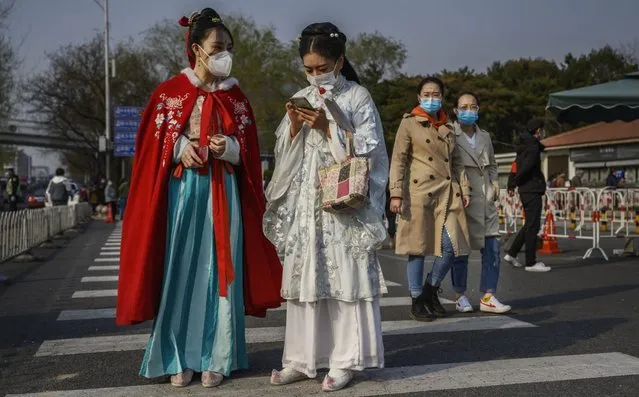
Chinese women wear protective masks as they are dressed in traditional clothing from the Qing Dynasty era outside a park on March 29, 2020 in Beijing, China. A limited section of the iconic tourist site was re-opened to the public this week allowing a smaller number of visitors to reserve tickets online in advance and to enter after passing health screening. With the pandemic hitting hard across the world, China recorded its first day with no new domestic cases of the coronavirus last week, since the government imposed sweeping measures to keep the disease from spreading. For two months, millions of people across China have been restricted in how they move from their homes, while other cities have been locked down in ways that appeared severe at the time but are now being replicated in other countries trying to contain the virus. Officials believe the worst appears to be over in China, though there are concerns of another wave of infections as the government attempts to reboot the worlds second largest economy. In Beijing, it is mandatory to wear masks outdoors, retail stores operate on reduced hours, restaurants employ social distancing among patrons, and tourist attractions at risk of drawing large crowds remain closed. Monitoring and enforcement of virus-related measures and the quarantine of anyone arriving to Beijing is carried out by neighborhood committees and a network of Communist Party volunteers who wear red arm bands. A primary concern for Chinese authorities remains the arrival of flights from Europe and elsewhere, given the exposure of passengers in regions now regarded as hotbeds for transmission. Since January, China has recorded more than 81,000 cases of COVID-19 and at least 3200 deaths, mostly in and around the city of Wuhan, in central Hubei province, where the outbreak first started. (Photo by Kevin Frayer/Getty Images)

Chinese women wear protective masks as they are dressed in traditional clothing from the Qing Dynasty era outside a park on March 29, 2020 in Beijing, China. A limited section of the iconic tourist site was re-opened to the public this week allowing a smaller number of visitors to reserve tickets online in advance and to enter after passing health screening. (Photo by Kevin Frayer/Getty Images)
Details
01 Apr 2020 00:05:00
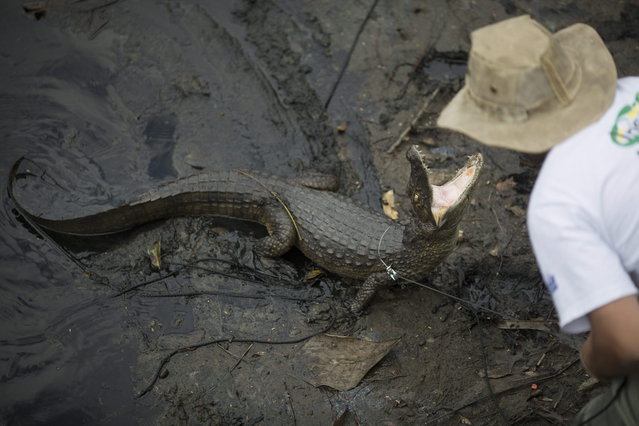
In this October 14, 2013 photo, ecology professor Ricardo Freitas catches a broad-snouted caiman to examine, then release back into the water channel in the affluent Recreio dos Bandeirantes suburb of Rio de Janeiro, Brazil. (Photo by Felipe Dana/AP Photo)

In this October 14, 2013 photo, ecology professor Ricardo Freitas catches a broad-snouted caiman to examine, then release back into the water channel in the affluent Recreio dos Bandeirantes suburb of Rio de Janeiro, Brazil. Caimans are like tanks, a very old species with a remarkable capacity for renovation that allows them to survive under extreme conditions where others couldn't, said Freitas, who runs the Instituto Jacare, or the Caiman Institute, which aims to protect the reptiles. (Photo by Felipe Dana/AP Photo)
Details
18 Oct 2013 09:05:00
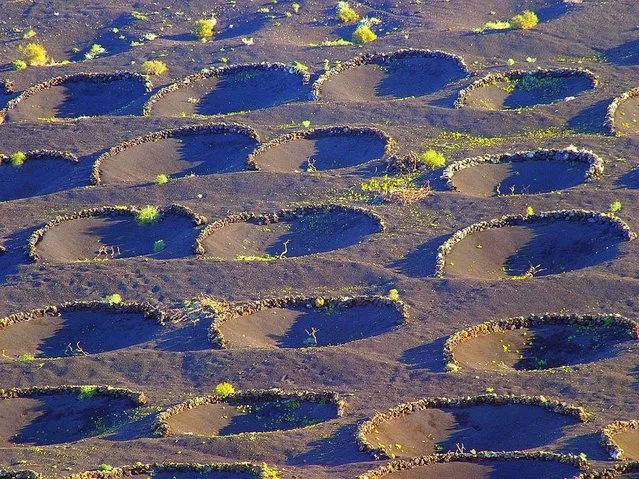
Grapes Born of Volcano In Lanzarote, Spanish

The valley of La Geria, which has been declared a 'Protected Area', is Lanzarote’s main wine-growing region, occupying about 20 square miles (52 square kilometres) and stretching on both sides of the road from Masdache to Uga and right up to the volcanic slopes. This area produces most of Lanzarote’s excellent wines, of which 75 per cent are made from the Malvasía grape, one of the oldest known grape varieties. Best known as a honey-coloured, very sweet wine with a rich flavour, already praised by Shakespeare hundreds of years ago, today the Malvasía grape produces a wide variety of quality white, red or rosé wines, from very sweet to very dry.
Details
31 Oct 2013 09:10:00