Loading...
Done
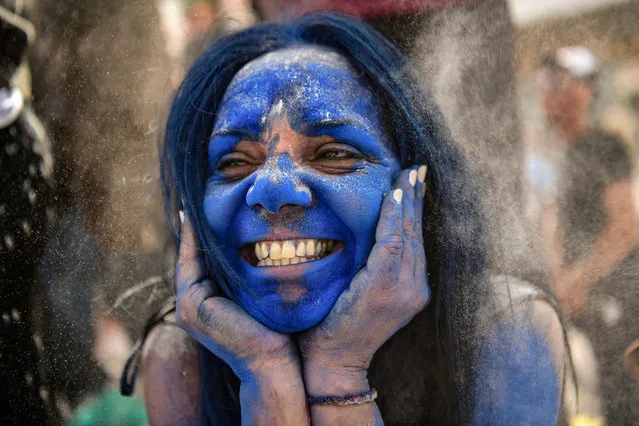
A reveller reacts amid a “flour war” during the “Ash Monday” celebrations, a traditional festivity marking the end of the carnival season and the start of the 40-day Lent period until the Orthodox Easter, in the port town of Galaxidi, Greece, on March 11, 2019. (Photo by Aris Messinis/AFP Photo)

A reveller reacts amid a “flour war” during the “Ash Monday” celebrations, a traditional festivity marking the end of the carnival season and the start of the 40-day Lent period until the Orthodox Easter, in the port town of Galaxidi, Greece, on March 11, 2019. (Photo by Aris Messinis/AFP Photo)
Details
13 Mar 2019 00:07:00
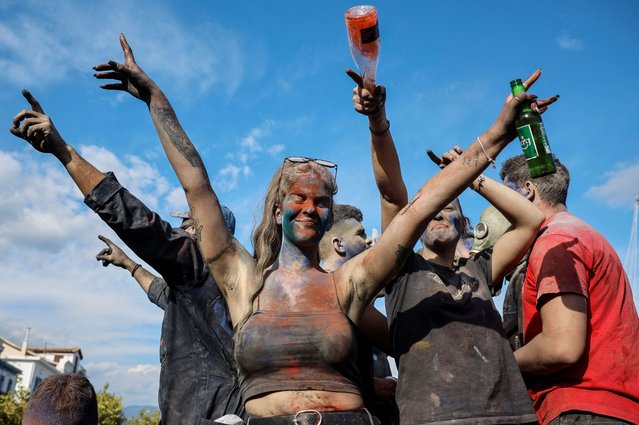
Revellers participate in a colourful “flour war”, celebrating the “Ash Monday” or “Clean Monday”, a traditional festivity marking the end of the carnival season and the start of the 40-day Lent period until the Orthodox Easter, in the town of Galaxidi, Greece, on March 18, 2024. (Photo by Louisa Gouliamaki/Reuters)

Revellers participate in a colourful “flour war”, celebrating the “Ash Monday” or “Clean Monday”, a traditional festivity marking the end of the carnival season and the start of the 40-day Lent period until the Orthodox Easter, in the town of Galaxidi, Greece, on March 18, 2024. (Photo by Louisa Gouliamaki/Reuters)
Details
12 Jun 2025 03:41:00
A follower of the Afro-Brazilian religion Umbanda pays tribute for Iemanja, goddess of the sea, in Copacabana Beach in Rio de Janeiro, Brazil December 29, 2017. (Photo by Ricardo Moraes/Reuters)

A follower of the Afro-Brazilian religion Umbanda pays tribute for Iemanja, goddess of the sea, in Copacabana Beach in Rio de Janeiro, Brazil December 29, 2017. Hundreds of practitioners of Brazil's Afro-Brazilian Candomble and Umbanda faiths have gathered at Rio de Janeiro's Copacabana beach to honor Yemanja. Worshippers were mostly dressed in white as they launched their offerings to Iemanja: small boats with flowers and bowls with candles and fruits. (Photo by Ricardo Moraes/Reuters)
Details
30 Dec 2017 06:22:00
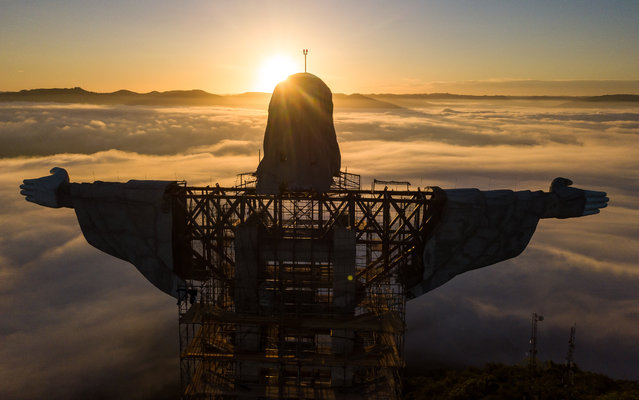
Aerial view of Christ The Protector Statue at sunrise on April 21, 2021 in Encantado, Brazil. The statue under construction in Encantado, Southern Brazil, will be named Cristo the Protector and will surpass the iconic Christ The Redeemer of Rio de Janeiro by five meters. Made of steel and concrete, it will stand 43 meters including its pedestal, and become the third-tallest statue of Jesus Christ in the world. (Photo by Buda Mendes/Getty Images)

Aerial view of Christ The Protector Statue at sunrise on April 21, 2021 in Encantado, Brazil. The statue under construction in Encantado, Southern Brazil, will be named Cristo the Protector and will surpass the iconic Christ The Redeemer of Rio de Janeiro by five meters. Made of steel and concrete, it will stand 43 meters including its pedestal, and become the third-tallest statue of Jesus Christ in the world. (Photo by Buda Mendes/Getty Images)
Details
22 Apr 2021 10:10:00
A health worker applies a dose of the AstraZeneca vaccine during the first day of a three-day COVID-19 vaccination campaign for people over age 35 in the Complexo da Maré favela of Rio de Janeiro, Brazil, Brazil, Thursday, July 29, 2021. Some recipients will be monitored to study the rate of protection the vaccines provide and the extent to which virus variants are circulating. (Photo by Bruna Prado/AP Photo)

A health worker applies a dose of the AstraZeneca vaccine during the first day of a three-day COVID-19 vaccination campaign for people over age 35 in the Complexo da Maré favela of Rio de Janeiro, Brazil, Brazil, Thursday, July 29, 2021. Some recipients will be monitored to study the rate of protection the vaccines provide and the extent to which virus variants are circulating. (Photo by Bruna Prado/AP Photo)
Details
30 Jul 2021 09:31:00
A woman with a sign that reads in Portuguese “Being woman without Temer”, stands next to a police barricade during a protest against the gang rape of a 16-year-old girl in Sao Paulo, Brazil, Wednesday, June 1, 2016. In response to the assault, Brazil's interim President Michel Temer said that the country will set up a specialized group to fight violence against women. (Photo by Andre Penner/AP Photo)

A woman with a sign that reads in Portuguese “Being woman without Temer”, stands next to a police barricade during a protest against the gang rape of a 16-year-old girl in Sao Paulo, Brazil, Wednesday, June 1, 2016. In response to the assault, Brazil's interim President Michel Temer said that the country will set up a specialized group to fight violence against women. (Photo by Andre Penner/AP Photo)
Details
03 Jun 2016 13:05:00
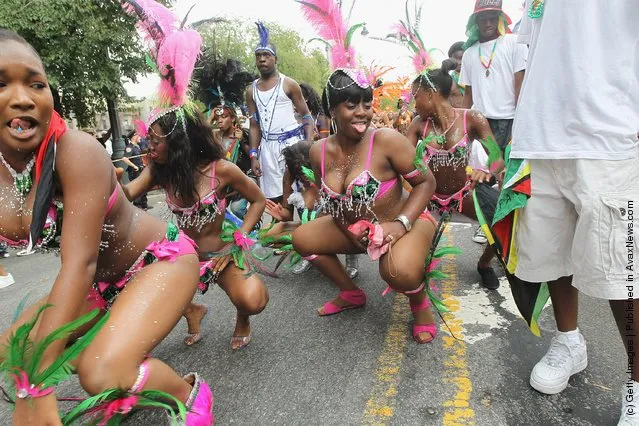
New Yorkers Celebrate At West Indian Day Parade

“The Labor Day Parade (or West Indian Carnival), is an annual celebration held on American Labor Day (the first Monday in September), in Crown Heights, Brooklyn, New York. Ms. Jessie Waddell and some of her West Indian friends started the Carnival in Harlem in the 1920s by staging costume parties in large enclosed places like the Savoy, Renaissance and Audubon Ballrooms due to the cold wintry weather of February. This is the usual time for the pre-Lenten celebrations held in most countries around the world. However, because of the very nature of Carnival, and the need to parade in costume to music, indoor confinement did not work well. The earliest known Carnival street parade was held on September 1, 1947. The Trinidad Carnival Pageant Committee was the founding force behind the parade, which was held in Harlem. The parade route was along Seventh Avenue, starting at 110th St.” – Wikipedia

Photo: A reveler looks on during the West Indian-American Day Parade September 5, 2011 in the Brooklyn borough of New York City. More than 2 million spectators were expected to attend the celebration of Caribbean culture. (Photo by Mario Tama/Getty Images)

Details
06 Sep 2011 11:18:00
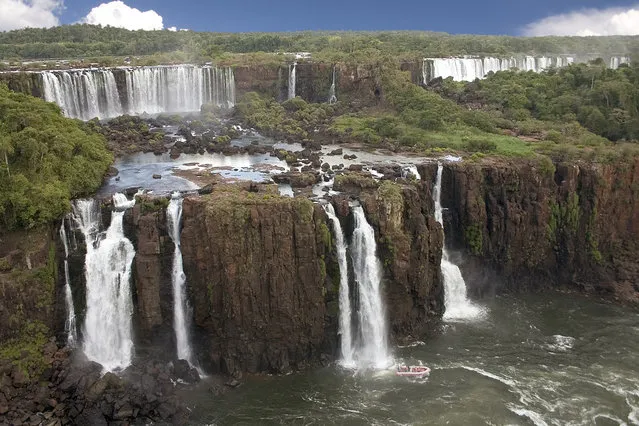
 Iguazu Falls

Iguazu Falls are waterfalls of the Iguazu River on the border of the Brazilian state of Paraná and the Argentinian province of Misiones. The falls divide the river into the upper and lower Iguazu. The Iguazu River rises near the city of Curitiba. It flows through Brazil for most of its course. Below its confluence with the San Antonio River, the Iguazu River forms the boundary between Argentina and Brazil.
Details
15 Jul 2013 11:54:00