Loading...
Done
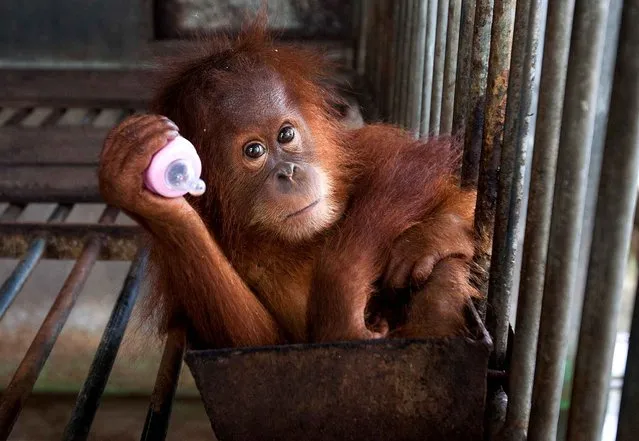
This picture shows a two-year old orangutan seized from a residents house at the provincial Nature Conservation and Agency (BKSDSA) office in Banda Aceh on September 16, 2014. The critically-endangered primates population are dwindling rapidly due to poaching and rapid destruction of their forest habitat that is being converted into palm oil plantations. (Photo by Chaideer Mahyuddin/AFP Photo)

This picture shows a two-year old orangutan seized from a residents house at the provincial Nature Conservation and Agency (BKSDSA) office in Banda Aceh on September 16, 2014. The critically-endangered primates population are dwindling rapidly due to poaching and rapid destruction of their forest habitat that is being converted into palm oil plantations. (Photo by Chaideer Mahyuddin/AFP Photo)
Details
20 Sep 2014 11:09:00
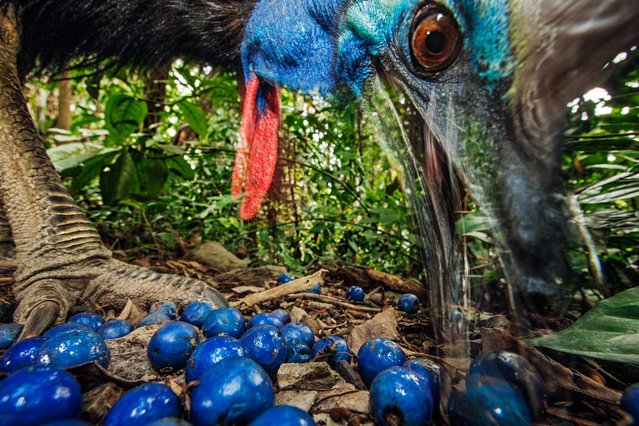
“Cassowaries are large, flightless birds related to emus and (more distantly) to ostriches, rheas, and kiwis”, writes Olivia Judson in the September issue of National Geographic magazine. (Photo by Christian Ziegler/National Geographic)

“Cassowaries are large, flightless birds related to emus and (more distantly) to ostriches, rheas, and kiwis”, writes Olivia Judson in the September issue of National Geographic magazine. How large? People-size: Adult males stand well over five foot five and top 110 pounds. Females are even taller, and can weigh more than 160 pounds. Dangerous when roused, they’re shy and peaceable when left alone. But even birds this big and tough are prey to habitat loss. The dense New Guinea and Australia rain forests where they live have dwindled. Today cassowaries might number 1,500 to 2,000. And because they help shape those same forests – by moving seeds from one place to another – “if they vanish”, Judson writes, “the structure of the forest would gradually change” too. (Photo by Christian Ziegler/National Geographic)
Details
06 Jan 2014 12:21:00
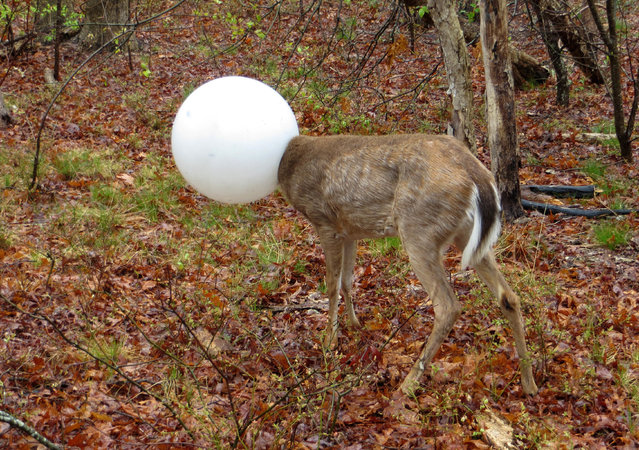
In this May 3, 2016 photo provided by the New York State Department of Environmental Conservation, a deer with its head caught in the globe from a lighting fixture over its head stands in the woods in Centereach, N.Y. The deer was able to extricate itself with the help of Environmental Conservation Officer, Jeff Hull. Hull wrestled with the deer for a while and the globe shook free in the process. (Photo by New York State Department of Environmental Conservation via AP Photo)

In this May 3, 2016 photo provided by the New York State Department of Environmental Conservation, a deer with its head caught in the globe from a lighting fixture over its head stands in the woods in Centereach, N.Y. The deer was able to extricate itself with the help of Environmental Conservation Officer, Jeff Hull. Hull wrestled with the deer for a while and the globe shook free in the process. (Photo by New York State Department of Environmental Conservation via AP Photo)

Details
08 May 2016 10:46:00
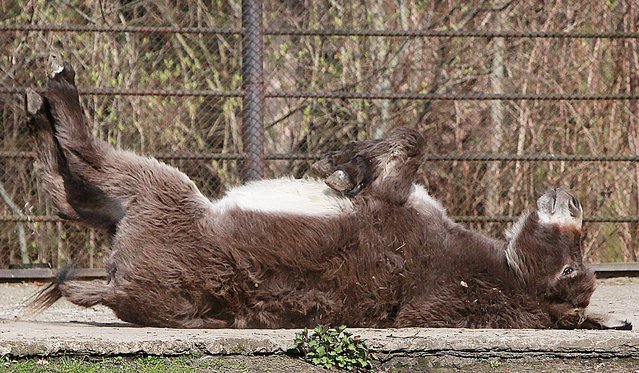
A donkey savors warming temperatures after a long winter at the zoo in Warsaw, Poland, on Wednesday, April 8, 2015. (Photo by Czarek Sokolowski/AP Photo)

A donkey savors warming temperatures after a long winter at the zoo in Warsaw, Poland, on Wednesday, April 8, 2015. (Photo by Czarek Sokolowski/AP Photo)
Details
11 Apr 2015 11:12:00
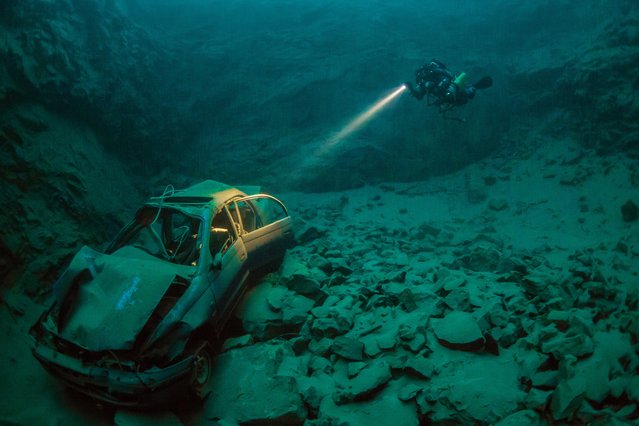
Wide-angle category winner. Part of the Illusion by Marcus Blatchford (UK). Location: National Dive & Activity Centre, Chepstow, Wales. “This is the deepest inland dive centre in the UK. The dive plan was to explore the deep end, but this time I dived ‘unplugged’ (without my strobes). With the exception of this change to my camera technique, there were no planned shots I wanted to achieve – just a fun dive with ad-hoc photos along the way. Shortly after this photo was captured, in 6C water and two hours of decompression ahead of us, we turned and started the long ascent back to the surface”. (Photo by Marcus Blatchford/Underwater Photographer of the Year 2016)

Wide-angle category winner. Part of the Illusion by Marcus Blatchford (UK). Location: National Dive & Activity Centre, Chepstow, Wales. “This is the deepest inland dive centre in the UK. The dive plan was to explore the deep end, but this time I dived ‘unplugged’ (without my strobes). With the exception of this change to my camera technique, there were no planned shots I wanted to achieve – just a fun dive with ad-hoc photos along the way. Shortly after this photo was captured, in 6C water and two hours of decompression ahead of us, we turned and started the long ascent back to the surface”. (Photo by Marcus Blatchford/Underwater Photographer of the Year 2016)
Details
18 Feb 2016 13:44:00
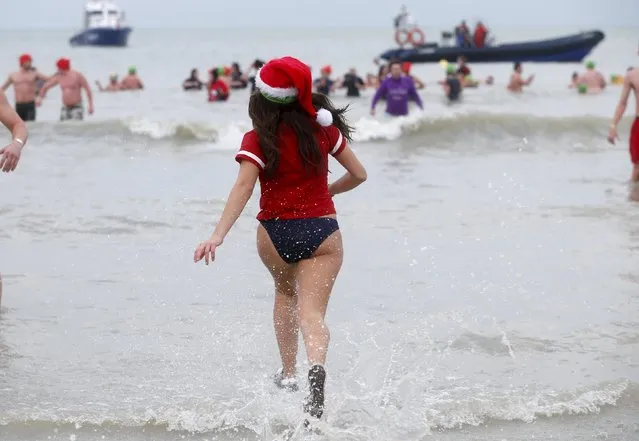
A participant runs towards the waters of the North Sea during the annual New Year's plunge event in Ostend, Belgium, January 2, 2016. (Photo by Francois Lenoir/Reuters)

A participant runs towards the waters of the North Sea during the annual New Year's plunge event in Ostend, Belgium, January 2, 2016. (Photo by Francois Lenoir/Reuters)
Details
04 Jan 2016 08:06:00
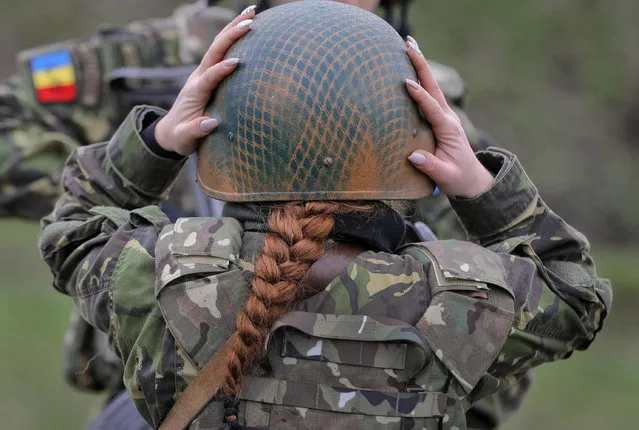
A Romanian female soldier adjusts her helmet before taking part in weapons training with US Marines female counterparts at the Capu Midia Surface to Air Firing Range, on the Black Sea coast in Romania, Monday, March 20, 2017. About 1,200 US and Romanian troops take part in the Spring Storm 17 exercise, meant to simulate defense of the Romanian Black Sea coastline and urban areas. (Photo by Vadim Ghirda/AP Photo)

A Romanian female soldier adjusts her helmet before taking part in weapons training with US Marines female counterparts at the Capu Midia Surface to Air Firing Range, on the Black Sea coast in Romania, Monday, March 20, 2017. About 1,200 US and Romanian troops take part in the Spring Storm 17 exercise, meant to simulate defense of the Romanian Black Sea coastline and urban areas. (Photo by Vadim Ghirda/AP Photo)
Details
21 Mar 2017 08:12:00
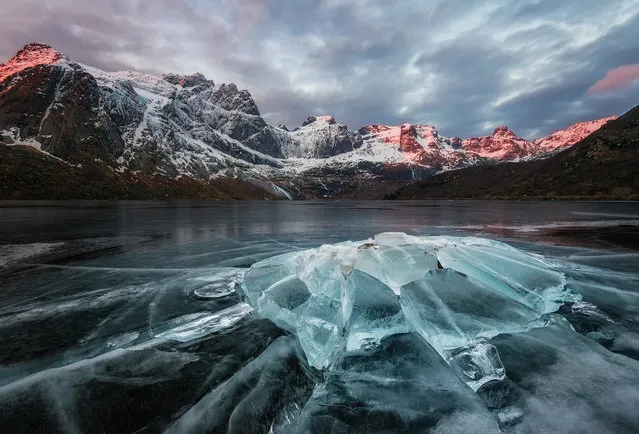
“Lofoten Glow”. I was desperately searching a good sunrise spot this particular morning. Normally Storvatnet Lake is completely covered in snow, so you can only imagine my surprise when I saw these crazy ice formations almost being shot out of the frozen lake. I put my crampons on and took a big risk walking out. Photo location: Storvatnet, Lofoten Islands in Northern Norway. (Photo and caption by Stian Klo/National Geographic Photo Contest)

“Lofoten Glow”. I was desperately searching a good sunrise spot this particular morning. Normally Storvatnet Lake is completely covered in snow, so you can only imagine my surprise when I saw these crazy ice formations almost being shot out of the frozen lake. I put my crampons on and took a big risk walking out. I could hear the ice cracking underneath my feet, and when you’re all alone in a fjord/canyon like this – the cracks are echoed and sound really frightening. Was it worth it? I sure think so! Photo location: Storvatnet, Lofoten Islands in Northern Norway. (Photo and caption by Stian Klo/National Geographic Photo Contest)
Details
08 Apr 2014 09:40:00