Loading...
Done
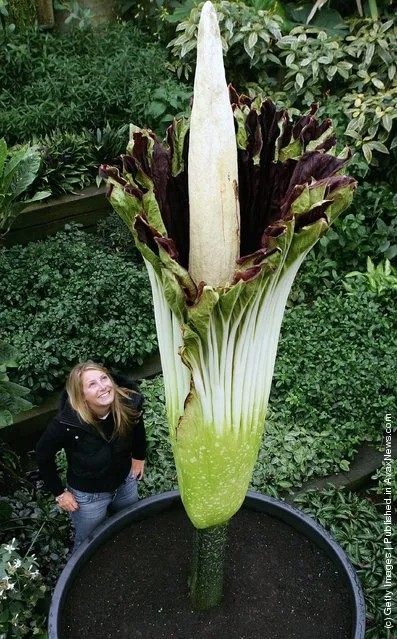
Kew Gardens employee Lauren Bird Royal examines the flowering of the Titan Arum lily at the Botanical Gardens

“The titan arum or Amorphophallus titanum (from Ancient Greek amorphos, “without form, misshapen” + phallos, “phallus”, and titan, “giant”) is a flowering plant with the largest unbranched inflorescence in the world. The titan arum's inflorescence is not as large as that of the Talipot palm, Corypha umbraculifera, but the inflorescence of the Talipot palm is branched rather than unbranched”. – Wikipedia

Photo: Kew Gardens employee Lauren Bird Royal examines the flowering of the Titan Arum lily at the Botanical Gardens at Kew on September 30, 2005 in London, England. For the first time in horticultural history, the Titan Arum lily can be seen at all three active stages in its lifecycle – in flower, fruit and leaf.The flowering corm is nearly three metres tall and weighs 91kg and is very rarely seen outside of the rainforests of Sumatra, Indonesia. (Photo by Scott Barbour/Getty Images)
Details
20 Sep 2011 11:13:00
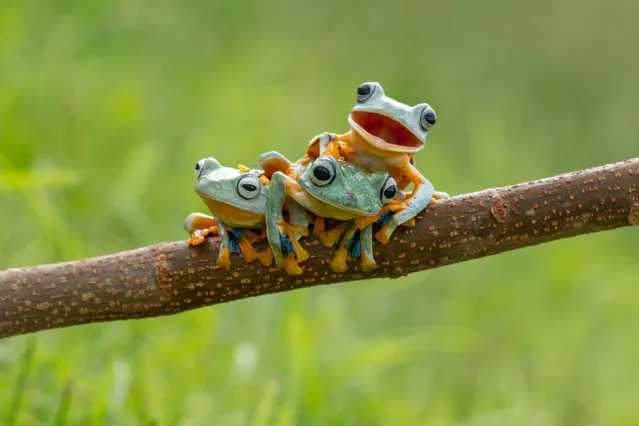
This green-skinned trio were happy to pose for the camera – with one little frog smiling happily for its close up. The three Reinwardt's Flying Frog, commonly known as the black webbed tree frog or the green flying frog, were spotted playing in a tree by photographer Hendy Mp. (Photo by Hendy Mp/SOLENT News)

This green-skinned trio were happy to pose for the camera – with one little frog smiling happily for its close up. The three Reinwardt's Flying Frog, commonly known as the black webbed tree frog or the green flying frog, were spotted playing in a tree by photographer Hendy Mp. The 25-year-old who saw the frogs near his home in Sambas, Kalimantan Barat, in Indonesia, said they reminded him of three brothers playing together. (Photo by Hendy Mp/SOLENT News)
Details
03 Feb 2015 13:27:00
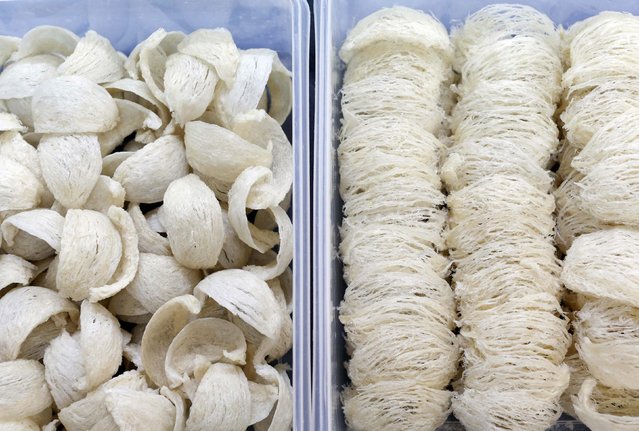
Two styles of cleaned bird's nest, Yan Zhan (L) and Su Zhan (R) await repacking at a processing plant in Kuala Lumpur, February 17, 2015. Prized in China for is alleged health benefits for hundreds of years, nests made from swiftlets' saliva are being mixed into coffee and cereal as the Southeast Asian producers of the delicacy seek to broaden its appeal, and their profit margins. (Photo by Olivia Harris/Reuters)

Two styles of cleaned bird's nest, Yan Zhan (L) and Su Zhan (R) await repacking at a processing plant in Kuala Lumpur, February 17, 2015. Prized in China for is alleged health benefits for hundreds of years, nests made from swiftlets' saliva are being mixed into coffee and cereal as the Southeast Asian producers of the delicacy seek to broaden its appeal, and their profit margins. The nests are among the world's most expensive foods, selling for up to $2,500 a kg and the swiftlets that weave them are indigenous to Indonesia, Malaysia, Thailand and Vietnam. (Photo by Olivia Harris/Reuters)
Details
24 Feb 2015 13:57:00
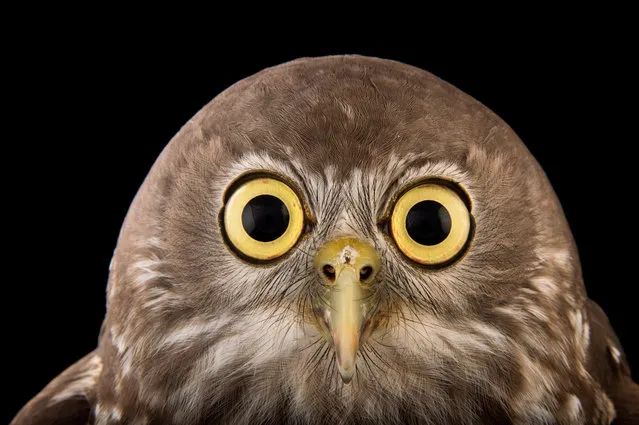
The National Geographic Photo Ark is a travelling exhibition of photographer Joel Sartore’s quest to create a photo archive of biodiversity around the world. So far, Sartore has captured studio portraits of more than 6,000 species – a number that he hopes to double. On 1 July, the ark will open at Melbourne zoo – the first time it has been exhibited in the southern hemisphere. More than 50 portraits will be on display, including many of Australian endangered animals being protected by programs at the zoo itself. These captions have been edited from text supplied by Melbourne zoo. Here: Barking owl. So-named because its call sounds like a barking dog, these birds are native to Australia, Indonesia and Papua New Guinea. In Victoria they are listed as an endangered species, and in 2003 there were estimated to be fewer than 50 breeding pairs. The main threat to the species in Victoria is loss of habitat, especially large trees with hollows in which they can nest and on which many of their prey depend. Apart from a bark, they may utter a chilling scream when they feel threatened. (Photo by Joel Sartore/National Geographic Photo Ark/The Guardian)

The National Geographic Photo Ark is a travelling exhibition of photographer Joel Sartore’s quest to create a photo archive of biodiversity around the world. So far, Sartore has captured studio portraits of more than 6,000 species – a number that he hopes to double. On 1 July, the ark will open at Melbourne zoo – the first time it has been exhibited in the southern hemisphere. More than 50 portraits will be on display, including many of Australian endangered animals being protected by programs at the zoo itself. These captions have been edited from text supplied by Melbourne zoo. Here: Barking owl. (Photo by Joel Sartore/National Geographic Photo Ark/The Guardian)
Details
01 Jul 2017 07:45:00
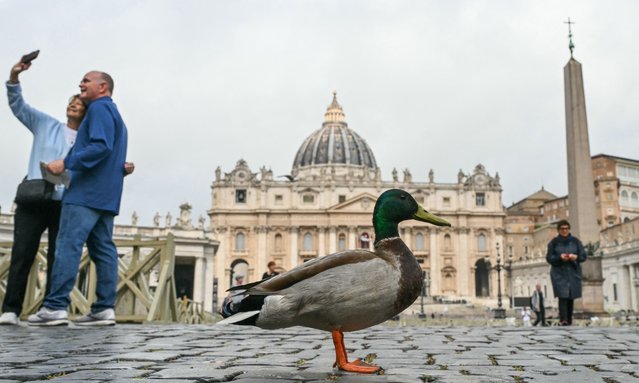
Visitors pose for a picture next to a mallard duck on the cobblestones of St Peter's Square with St Peter's Basilica in the background at The Vatican, on May 5, 2025. (Photo by Alberto Pizzoli/AFP Photo)

Visitors pose for a picture next to a mallard duck on the cobblestones of St Peter's Square with St Peter's Basilica in the background at The Vatican, on May 5, 2025. (Photo by Alberto Pizzoli/AFP Photo)
Details
18 May 2025 02:28:00
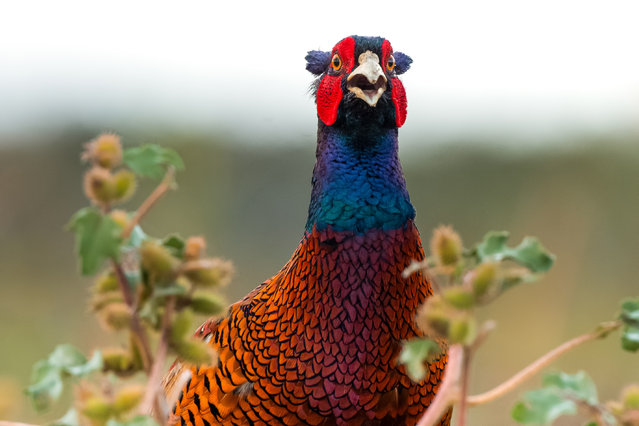
A pheasant is seen among grasses in Bursa, Turkiye on October 07, 2024. Pheasants mostly live in forested areas, thickets and wetlands. Unlike females, male pheasants have a much more remarkable structure with their long tails and feathers in bright and variable colors. Also, they feed on fruits, grains, seeds and invertebrates. (Photo by Alper Tuydes/Anadolu via Getty Images)

A pheasant is seen among grasses in Bursa, Turkiye on October 07, 2024. Pheasants mostly live in forested areas, thickets and wetlands. Unlike females, male pheasants have a much more remarkable structure with their long tails and feathers in bright and variable colors. Also, they feed on fruits, grains, seeds and invertebrates. (Photo by Alper Tuydes/Anadolu via Getty Images)
Details
27 Oct 2024 04:43:00
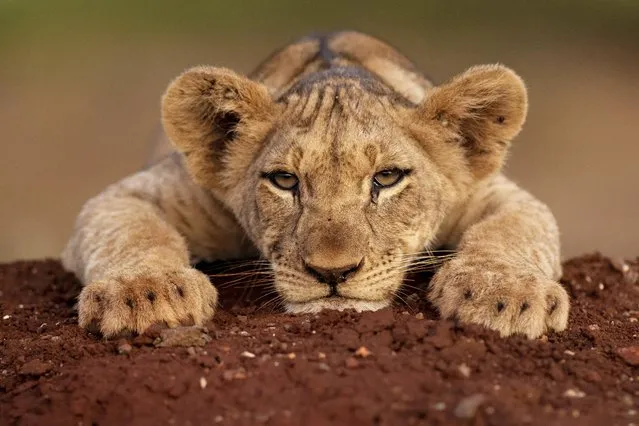
A lion cub wakes in the morning sun at the Zimanga private game reserve in South Africa on April 9, 2022. (Photo by Calvin Kotze/Animal News Agency)

A lion cub wakes in the morning sun at the Zimanga private game reserve in South Africa on April 9, 2022. (Photo by Calvin Kotze/Animal News Agency)
Details
17 Apr 2022 04:46:00
People take part in a gay pride parade in Warsaw, Poland, on Saturday, June 8, 2019. The Equality Parade is the largest gay pride parade in central and Eastern Europe. It brought thousands of people to the streets of Warsaw at a time when the LGBT rights movement in Poland is targeted by hate speeches and a government campaign depicting it as a threat to families and society. (Photo by Czarek Sokolowski/AP Photo)

People take part in a gay pride parade in Warsaw, Poland, on Saturday, June 8, 2019. The Equality Parade is the largest gay pride parade in central and Eastern Europe. It brought thousands of people to the streets of Warsaw at a time when the LGBT rights movement in Poland is targeted by hate speeches and a government campaign depicting it as a threat to families and society. (Photo by Czarek Sokolowski/AP Photo)
Details
07 Jan 2020 00:05:00