Loading...
Done
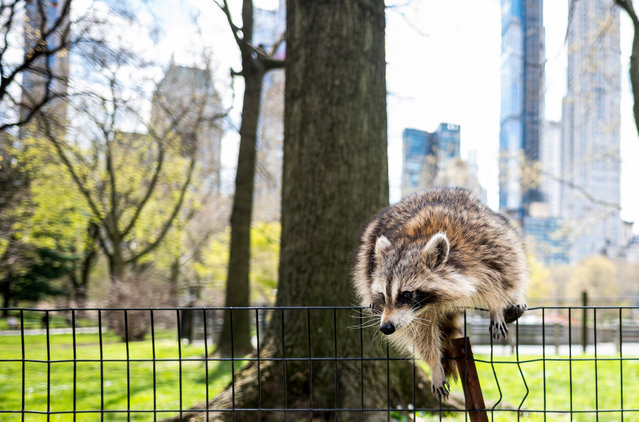
A racoon jumps over a fence in almost deserted Central Park in Manhattan on April 16, 2020 in New York City. Gone are the softball games, horse-drawn carriages and hordes of tourists. In their place, pronounced birdsong, solitary walks and renewed appreciation for Central Park's beauty during New York's coronavirus lockdown. The 843-acre (341-hectare) park – arguably the world's most famous urban green space – normally bustles with human activity as winter turns to spring, but this year due to Covid-19 it's the wildlife that is coming out to play. (Photo by Johannes Eisele/AFP Photo)

A racoon jumps over a fence in almost deserted Central Park in Manhattan on April 16, 2020 in New York City. Gone are the softball games, horse-drawn carriages and hordes of tourists. In their place, pronounced birdsong, solitary walks and renewed appreciation for Central Park's beauty during New York's coronavirus lockdown. The 843-acre (341-hectare) park – arguably the world's most famous urban green space – normally bustles with human activity as winter turns to spring, but this year due to Covid-19 it's the wildlife that is coming out to play. (Photo by Johannes Eisele/AFP Photo)
Details
14 Dec 2025 07:04:00
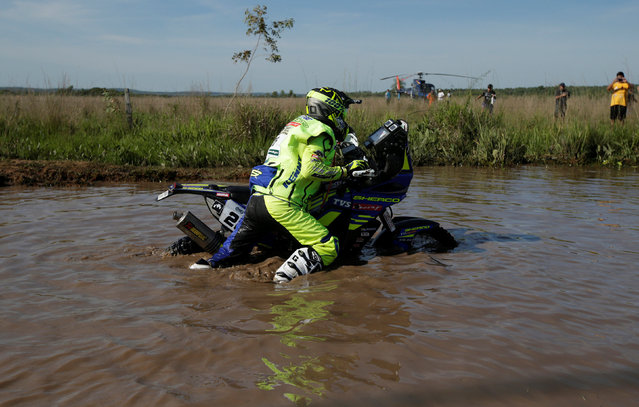
Dakar Rally, 2017 Paraguay-Bolivia-Argentina Dakar rally, 39th Dakar Edition, First stage from Asuncion, Paraguay to Resistencia, Argentina on January 2, 2017. Adrien Metge of France pushes his Sherco. (Photo by Ricardo Moraes/Reuters)

Dakar Rally, 2017 Paraguay-Bolivia-Argentina Dakar rally, 39th Dakar Edition, First stage from Asuncion, Paraguay to Resistencia, Argentina on January 2, 2017. Adrien Metge of France pushes his Sherco. (Photo by Ricardo Moraes/Reuters)
Details
03 Jan 2017 10:58:00
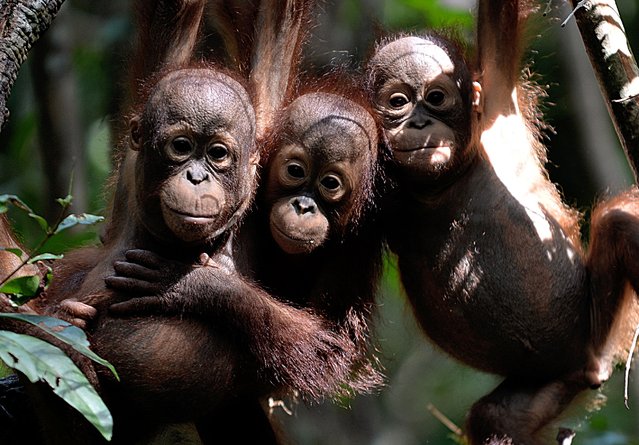
This picture taken on August 4, 2016 shows three orphaned orangutan babies hanging in a tree whilst attending “jungle school” at the International Animal Rescue centre outside the city of Ketapang in West Kalimantan. (Photo by Bay Ismoyo/AFP Photo)

This picture taken on August 4, 2016 shows three orphaned orangutan babies hanging in a tree whilst attending “jungle school” at the International Animal Rescue centre outside the city of Ketapang in West Kalimantan. (Photo by Bay Ismoyo/AFP Photo)
Details
01 Sep 2016 11:11:00
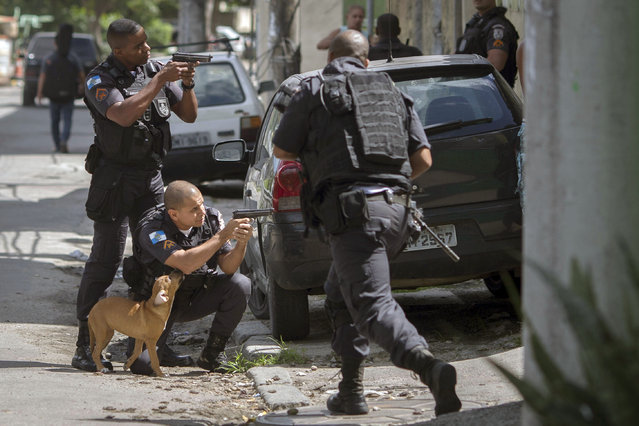
Military policemen take part in an operation at Cidade de Deus favela in Rio de Janeiro, Brazil, on February 01, 2018. (Photo by Mauro Pimentel/AFP Photo)

Military policemen take part in an operation at Cidade de Deus favela in Rio de Janeiro, Brazil, on February 01, 2018. (Photo by Mauro Pimentel/AFP Photo)
Details
02 Feb 2018 08:16:00
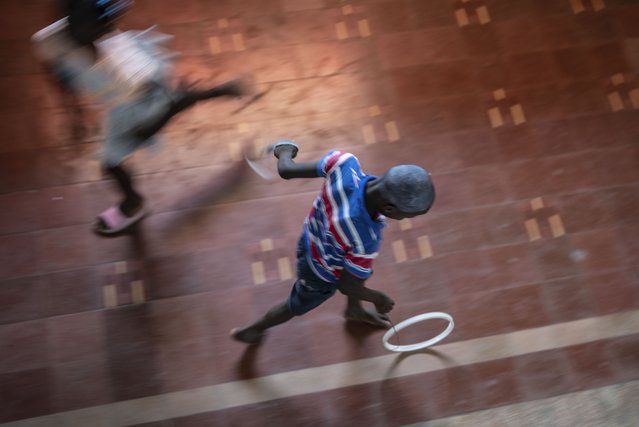
A youth rolls a hoop in the National Theater where families displaced by gang violence are taking shelter in Port-au-Prince, Haiti, May 9, 2024. (Photo by Ramon Espinosa/AP Photo)

A youth rolls a hoop in the National Theater where families displaced by gang violence are taking shelter in Port-au-Prince, Haiti, May 9, 2024. (Photo by Ramon Espinosa/AP Photo)
Details
23 May 2024 05:15:00
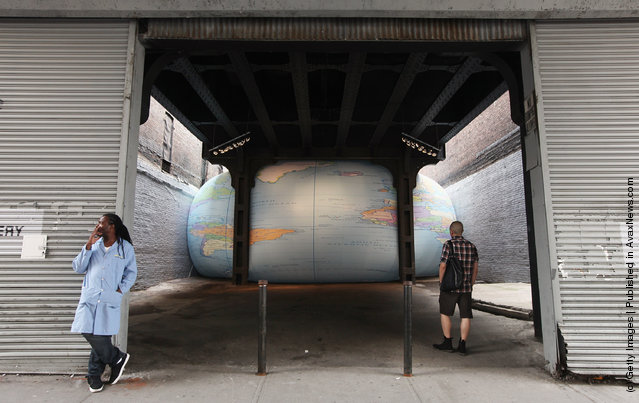
David Byrne's installation Tight Spot

People view artist David Byrne's installation "Tight Spot" beneath Manhattan's High Line park on September 27, 2011 in New York City. The 48-foot by 20-foot inflatable globe is squeezed beneath the steel support framework of the High Line and is accompanied with a rumbling audio soundtrack created by distorting Byrne's voice. (Photo by Mario Tama/Getty Images)
Details
28 Sep 2011 11:01:00
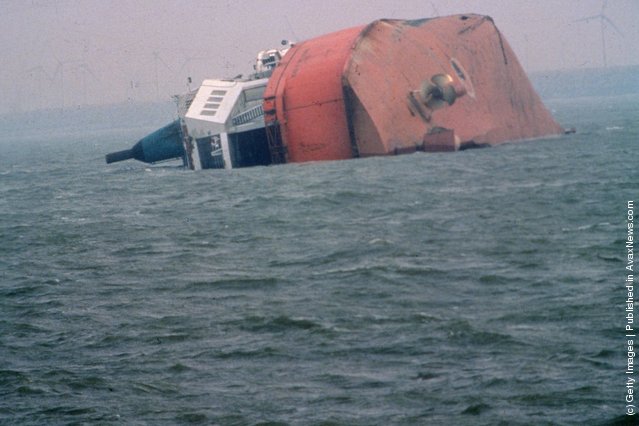
The wreck of the Herald of Free Enterprise, which capsized near Zeebrugge on the 6th of March 1987

“MS Herald of Free Enterprise was a roll-on roll-off (RORO) car and passenger ferry owned by Townsend Thoresen. She was one of three ships commissioned by the company to operate on the Dover–Calais route across the English Channel. The ferry capsized on the night of 6 March 1987, moments after leaving the Belgian port of Zeebrugge, killing 193 passengers and crew. This was the deadliest maritime disaster involving a British ship in peacetime since the sinking of the Iolaire in 1919”. – Wikipedia

Photo: The wreck of the Herald of Free Enterprise, which capsized near Zeebrugge on the 6th of March 1987. (Photo by Hulton Archive/Getty Images). 1987
Details
06 Mar 2012 13:26:00
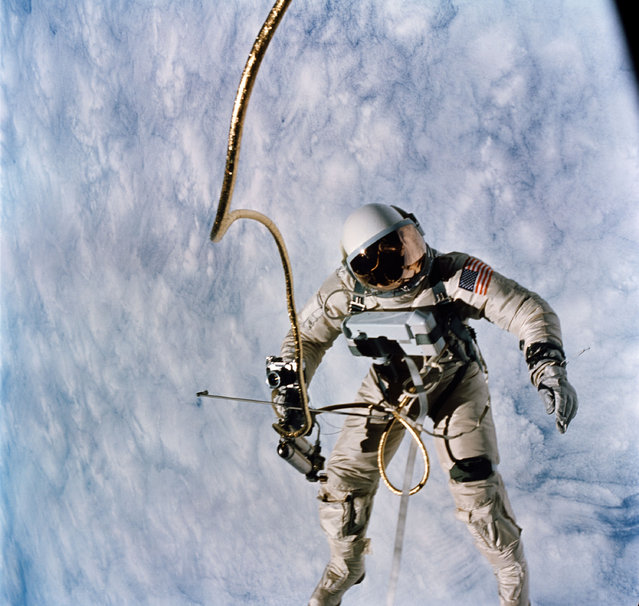
Astronaut Edward H. White II, pilot for the Gemini-Titan 4 (GT-4) spaceflight, floats in the zero-gravity of space during the third revolution of the GT-4 spacecraft on June 3, 1965. White wears a specially designed spacesuit. His face is shaded by a gold-plated visor to protect him from unfiltered rays of the sun. (Photo by NASA)

Astronaut Edward H. White II, pilot for the Gemini-Titan 4 (GT-4) spaceflight, floats in the zero-gravity of space during the third revolution of the GT-4 spacecraft on June 3, 1965. White wears a specially designed spacesuit. His face is shaded by a gold-plated visor to protect him from unfiltered rays of the sun. In his right hand he carries a Hand-Held Self-Maneuvering Unit (HHSMU) that gives him control over his movements in space. White also wears an emergency oxygen chest pack; and he carries a camera mounted on the HHSMU for taking pictures of the sky, Earth and the GT-4 spacecraft. He is secured to the spacecraft by a 25-feet umbilical line and a 23-feet tether line. Both lines are wrapped together in gold tape to form one cord. Astronaut James A. McDivitt, command pilot, remained inside the spacecraft during the extravehicular activity (EVA). Astronaut White died in the Apollo/Saturn 204 fire at Cape Kennedy on January 27, 1967. (Photo by NASA)
Details
22 Jul 2014 12:05:00