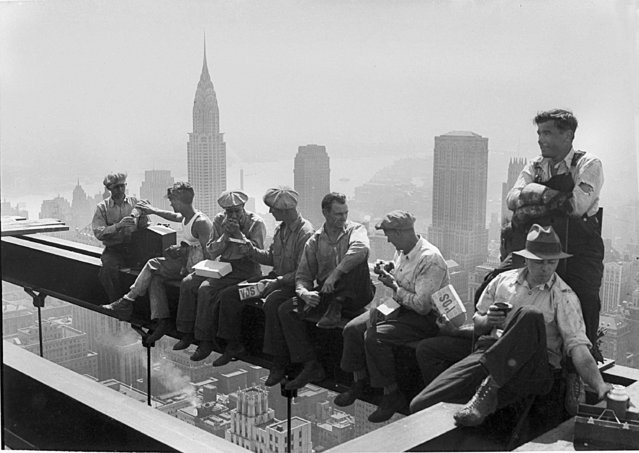
Construction workers take a lunch break on a steel beam atop the RCA Building at Rockefeller Center, New York, September 29, 1932. In the background is the Chrysler Building. (Photo by AP Photo)
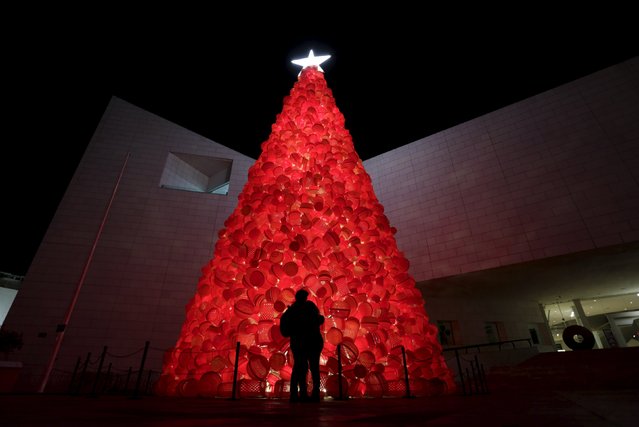
A couple hugs while standing near a Christmas tree made out of plastic bins and plastic hampers outside the Museum of History in Monterrey, Mexico, December 4, 2015. The humble Christmas tree has a rich history, from evergreen trees used to symbolise eternal life in Ancient Egypt to tree worship among pagan Europeans. The modern version has its origins in Germany, where the song “O Tannenbaum” is still a festive favourite. Today the traditional tree with lights and decorations appears in cities including Washington, Moscow and Beirut. Alternative constructions range from recycled rubbish in Mexico City to old window frames in Rakvere, Estonia. Whatever the shape or size, the message is the same: Merry Christmas. (Photo by Neil Hall/Reuters)
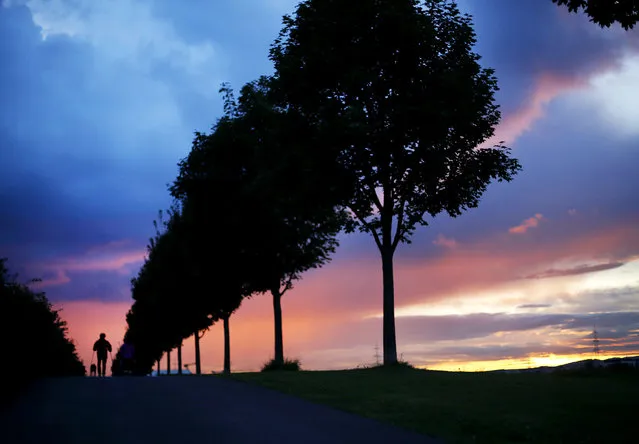
A man walks his dog as the sun sets in a park in Frankfurt, Germany, Monday, September 18, 2017. Cool damp weather is set to continue in this part of Germany for the next few days with temperatures in the mid teens Celsius. (Photo by Michael Probst/AP Photo)
Nikolai Vasilyev, 64, dressed as Father Frost, the Russian equivalent of Santa Claus, water-skis along the Yenisei River outside the Siberian city of Krasnoyarsk, Russia December 19, 2017. Vasilyev, former teacher of the Siberian State Aerospace University, constructed the water skis out of plastic foam and designed the sticks to propel him forward, while travelling on the water surface. (Photo by Ilya Naymushin/Reuters)
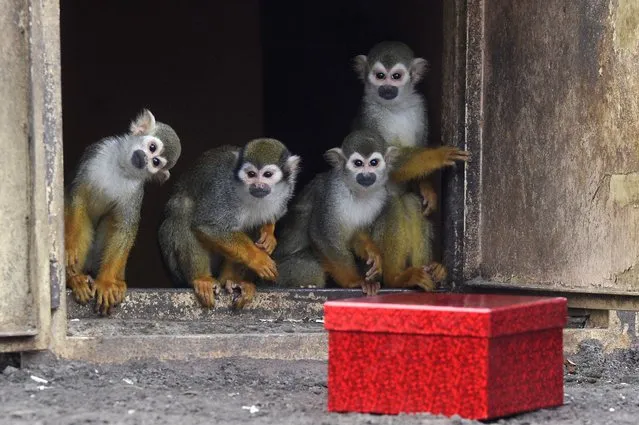
Common squirrel monkeys observe their Christmas present, a box full of mealworms, at the South America enclosure of the Budapest Zoo, in Budapest, Hungary, 24 December 2017. (Photo by Photo by Attila Kovacs/EPA/EFE/Rex Features/Shutterstock)
This picture taken on January 6, 2018 shows macaque monkeys looking at a man's camera during snowfall at Wulongkou Nature Reserve in Jiyuan in China's central Henan province. (Photo by AFP Photo/China Stringer Network)
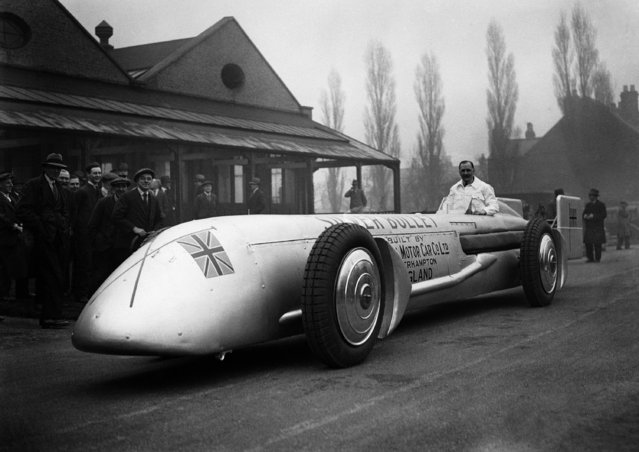
Kaye Don seated in the cockpit of his new racing car the “Silver Bullet” at Wolverhampton, England on February 21, 1930, in which he will attempt to beat world land speed record at Daytona. It has two 12-cylinder V shaped engines and each develops 2,000-h.p. The theoretical speed of the car is 275 m.p.h. but the designer estimated that will be able to reach 250 m.p.h. allowing for wind pressures. (Photo by AP Photo/Staff/Puttnam)