Loading...
Done


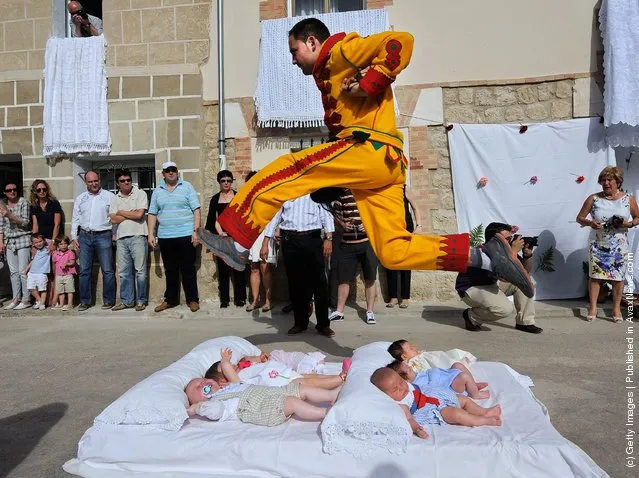
“Baby jumping (El Colacho) is a traditional Spanish practice dating back to 1620 that takes place annually to celebrate the Catholic feast of Corpus Christi in the village of Castrillo de Murcia near Burgos. During the act – known as El Salto del Colacho (the devil's jump) or simply El Colacho – men dressed as the Devil (known as the Colacho) jump over babies born during the previous twelve months of the year who lie on mattresses in the street. ... The festival has been rated as one of the most dangerous in the world”. – Wikipedia

Photo: A man representing the devil leaps over babies during the festival of El Colacho on June 26, 2011 in Castrillo de Murcia near Burgos, Spain. The festival, held on the first Sunday after Corpus Cristi, represents the devil taking away original sin from the newly born babies by leaping over them. (Photo by Denis Doyle/Getty Images)
Details
27 Jun 2011 09:20:00
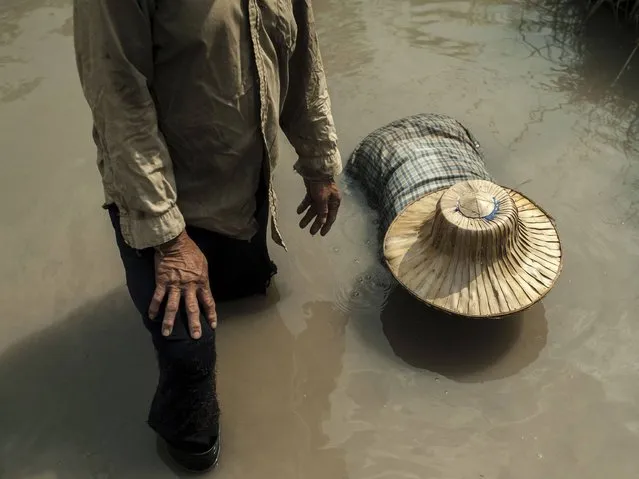
The workers begin to search for gold at 10 am and work until sunset, often working second jobs in the day in order to survive. (Photo by Borja Sanchez-Trillo/Getty Images)

Two workers shovel mud from the river as they look for gold on March 25, 2014 in Lampang, Thailand. Thai villagers from Wang Nuea, North of Thailand, look for gold in the river every year during the drought season. They are able to make an average around USD 15 per day, however two years ago they reached USD 200 in one day due to the river level dropping so much. The workers begin to search for gold at 10 AM and work until sunset, often working second jobs in the day in order to survive. (Photo by Borja Sanchez-Trillo/Getty Images)
Details
27 Mar 2014 06:09:00


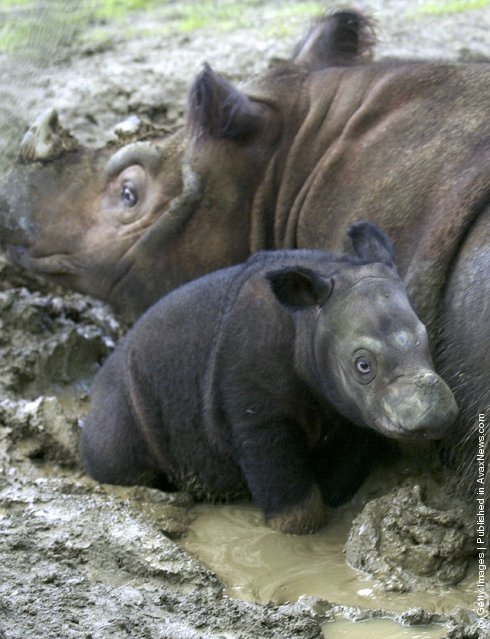
“The Sumatran Rhinoceros (Dicerorhinus sumatrensis) is a member of the family Rhinocerotidae and one of five extant rhinoceroses. It is the only extant species of the genus Dicerorhinus. It is the smallest rhinoceros, standing about 120–145 centimetres (3.9–4.76 ft) high at the shoulder, with a body length of 250 centimetres (8.2 ft) and weight of 500–800 kilograms (1,100–1,800 lb). Like the African species, it has two horns; the larger is the nasal horn, typically 15–25 centimetres (5.9–9.8 in), while the other horn is typically a stub. A coat of reddish-brown hair covers most of the Sumatran Rhino's body”. – Wikipedia

Photo: Emi, a Sumatran rhinoceros lies in the mud with her three-week-old female calf at the Cincinnati Zoo and Botanical Garden August 19, 2004 in Cincinnati, Ohio. Emi made history by becoming the first Sumatran rhino to produce two calves in captivity. (Photo by Mike Simons/Getty Images)
Details
22 Jun 2011 12:37:00
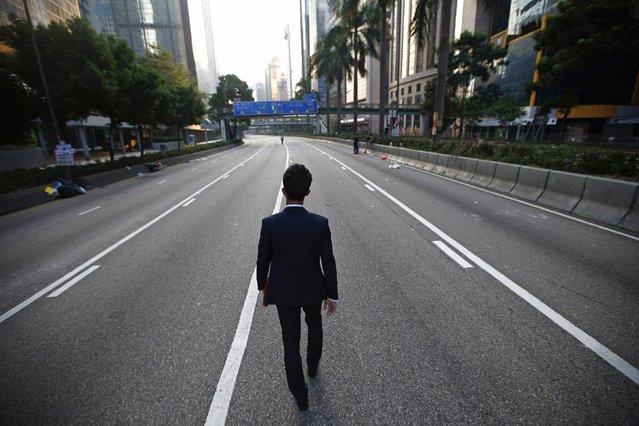
A man walks along an empty street near the central financial district in Hong Kong September 30, 2014. Tens of thousands of pro-democracy protesters extended a blockade of Hong Kong streets on Tuesday, stockpiling supplies and erecting makeshift barricades ahead of what some fear may be a push by police to clear the roads before Chinese National Day. (Photo by Carlos Barria/Reuters)

Reuters photographer Bobby Yip took a series of portraits of people taking part in the “Occupy Central” protests in Hong Kong, and asked them why they had joined the demonstrations. China rules Hong Kong under a “one country, two systems” formula that accords the territory limited democracy. Tens of thousands of mostly student protesters are demanding Beijing give them full democracy, with the freedom to nominate election candidates. The unrest is the worst in Hong Kong since China resumed its rule over the former British colony in 1997. (Photo by Carlos Barria/Reuters)
Details
30 Sep 2014 09:10:00
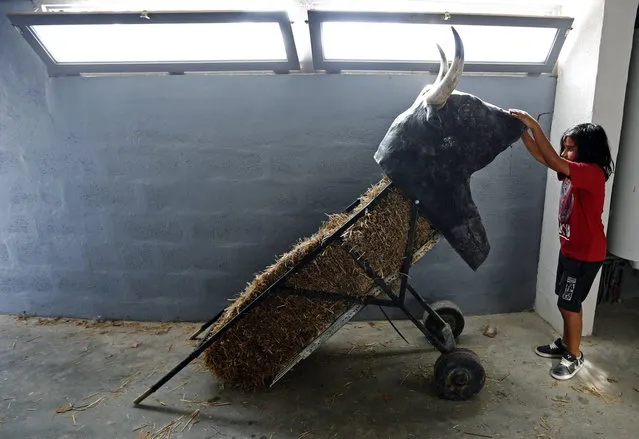
Nino, a ten-year-old toreador apprentice of the French Tauromachy Centre, nicknamed El Nino, touches a practice bull at the bullring of Garons, near Nimes, September 25, 2013. (Photo by Jean-Paul Pelissier/Reuters)

Nino, a ten-year-old toreador apprentice of the French Tauromachy Centre, nicknamed El Nino, touches a practice bull at the bullring of Garons, near Nimes, September 25, 2013. Since 1983, the French Tauromachy Centre in Nimes has trained some 1,000 youths in the art of bullfighting. Twenty of them have gone on to become professional matadors, facing fighting bulls in the arena. Twice a week, students take courses with a matador to learn the movements and gestures of the bullfighter in the ring, but without an animal present. Students train with calves in the surrounding fields during spring, and regularly participate in beginner's bullfights (becerradas) without killing calves. Solal has been taking courses for three years and Nino, for just a year now. Both are normally enrolled in French public schools, but have one thought in mind – bullfighting. They share a passion linked to the city of Nimes, famous for its ferias and bullring. (Photo by Jean-Paul Pelissier/Reuters)
Details
06 Nov 2013 10:12:00
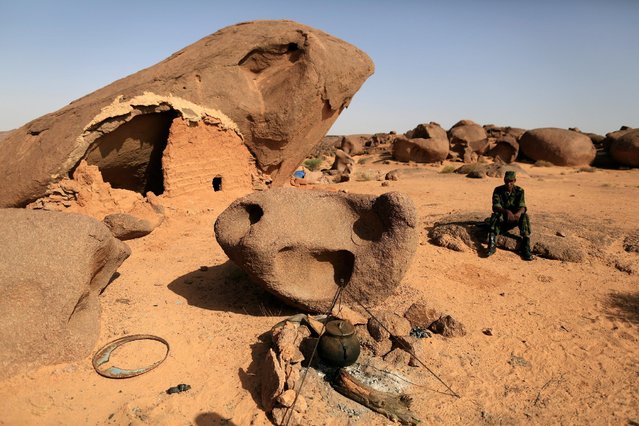
A Polisario fighter sits on a rock at a forward base on the outskirts of Tifariti, Western Sahara, September 9, 2016. At a rocky outpost in Western Sahara, a new generation of soldiers who have never known war are mobilising as tensions resurface in one of Africa's oldest disputes after a quarter century of uneasy peace. Young Sahrawi troops man new desert posts for the Polisario Front, which for more than 40 years has sought independence for the vast desert region - first in a guerrilla war against Morocco and then politically since a ceasefire deal in 1991. Now a standoff with Morocco, which controls the majority of Western Sahara, is renewing pressure for a diplomatic solution to ensure foot soldiers don't return to fighting as the last generation of commanders once did. The standoff since August has brought Moroccan and Polisario forces within 200 metres of each other in a narrow strip of land near the Mauritanian border. Rich in phosphate, Western Sahara has been contested since 1975 when Spanish colonial powers left. Morocco claimed the territory and fought the 16-year war with Polisario. (Photo by Zohra Bensemra/Reuters)

A Polisario fighter sits on a rock at a forward base on the outskirts of Tifariti, Western Sahara, September 9, 2016. At a rocky outpost in Western Sahara, a new generation of soldiers who have never known war are mobilising as tensions resurface in one of Africa's oldest disputes after a quarter century of uneasy peace. (Photo by Zohra Bensemra/Reuters)
Details
04 Nov 2016 12:09:00
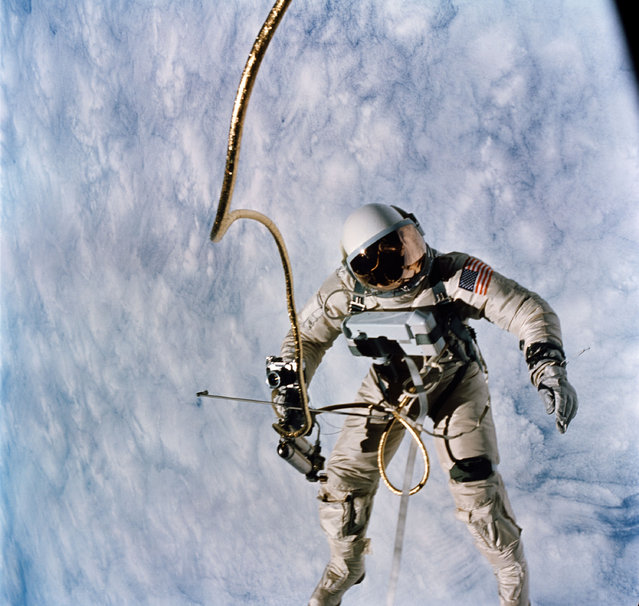
Astronaut Edward H. White II, pilot for the Gemini-Titan 4 (GT-4) spaceflight, floats in the zero-gravity of space during the third revolution of the GT-4 spacecraft on June 3, 1965. White wears a specially designed spacesuit. His face is shaded by a gold-plated visor to protect him from unfiltered rays of the sun. (Photo by NASA)

Astronaut Edward H. White II, pilot for the Gemini-Titan 4 (GT-4) spaceflight, floats in the zero-gravity of space during the third revolution of the GT-4 spacecraft on June 3, 1965. White wears a specially designed spacesuit. His face is shaded by a gold-plated visor to protect him from unfiltered rays of the sun. In his right hand he carries a Hand-Held Self-Maneuvering Unit (HHSMU) that gives him control over his movements in space. White also wears an emergency oxygen chest pack; and he carries a camera mounted on the HHSMU for taking pictures of the sky, Earth and the GT-4 spacecraft. He is secured to the spacecraft by a 25-feet umbilical line and a 23-feet tether line. Both lines are wrapped together in gold tape to form one cord. Astronaut James A. McDivitt, command pilot, remained inside the spacecraft during the extravehicular activity (EVA). Astronaut White died in the Apollo/Saturn 204 fire at Cape Kennedy on January 27, 1967. (Photo by NASA)
Details
22 Jul 2014 12:05:00
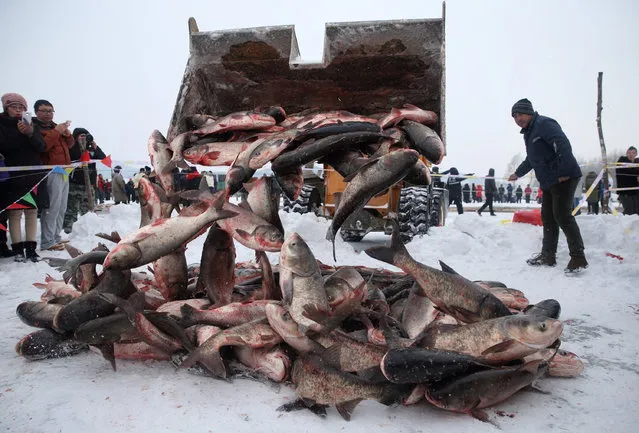
People participate in a winter fishing event in Changchun, Jilin province, China, December 25, 2016. Picture taken December 25, 2016. (Photo by Reuters/Stringer)

People participate in a winter fishing event in Changchun, Jilin province, China, December 25, 2016. Picture taken December 25, 2016. (Photo by Reuters/Stringer)
Details
27 Dec 2016 10:21:00