Loading...
Done
An Indian artist gives the finishing touches to a figure of the elephant-headed Hindu god Ganesha at a workshop ahead of the Ganesh Chaturthi festival in New Delhi on September 15, 2015. (Photo by Sajjad Hussain/AFP Photo)

An Indian artist gives the finishing touches to a figure of the elephant-headed Hindu god Ganesha at a workshop ahead of the Ganesh Chaturthi festival in New Delhi on September 15, 2015. The idol is meant for the forthcoming festival Ganesha Chaturthi, a ten-day long event which is celebrated all over India. During the Ganpati festival, that is celebrated as the birthday of Lord Ganesha, idols of the Hindu deity are worshipped at hundreds of pandals or makeshift tents before they are immersed into water bodies. This year, the festival starts on 17 September 2015. (Photo by Sajjad Hussain/AFP Photo)
Details
17 Sep 2015 10:38:00
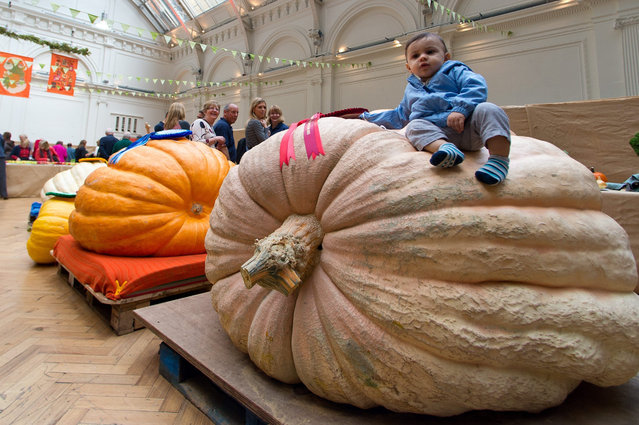
A toddler sits on the winner of the giant pumpkin category during the RHS (Royal Horticultural Society) London Harvest Festival Show at RHS Lindley Halls on October 6, 2015 in London, England. The traditional harvest themed show runs October 6-7 and showcases a wide range of late summer grown fruit and vegetables. (Photo by Ben Pruchnie/Getty Images)

A toddler sits on the winner of the giant pumpkin category during the RHS (Royal Horticultural Society) London Harvest Festival Show at RHS Lindley Halls on October 6, 2015 in London, England. The traditional harvest themed show runs October 6-7 and showcases a wide range of late summer grown fruit and vegetables. (Photo by Ben Pruchnie/Getty Images)
Details
09 Oct 2015 08:07:00
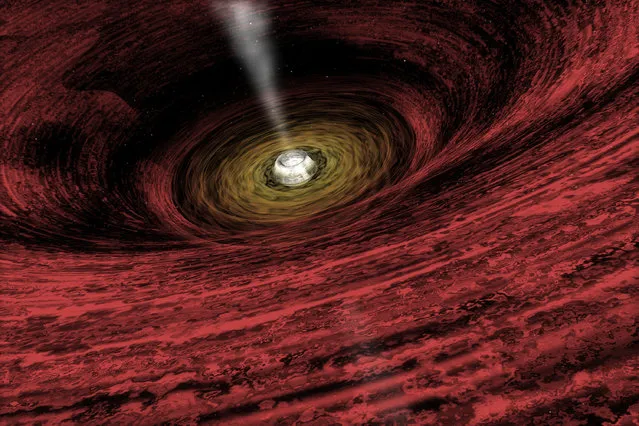
An artist's impression of a growing supermassive black hole located in the early Universe is seen in this NASA handout illustration released on June 15, 2011. Using the deepest X-ray image ever taken, astronomers found the first direct evidence that massive black holes were common in the early universe. This discovery from NASA's Chandra X-Ray Observatory shows that very young black holes grew more aggressively than previously thought, in tandem with the growth of their host galaxies. (Photo by Reuters/NASA/Chandra X-Ray Observatory/A.Hobart)

An artist's impression of a growing supermassive black hole located in the early Universe is seen in this NASA handout illustration released on June 15, 2011. Using the deepest X-ray image ever taken, astronomers found the first direct evidence that massive black holes were common in the early universe. This discovery from NASA's Chandra X-Ray Observatory shows that very young black holes grew more aggressively than previously thought, in tandem with the growth of their host galaxies. (Photo by Reuters/NASA/Chandra X-Ray Observatory/A.Hobart)
Details
11 Feb 2016 12:57:00
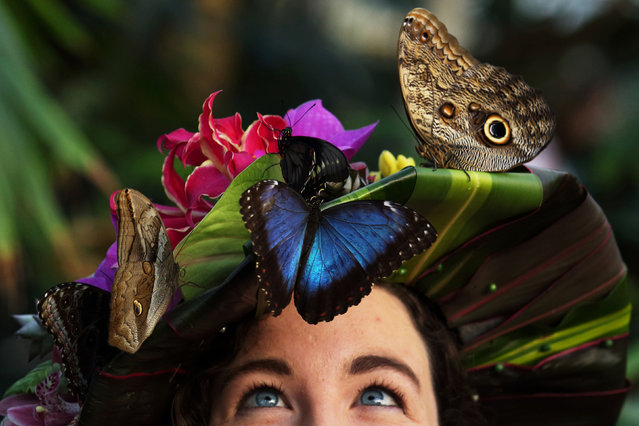
Entomologist Anna Platoni wears a hat made of tropical flowers made by florist Emma Reynolds with a Blue Morpho butterfly on her cheek to mark the opening of Butterflies in the Glasshouse at RHS Garden Wisley, south of London, on Janurary 15, 2016. (Photo by Luke MacGregor/PA Wire/RHS)

Entomologist Anna Platoni wears a hat made of tropical flowers made by florist Emma Reynolds with a Blue Morpho butterfly on her cheek to mark the opening of Butterflies in the Glasshouse at RHS Garden Wisley, south of London, on Janurary 15, 2016. (Photo by Luke MacGregor/PA Wire/RHS)
Details
16 Jan 2016 10:22:00
A woman with a snake on her body, taken in Rio de Janeiro, Brazil, April 2017. A holistic therapist uses snakes to massage her clients – claiming it cures depression and even helps victims of abuse. Instead of traditional massaging techniques, Sarah Zaad uses up to six pythons and boa constrictors on brave customers who want to relax or be treated for mental disorders. The flamboyant therapist from Rio de Janeiro, Brazil believes her snakes have a magic touch, which can benefit people by massaging their bodies. (Photo by Kadeh Ferreira/Barcroft Images)

A woman with a snake on her body, taken in Rio de Janeiro, Brazil, April 2017. A holistic therapist uses snakes to massage her clients – claiming it cures depression and even helps victims of abuse. Instead of traditional massaging techniques, Sarah Zaad uses up to six pythons and boa constrictors on brave customers who want to relax or be treated for mental disorders. The flamboyant therapist from Rio de Janeiro, Brazil believes her snakes have a magic touch, which can benefit people by massaging their bodies. (Photo by Kadeh Ferreira/Barcroft Images)
Details
15 Apr 2017 09:14:00
Women demonstrate on International Women's Day as they strike to demand the end to domestic violence and the country's prevailing “macho” culture, in Milan, Italy on March 8, 2023. (Photo by Claudia Greco/Reuters)

Women demonstrate on International Women's Day as they strike to demand the end to domestic violence and the country's prevailing “macho” culture, in Milan, Italy on March 8, 2023. (Photo by Claudia Greco/Reuters)
Details
10 Mar 2023 00:21:00
A handout picture provided by Solar Impulse on 18 March 2015 shows the Swiss solar-powered plane Solar Impulse 2, HB-SIB, taking off with Swiss explorer Andre Borshberg on board for the third leg Ahmedabad to Varanasi, of the Round-The-World, in Ahmedabad, India, 18 March 2015. Swiss explorers Bertrand Piccard and Andre Borschberg attempt to circumnavigate the world flying with an aircraft, with a 72 metres wingspan, powered only by solar energy without a drop of fuel. (Photo by EPA/Solar Impulse)

A handout picture provided by Solar Impulse on 18 March 2015 shows the Swiss solar-powered plane Solar Impulse 2, HB-SIB, taking off with Swiss explorer Andre Borshberg on board for the third leg Ahmedabad to Varanasi, of the Round-The-World, in Ahmedabad, India, 18 March 2015. Swiss explorers Bertrand Piccard and Andre Borschberg attempt to circumnavigate the world flying with an aircraft, with a 72 metres wingspan, powered only by solar energy without a drop of fuel. (Photo by EPA/Solar Impulse)
Details
21 Mar 2015 12:56:00
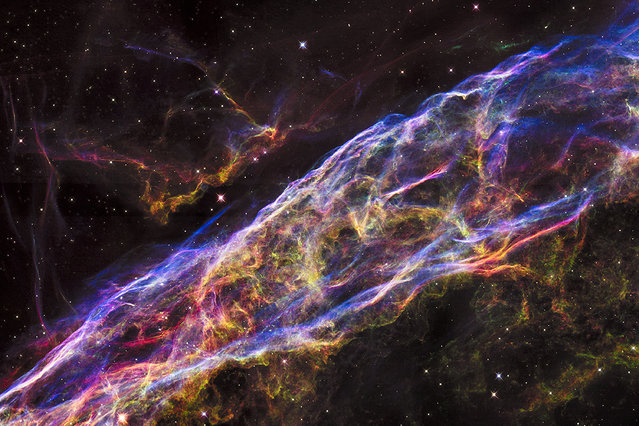
A small section of the expanding remains of the Veil Nebula, a massive star that exploded about 8,000 years ago. The entire nebula is 110 light-years across, covering six full moons on the sky as seen from Earth, and resides about 2,100 light-years away in the constellation Cygnus, the Swan. Image taken by NASA's Hubble Space Telescope. Released September 24, 2015. (Photo by Reuters/NASA/ESA/Hubble Heritage Team)

A small section of the expanding remains of the Veil Nebula, a massive star that exploded about 8,000 years ago. The entire nebula is 110 light-years across, covering six full moons on the sky as seen from Earth, and resides about 2,100 light-years away in the constellation Cygnus, the Swan. Image taken by NASA's Hubble Space Telescope. Released September 24, 2015. (Photo by Reuters/NASA/ESA/Hubble Heritage Team)
Details
10 Dec 2015 08:01:00