Loading...
Done


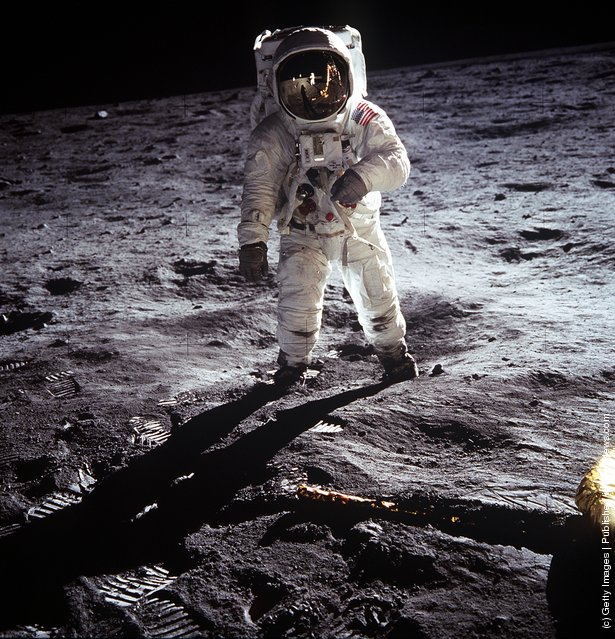
Astronaut Edwin E. Aldrin Jr. walks near the Lunar Module during the Apollo 11 extravehicular activity July 20, 1969 on the Moon. (Photo by NASA/Newsmakers)
Details
28 May 2011 11:04:00


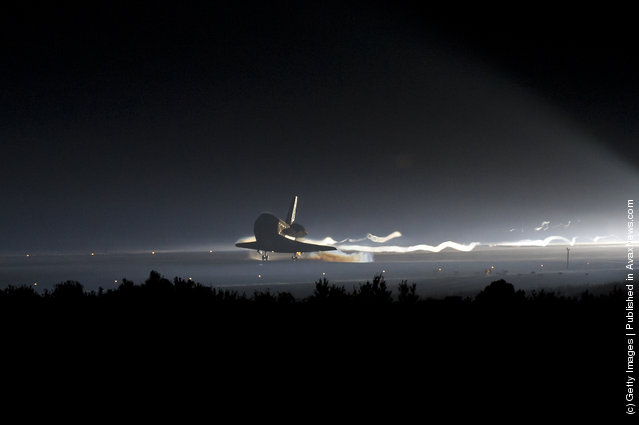
Space Shuttle Atlantis lands at the Kennedy Space Center July 21, 2011 in Cape Canaveral, Florida. The landing brings to a close the 30-year era of the space shuttle program that began in 1981, and has included 135 missions. (Photo by Bill Ingalls/NASA via Getty Images)
Details
22 Jul 2011 10:49:00
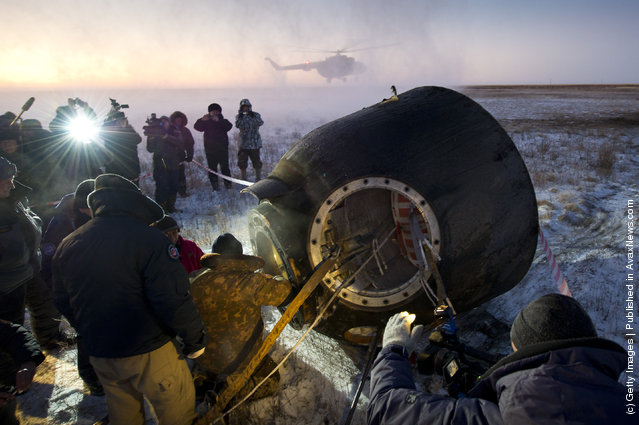
Russian support personnel work to help get Expedition 29 crew members out of the Soyuz TMA-02M spacecraft shortly after the capsule landed

Russian support personnel work to help get Expedition 29 crew members out of the Soyuz TMA-02M spacecraft shortly after the capsule landed with Expedition 29 Commander Mike Fossum, and Flight Engineers Sergei Volkov and Satoshi Furukawa on November 22, 2011 outside of the town of Arkalyk, Kazakhstan. NASA Astronaut Fossum, Russian Cosmonaut Volkov and JAXA (Japan Aerospace Exploration Agency) Astronaut Furukawa are returning from more than five months onboard the International Space Station (ISS) where they served as members of the Expedition 28 and 29 crews. (Photo by Bill Ingalls/NASA via Getty Images)
Details
22 Nov 2011 13:41:00
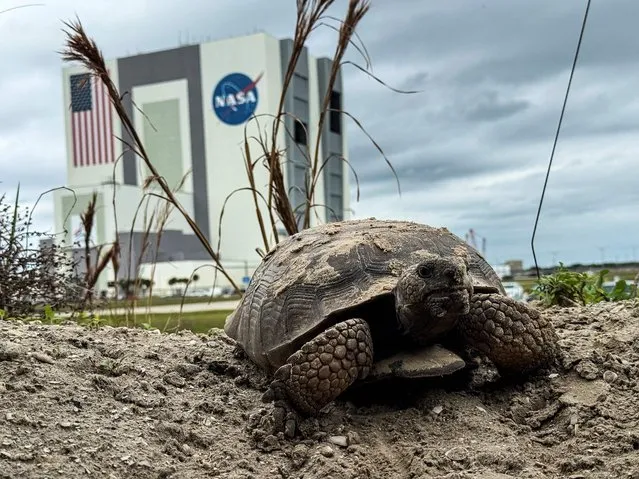
A gopher tortoise walks the grounds of NASA's Kennedy Space Center in Florida, near the Vehicle Assembly Building on January 18, 2024. An all-European crew including Turkey's first astronaut are poised to blast off to the International Space Station in a mission with Axiom Space, as countries hungry for a taste of space turn increasingly to the private sector. (Photo by Chandan Khanna/AFP Photo)

A gopher tortoise walks the grounds of NASA's Kennedy Space Center in Florida, near the Vehicle Assembly Building on January 18, 2024. An all-European crew including Turkey's first astronaut are poised to blast off to the International Space Station in a mission with Axiom Space, as countries hungry for a taste of space turn increasingly to the private sector. (Photo by Chandan Khanna/AFP Photo)
Details
26 Jan 2024 09:15:00
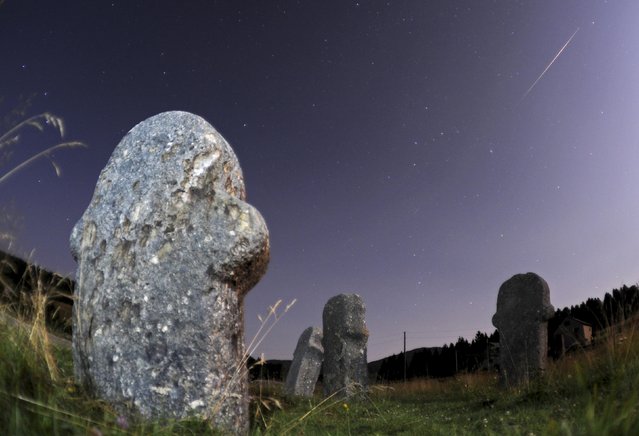
A meteor streaks over the sky during the Perseid meteor shower at the Maculje archaeological site near Novi Travnik August 12, 2014. According to NASA, the annual Perseid meteor shower reaches its peak on August 12 and 13 in Europe. The fireballs from the meteorites are fast and plentiful, although a nearly full moon (Supermoon) makes it difficult to view them this year, the agency adds. (Photo by Dado Ruvic/Reuters)

A meteor streaks over the sky during the Perseid meteor shower at the Maculje archaeological site near Novi Travnik August 12, 2014. According to NASA, the annual Perseid meteor shower reaches its peak on August 12 and 13 in Europe. The fireballs from the meteorites are fast and plentiful, although a nearly full moon (Supermoon) makes it difficult to view them this year, the agency adds. (Photo by Dado Ruvic/Reuters)
Details
14 Aug 2014 10:45:00


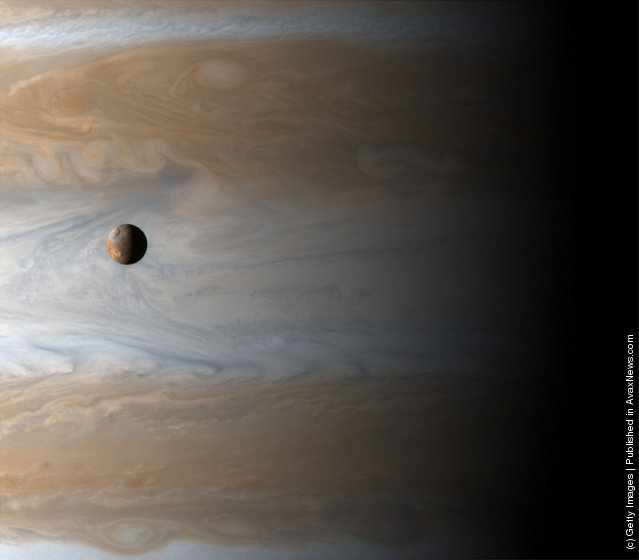
Gliding past the planet Jupiter, the Cassini spacecraft captures this awe inspiring view of active Io, Jupiter's third largest satellite, with the largest gas giant as a backdrop, offering a stunning demonstration of the ruling planet's relative size, April 20, 2001. The Cassini spacecraft itself was about 10 million kilometers from Jupiter when recording the image data. (Photo courtesy of NASA/Newsmakers)
Details
23 Mar 2011 10:32:00
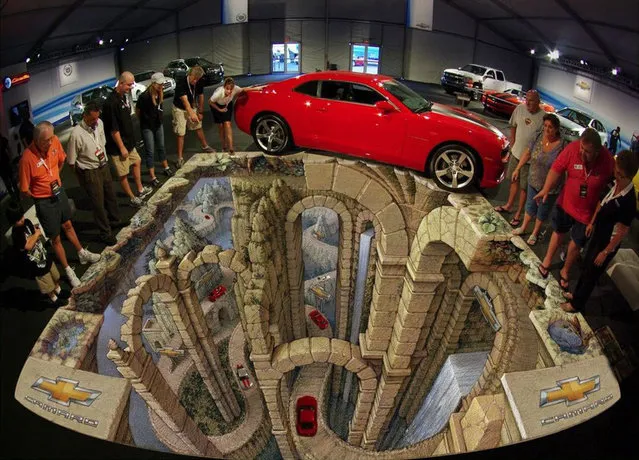
3d Street Art Kurt Wenner

American artist Kurt Wenner creates unparalleled three-dimensional drawings on asphalt streets and of floor. Kurt – A former employee of NASA, which is the love of the art of the Renaissance left the space agency and left to raise the artistic skills in Rome. Has a variety of awards in the arts. Here is a selection of his works made in different cities around the world.
Details
05 Jun 2014 22:01:00
On August 31, 2012, a long filament of solar material that had been hovering in the sun's atmosphere, the corona, erupted out into space at 4:36 p.m. EDT. The coronal mass ejection, or CME, traveled at over 900 miles per second. The CME did not travel directly toward Earth, but did connect with Earth's magnetic environment, or magnetosphere, causing aurora to appear on the night of Monday, September 3. (Photo by NASA/GSFC/SDO)

On August 31, 2012, a long filament of solar material that had been hovering in the sun's atmosphere, the corona, erupted out into space at 4:36 p.m. EDT. The coronal mass ejection, or CME, traveled at over 900 miles per second. The CME did not travel directly toward Earth, but did connect with Earth's magnetic environment, or magnetosphere, causing aurora to appear on the night of Monday, September 3. (Photo by NASA/GSFC/SDO via The Atlantic)
Details
14 Sep 2012 09:01:00