Loading...
Done
This photo taken on February 10, 2025 shows a captured green iguana being held by hunters after it was brought down by a slingshot in Pingtung. Taiwan's iguana population has exploded since the spikey-backed giant lizards were introduced from Central and South America more than 20 years ago as exotic pets. Many escaped or were dumped by their owners and have bred rapidly in the warm climate of southern Taiwan, invading neighbourhoods and ravaging farmers' crops. (Photo by I-Hwa Cheng/AFP Photo)

This photo taken on February 10, 2025 shows a captured green iguana being held by hunters after it was brought down by a slingshot in Pingtung. Taiwan's iguana population has exploded since the spikey-backed giant lizards were introduced from Central and South America more than 20 years ago as exotic pets. Many escaped or were dumped by their owners and have bred rapidly in the warm climate of southern Taiwan, invading neighbourhoods and ravaging farmers' crops. (Photo by I-Hwa Cheng/AFP Photo)
Details
02 Mar 2025 04:03:00
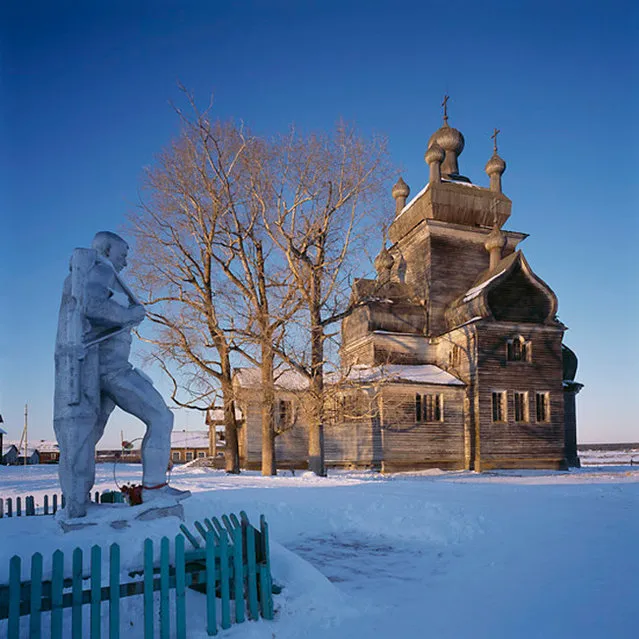
Wooden Churches - Travelling In The Russian North By Richard Davies Part 2

While communism, collectivism, worms, dry rot and casual looting failed to destroy the majestic wooden churches of Russia, it may be ordinary neglect that finally does them in. Dwindled now to several hundred remaining examples, these glories of vernacular architecture lie scattered amid the vastness of the world’s largest country. Just over a decade ago, Richard Davies, a British architectural photographer, struck out on a mission to record the fragile and poetic structures. Austerely beautiful and haunting, “Wooden Churches: Traveling in the Russian North” (White Sea Publishing; $132) is the result. Covering thousands of miles, Mr. Davies described how he and the writer Matilda Moreton tracked down the survivors from among the thousands of onion-domed structures built after Prince Vladimir converted to Christianity in 988.

See also: Wooden Churches Part1
Details
28 Nov 2013 12:13:00
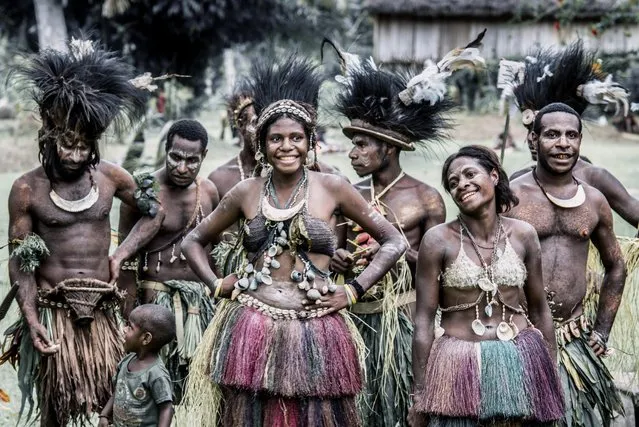
Stunning images capture the tribes of Papua New Guinea during a gathering of clans. (Photo by Trevor Cole/Media Drum World)

These powerful images capture the spear-wielding tribes of Papua new Guinea who believe they are possessed with the spirit of the crocodile. They show how the Kangunaman clansmen scar their backs to resemble reptile scales while the Huli Wigmen wear elaborate headdresses to signal they are ready for battle. (Photo by Trevor Cole/Media Drum World)
Details
05 May 2018 00:05:00
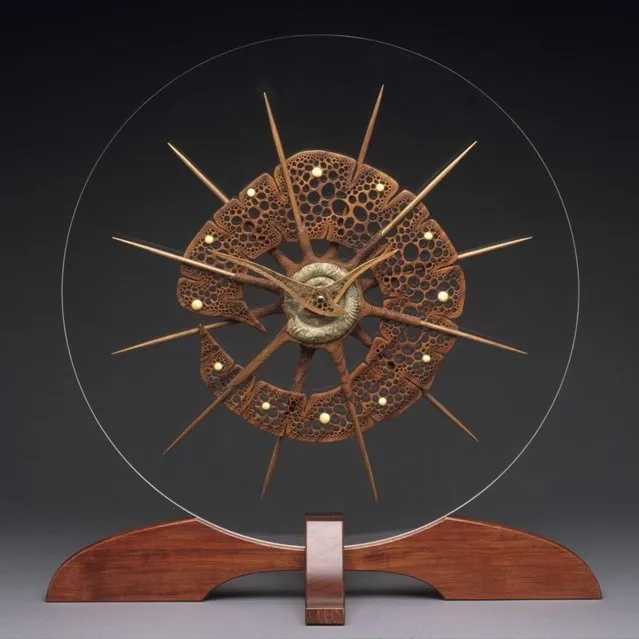
The Wood Art Of Mark Doolittle

Mantle Or Desk Clock “Ancient Sea Form”

A large Mantle or Desk Clock featuring a fossil ammonite at its center, carved from the South American wood Keolbra with radiating Walnut spines. The clock hangs on a round, Plexiglass back supported by a wood base (Bubinga). The clockworks is a quartz, high-torque movement that runs on a single AA battery.
Details
21 Nov 2013 11:49:00


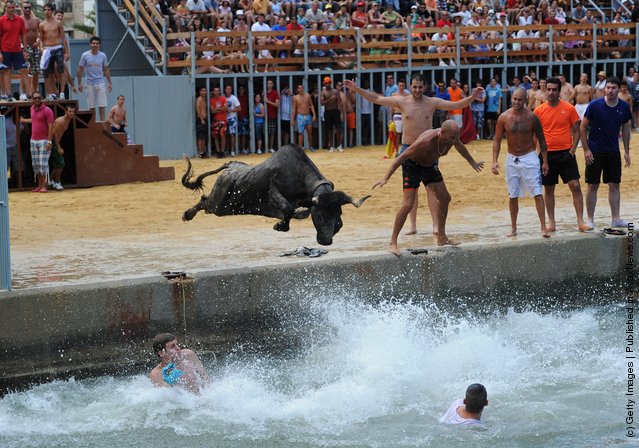
Revellers chase a bull into the sea during the “Bous a la Mar” festival on July 14, 2011 in Denia, Spain. The Spanish “Bous a la Mar” or “Bulls to the Sea” festival is held in honour of the Santisima Sangre and commemorate a monk named Pedro Esteve, who, as the legend has it, saved the coastal town of Denia from a plague in 1633. The bulls chased into the sea are later brought back to land by small boats. (Photo by Jasper Juinen/Getty Images)
Details
16 Jul 2011 12:47:00


“The Southern Tamandua, Collared Anteater or Lesser Anteater (Tamandua tetradactyla) is a species of anteater from South America. It is a solitary animal, found in many habitats from mature to highly disturbed secondary forests and arid savannas. It feeds on ants, termites and bees. It has very strong foreclaws that can be used to break insect nests or to defend itself”. – Wikipedia

Photo: A three-month-old baby Southern Tamandua “Konbu” lies on its mother Tae's back at Sunshine International Aquarium on July 7, 2009 in Tokyo, Japan. Baby Southern Tamandua feels safe and comfortable holding onto something and normally stays on the mother's back until around 3 months old. (Photo by Junko Kimura/Getty Images)
Details
19 May 2011 10:31:00
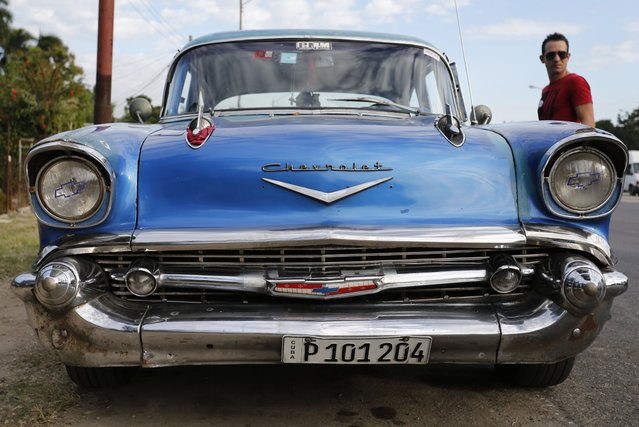
In this December 19, 2014 photo, a man stands beside his 1957 Chevrolet Bel-Air car in Havana, Cuba.  U.S. car sales have been banned in Cuba since 1959. Cubans have been have been forced to patch together Fords, Chevrolets and Chryslers that date back to before Fidel Castro's revolution which can make it appear like the country is stuck in a 1950s time warp. (Photo by Desmond Boylan/AP Photo)

In this December 19, 2014 photo, a man stands beside his 1957 Chevrolet Bel-Air car in Havana, Cuba. U.S. car sales have been banned in Cuba since 1959. Cubans have been have been forced to patch together Fords, Chevrolets and Chryslers that date back to before Fidel Castro's revolution which can make it appear like the country is stuck in a 1950s time warp. Since the Communist economic system isn't likely to change soon, many of those cars will have to stay on the road for years. (Photo by Desmond Boylan/AP Photo)
Details
26 Dec 2014 15:35:00
Law enforcement officers stand, with some turning their backs, as New York City Mayor Bill de Blasio speaks on a monitor outside the funeral for NYPD officer Wenjian Liu in the Brooklyn borough of New York January 4, 2015. Tens of thousands of law enforcement officers from across the country gathered on Sunday for the funeral of the second of two New York City policemen killed last month in an ambush that galvanized critics of Mayor de Blasio. (Photo by Shannon Stapleton/Reuters)

Law enforcement officers stand, with some turning their backs, as New York City Mayor Bill de Blasio speaks on a monitor outside the funeral for NYPD officer Wenjian Liu in the Brooklyn borough of New York January 4, 2015. Tens of thousands of law enforcement officers from across the country gathered on Sunday for the funeral of the second of two New York City policemen killed last month in an ambush that galvanized critics of Mayor de Blasio. (Photo by Shannon Stapleton/Reuters)
Details
05 Jan 2015 13:42:00