Loading...
Done
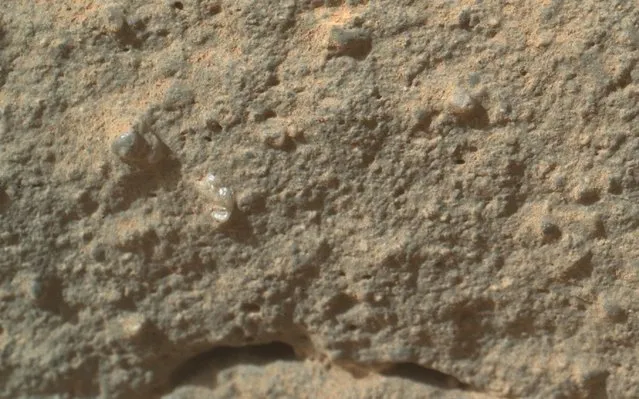
Scientists say that a “Martian flower”, seen here in an image from the Curiosity rover's Mars Hand Lens Imager, is a 2-millimeter-wide grain or pebble that's embedded in the surrounding rock. Another, darker-colored mineral grain can be seen above and to the left. (Photo by NASA)

“The scientists behind NASA's $2.5 billion Curiosity rover mission on Mars on Tuesday explained the nature of a tiny, gleaming "flower" embedded in Red Planet rock, and revealed where they'll be using the SUV-sized robot's drill for the first time”. – Alan Boyle via NBCNews.com

Photo: Scientists say that a “Martian flower”, seen here in an image from the Curiosity rover's Mars Hand Lens Imager, is a 2-millimeter-wide grain or pebble that's embedded in the surrounding rock. Another, darker-colored mineral grain can be seen above and to the left. (Photo by NASA)
Details
16 Jan 2013 11:12:00
A Sorb egg painter decorates an Easter egg while using bent spoons full of melted wax as coloring at the annual Easter egg market on March 16, 2013 in Schleife, Germany. Easter is a particularly important time of year for Sorbs, a Slavic minority in eastern Germany, and the period includes the tradition of painting Easter eggs that include visual elements intended to ward off evil. Many Sorbs still speak Sorbian, a language closely related to Polish and Czech.  (Photo by Adam Berry)

A Sorb egg painter decorates an Easter egg while using bent spoons full of melted wax as coloring at the annual Easter egg market on March 16, 2013 in Schleife, Germany. Easter is a particularly important time of year for Sorbs, a Slavic minority in eastern Germany, and the period includes the tradition of painting Easter eggs that include visual elements intended to ward off evil. Many Sorbs still speak Sorbian, a language closely related to Polish and Czech. (Photo by Adam Berry)
Details
19 Mar 2013 06:41:00
The spinning vortex of Saturn's north polar storm resembles a deep red rose of giant proportions surrounded by green foliage in this false-color image from NASA's Cassini spacecraft. (Photo by NASA/JPL-Caltech/SSI)

NASA's Cassini spacecraft has provided scientists the first close-up, visible-light views of a behemoth hurricane swirling around Saturn's north pole. In high-resolution pictures and video, scientists see the hurricane's eye is about 1,250 miles (2,000 kilometers) wide, 20 times larger than the average hurricane eye on Earth. Thin, bright clouds at the outer edge of the hurricane are traveling 330 mph(150 meters per second). The hurricane swirls inside a large, mysterious, six-sided weather pattern known as the hexagon. Photo: The spinning vortex of Saturn's north polar storm resembles a deep red rose of giant proportions surrounded by green foliage in this false-color image from NASA's Cassini spacecraft. (Photo by NASA/JPL-Caltech/SSI)
Details
31 May 2015 09:11:00
View of the “Sunset Lake” hot spring with it's unique colors caused by brown, orange and yellow algae-like bacteria called Thermophiles, that thrive in the cooling water turning the vivid aqua-blues to a murkier greenish brown, in the Yellowstone National Park, Wyoming on June 1, 2011. (Photo by Mark Ralston/AFP Photo)

View of the “Sunset Lake” hot spring with it's unique colors caused by brown, orange and yellow algae-like bacteria called Thermophiles, that thrive in the cooling water turning the vivid aqua-blues to a murkier greenish brown, in the Yellowstone National Park, Wyoming on June 1, 2011. Yellowstone National Park, was established by the U.S. Congress and signed into law by President Grant on March 1, 1872. The park is located primarily in the U.S. state of Wyoming, though it also extends into Montana and Idaho and was the first national park in the world. It is known for its wildlife and its many geothermal features, especially the Old Faithful Geyser. (Photo by Mark Ralston/AFP Photo)
Details
06 Apr 2014 08:02:00
A young performer cries as she parades during the Bun Festival on Cheung Chau island in Hong Kong Tuesday, May 6, 2014. Bun Festival, the Taoist God of the Sea, is worshipped and evil spirits are believed to be scared away by loud gongs and drums during the procession. The celebration includes bun scrambling, parades, opera performances, and children dressed in colorful costumes. (Photo by Kin Cheung/AP Photo)

A young performer cries as she parades during the Bun Festival on Cheung Chau island in Hong Kong Tuesday, May 6, 2014. Bun Festival, the Taoist God of the Sea, is worshipped and evil spirits are believed to be scared away by loud gongs and drums during the procession. The celebration includes bun scrambling, parades, opera performances, and children dressed in colorful costumes. (Photo by Kin Cheung/AP Photo)
Details
08 May 2014 07:31:00
A police officer sprinkles colored powder onto a police dog at Nepal's Central Police Dog Training School during a dog worship day as part of the Diwali festival, also known as Tihar Festival, in Kathmandu, Nepal, 10 November 2015. The Tihar festival is the second major festival for Nepalese Hindus and this year is held from 10 November 2015. (Photo by Narendra Shrestha/EPA)

A police officer sprinkles colored powder onto a police dog at Nepal's Central Police Dog Training School during a dog worship day as part of the Diwali festival, also known as Tihar Festival, in Kathmandu, Nepal, 10 November 2015. The Tihar festival is the second major festival for Nepalese Hindus and this year is held from 10 November 2015. (Photo by Narendra Shrestha/EPA)
Details
13 Nov 2015 08:04:00
People wearing bear furs perform during a festival of New Year ritual dances attended by hundreds in Comanesti, northern Romania, Wednesday, December 30 2015. In pre-Christian rural traditions, dancers wearing colored costumes or animal furs, toured from house to house in villages singing and dancing to ward off evil, in the present the tradition has moved to Romania's cities too, where dancers travel to perform the ritual for money. (Photo by Vadim Ghirda/AP Photo)

People wearing bear furs perform during a festival of New Year ritual dances attended by hundreds in Comanesti, northern Romania, Wednesday, December 30 2015. In pre-Christian rural traditions, dancers wearing colored costumes or animal furs, toured from house to house in villages singing and dancing to ward off evil, in the present the tradition has moved to Romania's cities too, where dancers travel to perform the ritual for money. (Photo by Vadim Ghirda/AP Photo)
Details
31 Dec 2015 08:52:00
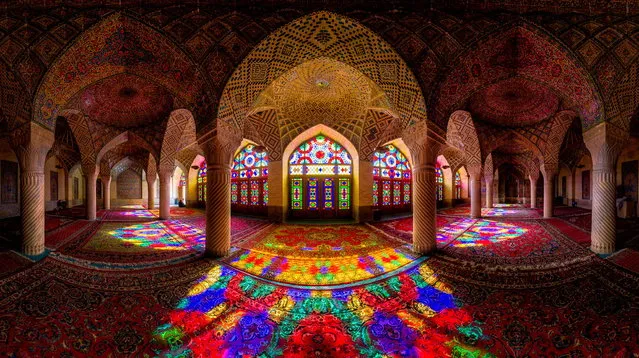
The Nasir Al-Mulk Mosque

The Nasīr al-Mulk Mosque or Pink Mosque is a traditional mosque in Shiraz, Iran, located in Goade-e-Araban place (near the famous Shah Cheragh mosque). The mosque was built during the Qājār era, and is still in use under protection by Nasir al Mulk's Endowment Foundation. It was built by the order of Mirza Hasan Ali Nasir al Molk, one of the lords of the Qajar Dynasty, in 1876 and was finished in 1888. The designers were Muhammad Hasan-e-Memar and Muhammad Reza Kashi Paz-e-Shirazi. The mosque extensively uses colored glass in its facade, and displays other traditional elements such as panj kāseh-i (five concaves) in its design, it is also named in popular culture as Pink Mosque due to the usage of beautiful pink color tiles for its interior design.
Details
26 Mar 2014 14:04:00