Loading...
Done
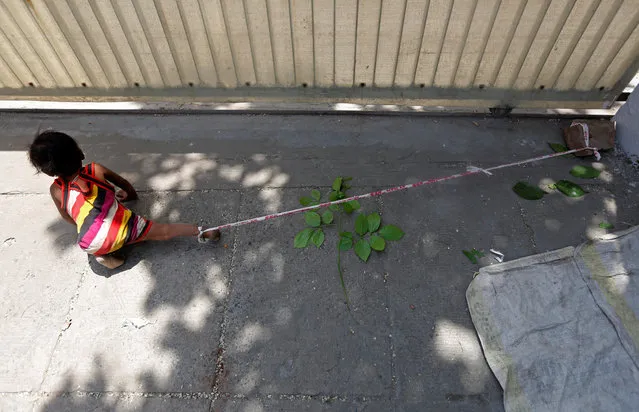
Barrier tape is tied around 15-month-old Shivani's ankle to prevent her from running away, while her mother Sarta Kalara works at a construction site nearby, in Ahmedabad, India, April 19, 2016. Kalara says she has no option but to tether her daughter Shivani to a stone despite her crying, while she and her husband work for 250 rupees ($3.8) each a shift digging holes for electricity cables in the city of Ahmedabad. There are about 40 million construction workers in India, at least one in five of them women, and the majority poor migrants who shift from site to site, building infrastructure for India's booming cities. Across the country it is not uncommon to see young children rolling in the sand and mud as their parents carry bricks or dig for new roads or luxury houses. (Photo by Amit Dave/Reuters)

Barrier tape is tied around 15-month-old Shivani's ankle to prevent her from running away, while her mother Sarta Kalara works at a construction site nearby, in Ahmedabad, India, April 19, 2016. Kalara says she has no option but to tether her daughter Shivani to a stone despite her crying, while she and her husband work for 250 rupees ($3.8) each a shift digging holes for electricity cables in the city of Ahmedabad. There are about 40 million construction workers in India, at least one in five of them women, and the majority poor migrants who shift from site to site, building infrastructure for India's booming cities. Across the country it is not uncommon to see young children rolling in the sand and mud as their parents carry bricks or dig for new roads or luxury houses. (Photo by Amit Dave/Reuters)
Details
14 Dec 2016 07:39:00
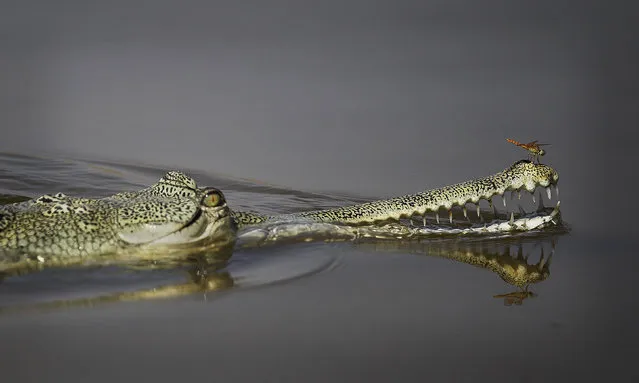
In this photo taken Wednesday, April 30, 2014, a dragonfly sits on the nose of a Gharial, rare crocodile-like creatures, in the River Chambal near Bhopepura village in the northern Indian state of Uttar Pradesh. The narrow 250-mile stretch of the Chambal is a place of crocodiles and jackals, of river dolphins and the occasional wolf. Hundreds of species of birds, storks, geese, babblers, larks, falcons and so many more, nest along the river. (Photo by Altaf Qadri/AP Photo)

In this photo taken Wednesday, April 30, 2014, a dragonfly sits on the nose of a Gharial, rare crocodile-like creatures, in the River Chambal near Bhopepura village in the northern Indian state of Uttar Pradesh. The narrow 250-mile stretch of the Chambal is a place of crocodiles and jackals, of river dolphins and the occasional wolf. Hundreds of species of birds, storks, geese, babblers, larks, falcons and so many more, nest along the river. Endangered birds lay small speckled eggs in tiny pits they dig in the sandbars. Gharials, rare crocodile-like creatures that look like they swaggered out of the Mesozoic Era, are commonplace here and nowhere else. (Photo by Altaf Qadri/AP Photo)
Details
23 Feb 2015 12:55:00
Beards Of Christmas By Stephanie Jarstad

Why would you want to buy a Christmas tree if you have a luscious full beard? Or maybe you have a friend that is willing to volunteer? Just glue some ornaments onto his facial forest and make him stand in the corner. Just don’t forget to feed him! You don’t want your Christmas tree to go bad before the holidays are over! Stephanie Jarstad had created something similar in her project, The Twelve Bears of Christmas, in order to honor the Decembeard (much like Movember), in order to bring awareness to Men’s health problems. (Photo by Stephanie Jarstad)
Details
25 Dec 2014 13:22:00
Performers take part in a rain soaked Notting Hill Carnival on August 25th, 2014 in London, England.  (Photo by Mary Turner/Getty Images)

Performers take part in a rain soaked Notting Hill Carnival on August 25th, 2014 in London, England. Despite the bad weather over 1 million visitors are expected to attend the two-day event which is the largest of its kind in Europe. The event has taken place on the West London streets every August Bank Holiday weekend since 1964. (Photo by Mary Turner/Getty Images)
Details
26 Aug 2014 10:57:00
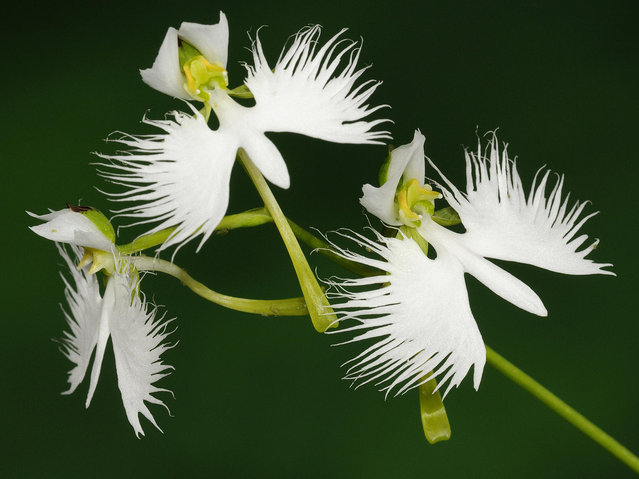
The White Egret Flower - Habenaria Radiata

The close-up of the Pecteilis radiata is very reminiscent of a beautiful white bird soaring in the skies. This is probably the reason why people have started calling this flower the White Egret Flower. Truly, the resemblance of this flower to an egret flying through heavens is staggering. It is too bad that these flowers are so small. Otherwise, they would make for a stunning bouquet. However, who wouldn’t want to receive such a precious flower as a gift; a flower which can be used as a symbol for beauty, good intentions, and the purity of soul. (Photo by AngiBudd)
Details
08 Aug 2015 11:55:00
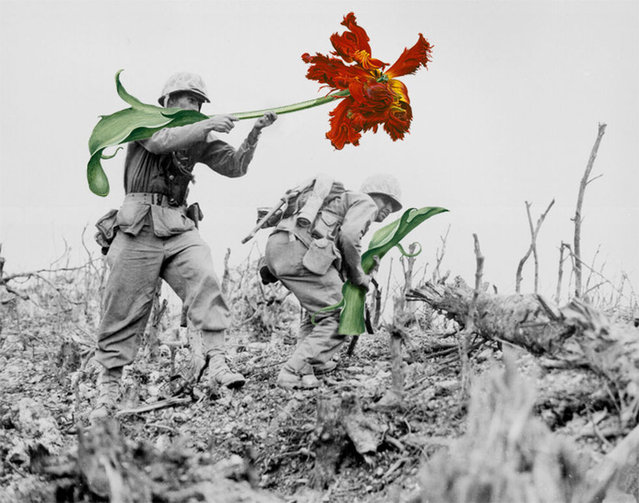
Flowers Of War By Mister Blick

It would have been so much better if the pictures created by Mister Blick were real. How wonderful it would be if these men were actually holding flowers, and none of these wars happened. Regretfully, all these wars have left their mark on the history of mankind. Wars are always bad. They bring nothing but destruction and terror to the regular people, while the big players make huge profits off of the suffering of the common folk. However, establishing dominance is an integral part of the human nature, and the desire to wage wars is simply an extension of this trait. Strong countries always suppress the weaker ones to gain even more power. Unfortunately, this is as inevitable as the sunrise or sunset. (Photo by Mister Blick)
Details
23 Nov 2014 11:58:00
“Potholes” Project by Photographer Davide Luciano

“Potholes” is a series of photographs depicting the concave street cracks and holes as a collection of imaginative tableaux in the city. Captured within the backdrops of New York City, Los Angeles, Toronto and Montreal, the sets explore the urban flaws as a playground creating a multitude of uses out of the potholes. Directly engaging the street and the city, the highly imaginative series transforms the bad into good, creating a tongue-in-cheek collection that is at once contextual and surreal”. (Photo and caption by Davide Luciano)
Details
03 Dec 2013 06:15:00


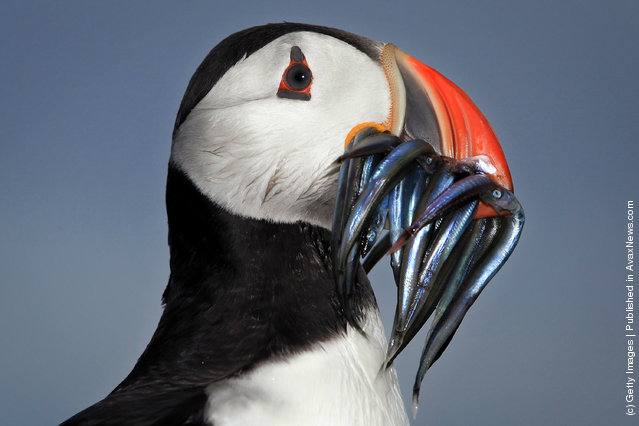
A Puffin returns to it's nest with a beak full of sand eels on June 25, 2011 on Inner Farne, England. The Farne Islands, which are run by the National Trust, are situated two to three miles off the Northumberland coastline. The archipeligo of 16-28 separate islands (depending on the tide) make the summer home to approximately 100,000 pairs of breeding seabirds including around 36,000 Puffins, 32,000 Guillemots and 2,000 pairs of Arctic Terns. The species of birds which nest in internationally important numbers include Shag, Sandwich Tern and Arctic Tern. The coastline around The Farnes are also the breeding ground to one of Europe's largest Grey Seal colonies with around 4,000 adults giving birth to 1500 pups every year. (Photo by Dan Kitwood/Getty Images)
Details
27 Jun 2011 12:58:00