Loading...
Done
US actress Glenn Close, US actress Sarah Paulson, US actress Teyana Taylor, US reality TV personality Kim Kardashian, US actress Niecy Nash-Betts and British actress Naomi Watts pose during a photocall for the premiere of “All's Fair” TV series in Paris on October 21, 2025. (Photo by Bertrand Guay/AFP Photo)

US actress Glenn Close, US actress Sarah Paulson, US actress Teyana Taylor, US reality TV personality Kim Kardashian, US actress Niecy Nash-Betts and British actress Naomi Watts pose during a photocall for the premiere of “All's Fair” TV series in Paris on October 21, 2025. (Photo by Bertrand Guay/AFP Photo)
Details
06 Nov 2025 04:46:00
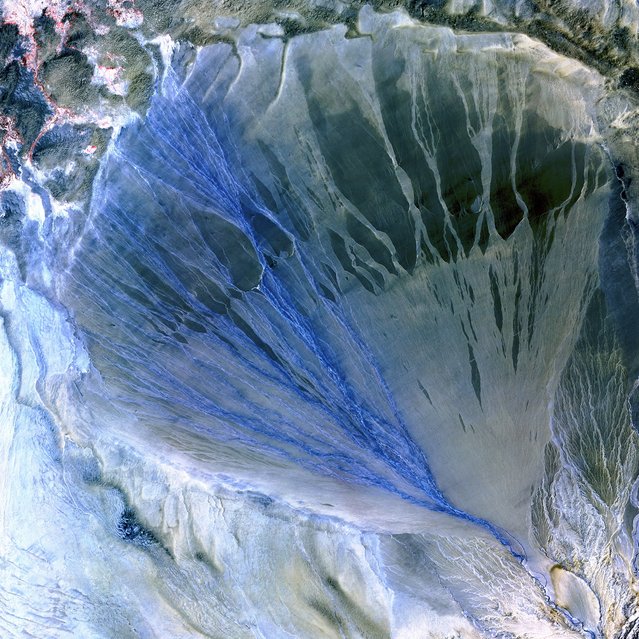
Alluvial Fan, China. A vast alluvial fan blossoms across the desolate landscape between the Kunlun and Altun mountain ranges that form the southern border of the Taklimakan Desert in China’s XinJiang Province. Image taken by the ASTER instrument on NASA’s Terra satellite on May 2nd, 2002. (Photo by NASA/GSFC/USGS EROS Data Center)

Alluvial Fan, China. A vast alluvial fan blossoms across the desolate landscape between the Kunlun and Altun mountain ranges that form the southern border of the Taklimakan Desert in China’s XinJiang Province. Image taken by the ASTER instrument on NASA’s Terra satellite on May 2nd, 2002. (Photo by NASA/GSFC/USGS EROS Data Center)
Details
07 Jan 2013 09:27:00
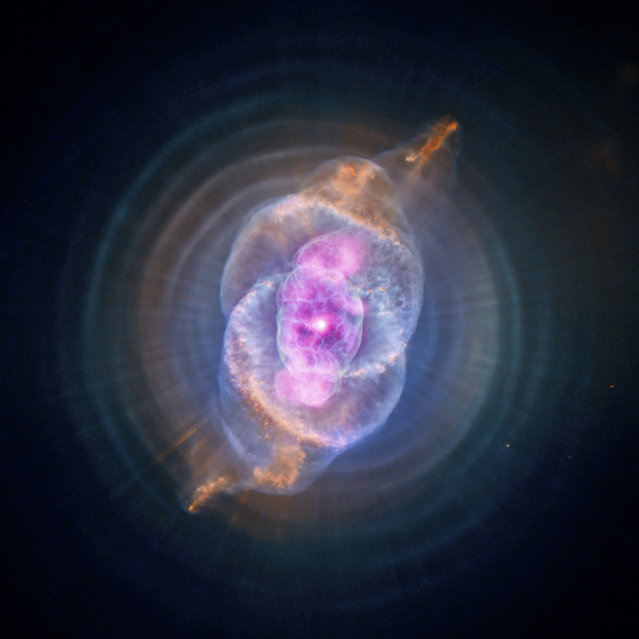
This image is NGC 6543 known as the Cat's Eye Nebula as it appears to the Chandra X-Ray Observatory and Hubble Telescope. A planetary nebula is a phase of stellar evolution that the sun should experience several billion years from now, when it expands to become a red giant and then sheds most of its outer layers, leaving behind a hot core that contracts to form a dense white dwarf star. This image was released October 10, 2012. (Photo by J. Kastner/NASA/CXC/RIT)

This image is NGC 6543 known as the Cat's Eye Nebula as it appears to the Chandra X-Ray Observatory and Hubble Telescope. A planetary nebula is a phase of stellar evolution that the sun should experience several billion years from now, when it expands to become a red giant and then sheds most of its outer layers, leaving behind a hot core that contracts to form a dense white dwarf star. This image was released October 10, 2012. (Photo by J. Kastner/NASA/CXC/RIT)
Details
15 Apr 2013 10:09:00
A guard stands at Dityatki checkpoint, marking a 30 km (18-mile) zone around the Chernobyl nuclear power plant April 23, 2013. Ukraine will mark the 27th anniversary of the Chernobyl disaster, the world's worst civil nuclear accident, on April 26. (Photo by Gleb Garanich/Reuters)

A guard stands at Dityatki checkpoint, marking a 30 km (18-mile) zone around the Chernobyl nuclear power plant April 23, 2013. Ukraine will mark the 27th anniversary of the Chernobyl disaster, the world's worst civil nuclear accident, on April 26. (Photo by Gleb Garanich/Reuters)
Details
27 Apr 2013 09:27:00
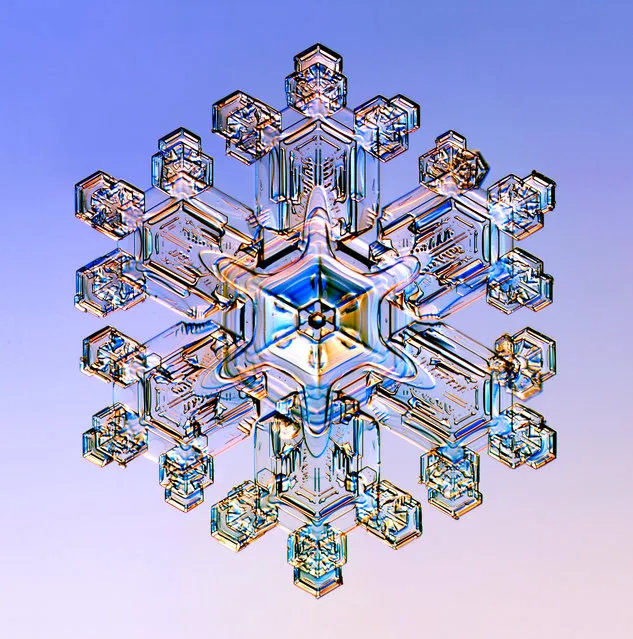
Nikon Small World Photomicrography Competition 2012. Honorable Mention. “Snow crystal, illuminated with colored lights (5x)”. (Photo by Dr. Kenneth Libbrecht, California Institute of Technology (Caltech), Department of Physics, Pasadena, California, USA)

Most people know Nikon as a purveyor of pro and consumer-grade digital cameras. But the company's expertise with optics bleeds over into related markets – it's one of the science community's major suppliers of microscopes. And each year the company asks the community to send it some of their favorite images of tiny objects. A panel of scientists and journalists have chosen the best of this past year's submissions, which Nikon has placed on its Small World site.

Photo: Honorable Mention. “Snow crystal, illuminated with colored lights (5x)”. (Photo by Dr. Kenneth Libbrecht, California Institute of Technology (Caltech), Department of Physics, Pasadena, California, USA)
Details
25 Oct 2012 13:49:00
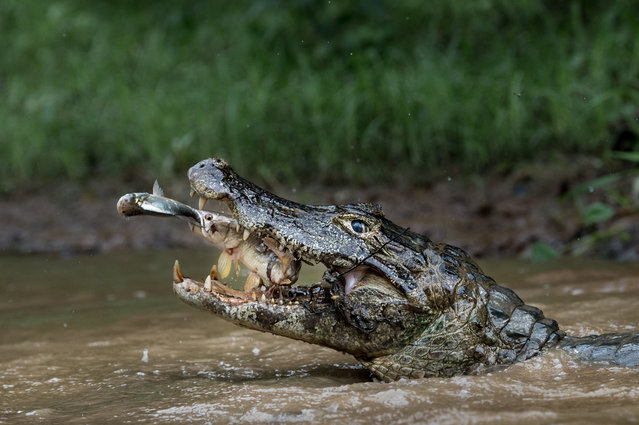
Second place, nature: double trapping. Picture taken in the Brazilian Pantanal ... when I downloaded the CF did not want to believe it ... The nature knows we always give magnificent events but sometimes extraordinary. (Photo by Massimiliano Bencivenni/National Geographic Travel Photographer of the Year Contest)

Second place, Nature: double trapping. Picture taken in the Brazilian Pantanal ... when I downloaded the CF did not want to believe it ... The nature knows we always give magnificent events but sometimes extraordinary. (Photo by Massimiliano Bencivenni/National Geographic Travel Photographer of the Year Contest)
Details
02 Jul 2016 12:53:00
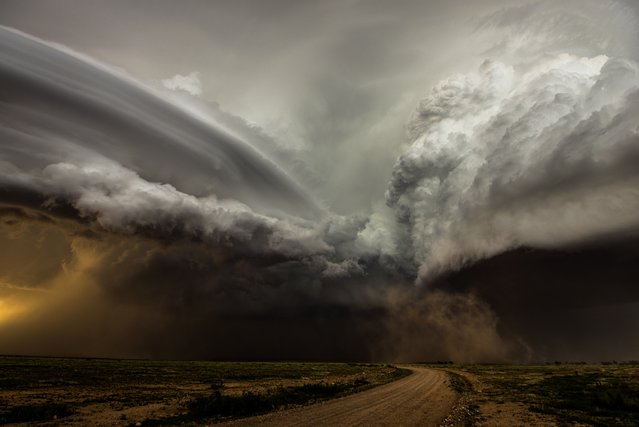
Clash of the storms, New Mexico, US by Camelia Czuchnicki. “A clash between two storm cells in New Mexico, US, each with its own rotating updraft. The curved striations of the oldest noticeable against the new bubbling convection of the newer. It was a fantastic sight to watch and it’s the rarity of such scenes that keep drawing me back to the US Plains each year”. (Photo by Camelia Czuchnicki/Weather Photographer of the Year 2016)

Clash of the storms, New Mexico, US by Camelia Czuchnicki. “A clash between two storm cells in New Mexico, US, each with its own rotating updraft. The curved striations of the oldest noticeable against the new bubbling convection of the newer. It was a fantastic sight to watch and it’s the rarity of such scenes that keep drawing me back to the US Plains each year”. (Photo by Camelia Czuchnicki/Weather Photographer of the Year 2016)
Details
16 Sep 2016 11:11:00
Capgrossos de Mataro team members fall during the 25th Castells' contest at the Tarraco Arena in Tarragona, Catalonia, northeastern Spain, 02 October 2016. The “Castells” is a popular event in which people create human towers up to a height of between six and ten levels. (Photo by Jaume Sellart/EPA)

Capgrossos de Mataro team members fall during the 25th Castells' contest at the Tarraco Arena in Tarragona, Catalonia, northeastern Spain, 02 October 2016. The “Castells” is a popular event in which people create human towers up to a height of between six and ten levels. (Photo by Jaume Sellart/EPA)
Details
03 Oct 2016 09:55:00