Loading...
Done
Pineapple

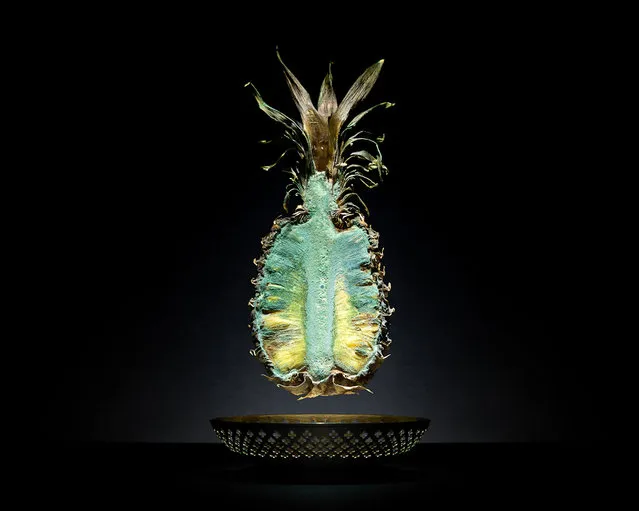
“One Third” – a project on food waste by an Austrian photography Klaus Pichler. According to a UN study one third of the world's food goes to waste – the largest part thereof in the industrialized nations of the global north. Equally, 925 million people around the world are threatened by starvation. The series “One Third” describes the connection between individual wastage of food and globalized food production.

Photo: Pineapple. Place of production: Guayaquil, Ecuador. Cultivation method: Outdoor plantation • Time of harvest: All- season. Transporting distance: 10.666 km (linear distance) • Means of transportation: Aircraft, truck. Carbon footprint (total) per kg: 11,94 kg • Water requirement (total) per kg: 360 l. Price: 2,10 € / kg. (Photo by Klaus Picher)
Details
02 May 2012 11:01:00
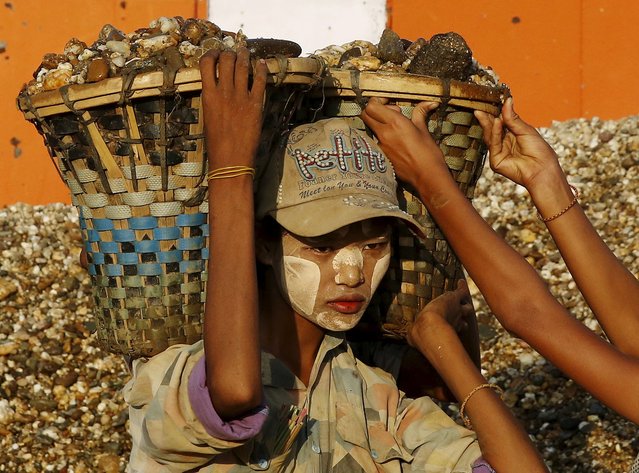
Labourers unload gravel from a boat docked in Dala township, opposite Yangon city, Myanmar, November 12, 2015. (Photo by Olivia Harris/Reuters)

Labourers unload gravel from a boat docked in Dala township, opposite Yangon city, Myanmar, November 12, 2015. (Photo by Olivia Harris/Reuters)
Details
16 Nov 2015 08:09:00
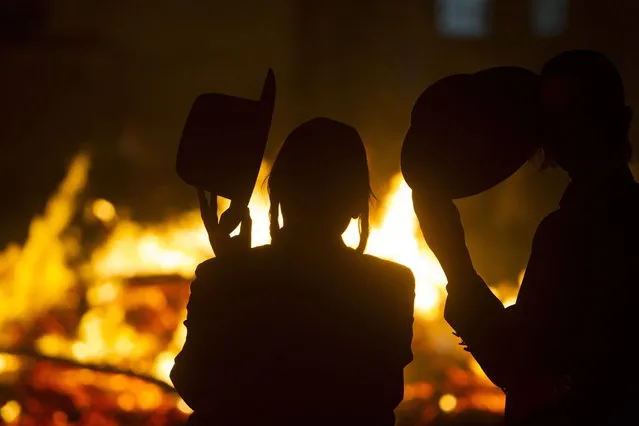
Ultra Orthodox Jewish men watch a bonfire during the Jewish holiday of Lag Ba-Omer in Jerusalem's Mea Shearim neighbourhood April 27, 2013. Israelis celebrate the Jewish holiday of Lag Ba-Omer, which marks the end of a plague in the Middle Ages that killed thousands of disciples of a revered rabbi in the holy land, by lighting bonfires across the country. (Photo by Ronen Zvulun/Reuters)

Ultra Orthodox Jewish men watch a bonfire during the Jewish holiday of Lag Ba-Omer in Jerusalem's Mea Shearim neighbourhood April 27, 2013. Israelis celebrate the Jewish holiday of Lag Ba-Omer, which marks the end of a plague in the Middle Ages that killed thousands of disciples of a revered rabbi in the holy land, by lighting bonfires across the country. (Photo by Ronen Zvulun/Reuters)
Details
28 Apr 2013 10:44:00


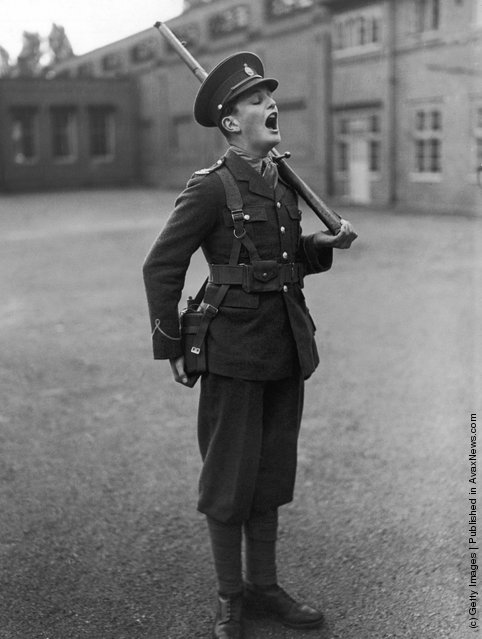
A member of the Eton public school O.T.C. (Officers Training Corps) practising shouting out orders during a training session, 20th January 1940. (Photo by Hulton Archive/Getty Images)
Details
04 Jun 2011 06:46:00


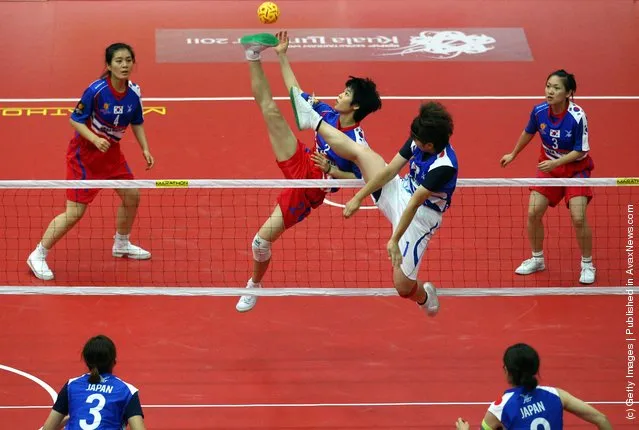
“Sepak takraw or kick volleyball, is a sport native to the Malay-Thai Peninsula. Sepak takraw differs from the similar sport of volleyball in its use of a rattan ball and only allowing players to use their feet, knee, chest and head to touch the ball. It is a popular sport in Indonesia, Malaysia, Thailand, Singapore, Myanmar, Vietnam, Cambodia, Laos, and Philippines”. – Wikipedia

Photo: Hyun Ju Kim of Korea kicks over the net against Yukie Sato of Japan during the round robin match between Korea and Japan during day one of the ISTAF Sepaktakraw World Cup at Titiwangsa Stadium on July 21, 2011 in Kuala Lumpur, Malaysia. (Photo by Ryan Pierse/Getty Images for UFA Sports)
Details
23 Jul 2011 11:45:00
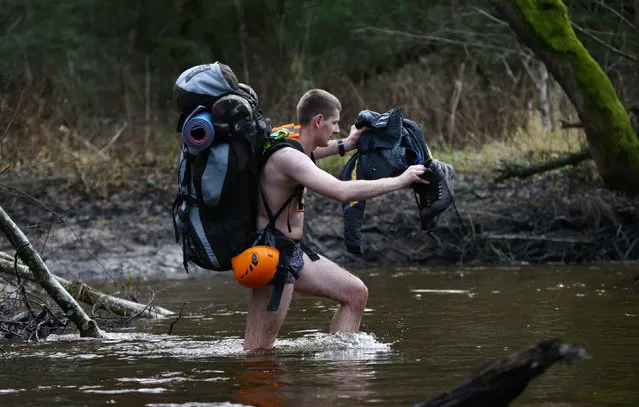
A Belarussian tourist crosses the river as he takes part in “Search and rescue operations – 2016”, a three-day competition, near the village of Priselki, Belarus, November 25, 2016. Photo taken November 25, 2016. (Photo by Vasily Fedosenko/Reuters)

A Belarussian tourist crosses the river as he takes part in “Search and rescue operations – 2016”, a three-day competition, near the village of Priselki, Belarus, November 25, 2016. Photo taken November 25, 2016. (Photo by Vasily Fedosenko/Reuters)
Details
28 Nov 2016 11:51:00
A woman smokes a cigar as she reads the newspaper in a street of Havana, on November 26, 2016, the day after Cuban revolutionary leader Fidel Castro died aged 90. One of the world's longest-serving rulers and modern history's most singular characters, Castro defied 11 US administrations and hundreds of assassination attempts. (Photo by Yamil Lage/AFP Photo)

A woman smokes a cigar as she reads the newspaper in a street of Havana, on November 26, 2016, the day after Cuban revolutionary leader Fidel Castro died aged 90. One of the world's longest-serving rulers and modern history's most singular characters, Castro defied 11 US administrations and hundreds of assassination attempts. (Photo by Yamil Lage/AFP Photo)
Details
27 Nov 2016 09:13:00
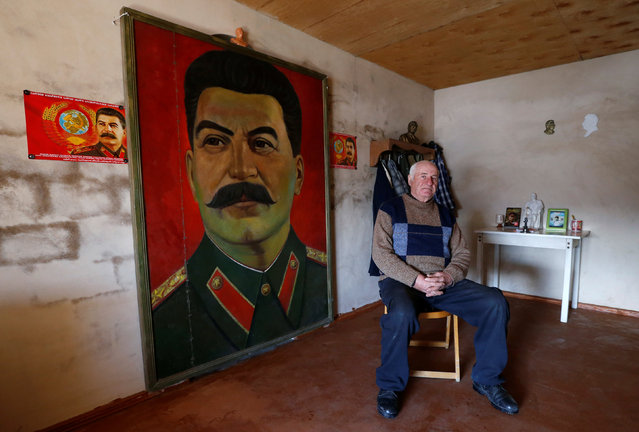
Retired builder Vasili Sidamonidze, 70, poses for a portrait at his home in Gori, Georgia, December 6, 2016. “Unfortunately, Stalin is not popular nowadays. Our people don't respect him. Only we, members of the (Communist) Party, respect him”, Sidamonidze said. “I always try to attend Stalin's birthday anniversaries in Gori. Unfortunately many people don't want to join us even if they live nearby. They look at us from their windows”. Stalin, who was born in Gori in 1878 and died in 1953, is largely reviled today in Georgia, which regained its independence during the 1991 collapse of the Soviet Union. Over the years, his memorials have been dismantled, most recently in 2010 when authorities removed a statue of the dictator from Gori's central square. But Stalin is still revered by a small group of mainly elderly supporters who stress his role in the industrialisation of the Soviet Union and in defeating Nazi Germany in World War Two. Each Dec. 21, a few dozen people mark his birthday by gathering outside a Gori museum dedicated to Stalin, where they make speeches and walk to the square where a 6-meter-high bronze statue of him once stood, calling for it to be reinstated. Opponents say it was a symbol of Moscow's still lingering shadow. In 2008, Russia fought a brief war with Georgia and recognised its breakaway regions of Abkhazia and South Ossetia as independent states. (Photo by David Mdzinarishvili/Reuters)

Retired builder Vasili Sidamonidze, 70, poses for a portrait at his home in Gori, Georgia, December 6, 2016. “Unfortunately, Stalin is not popular nowadays. Our people don't respect him. Only we, members of the (Communist) Party, respect him”, Sidamonidze said. “I always try to attend Stalin's birthday anniversaries in Gori. Unfortunately many people don't want to join us even if they live nearby. They look at us from their windows”. (Photo by David Mdzinarishvili/Reuters)
Details
17 Dec 2016 07:59:00