Loading...
Done
Monks dressed as Tibetan Buddhism characters attend a religious ceremony, known as “Da Gui” or beating ghost, to celebrate the upcoming Tibetan New Year which starts on March 1 at Yonghegong Lama Temple, in Beijing February 28, 2014. This Tibetan ceremony is held annually at the end of the first lunar month with mask dancing to expel ghosts, according to a press release. (Photo by Jason Lee/Reuters)

Monks dressed as Tibetan Buddhism characters attend a religious ceremony, known as “Da Gui” or beating ghost, to celebrate the upcoming Tibetan New Year which starts on March 1 at Yonghegong Lama Temple, in Beijing February 28, 2014. This Tibetan ceremony is held annually at the end of the first lunar month with mask dancing to expel ghosts, according to a press release. (Photo by Jason Lee/Reuters)
Details
01 Mar 2014 13:07:00
A visitor holds an Israeli-made rifle during the 8th International Land and Naval Defense system exhibition, in New Delhi, India, on February 6, 2014. (Photo by Anindito Mukherjee/Reuters)

A visitor holds an Israeli-made rifle during the 8th International Land and Naval Defense system exhibition, in New Delhi, India, on February 6, 2014. (Photo by Anindito Mukherjee/Reuters)
Details
08 Feb 2014 15:38:00
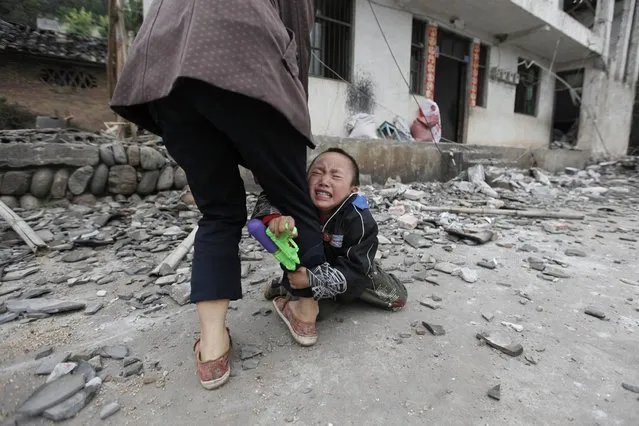
A boy holds his mother's leg as he cries in front of their damaged house after a strong 6.6 magnitude earthquake at Longmen village, Lushan county in Ya'an, Sichuan province. (Photo by Jason Lee/Reuters)

A boy holds his mother's leg as he cries in front of their damaged house after a strong 6.6 magnitude earthquake at Longmen village, Lushan county in Ya'an, Sichuan province. (Photo by Jason Lee/Reuters)
Details
02 Jan 2014 11:56:00
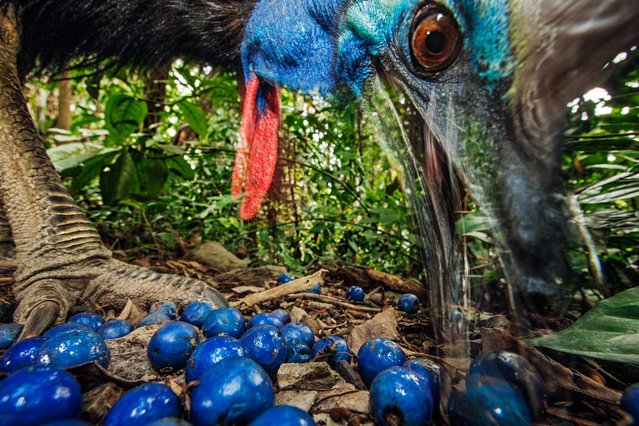
“Cassowaries are large, flightless birds related to emus and (more distantly) to ostriches, rheas, and kiwis”, writes Olivia Judson in the September issue of National Geographic magazine. (Photo by Christian Ziegler/National Geographic)

“Cassowaries are large, flightless birds related to emus and (more distantly) to ostriches, rheas, and kiwis”, writes Olivia Judson in the September issue of National Geographic magazine. How large? People-size: Adult males stand well over five foot five and top 110 pounds. Females are even taller, and can weigh more than 160 pounds. Dangerous when roused, they’re shy and peaceable when left alone. But even birds this big and tough are prey to habitat loss. The dense New Guinea and Australia rain forests where they live have dwindled. Today cassowaries might number 1,500 to 2,000. And because they help shape those same forests – by moving seeds from one place to another – “if they vanish”, Judson writes, “the structure of the forest would gradually change” too. (Photo by Christian Ziegler/National Geographic)
Details
06 Jan 2014 12:21:00
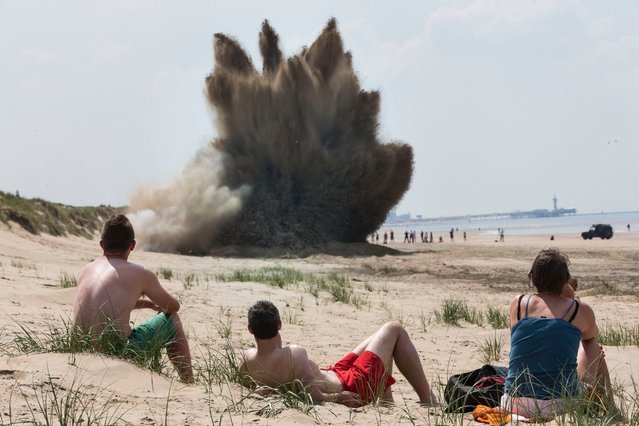
Beachgoers watch the detonation of a 500 pound British bomb on the beach on May 19, 2014 in Wassenaar, Netherlands. The bomb was dropped by the British allied forces during the second world war over nearby Leiden where it was found on a building site. (Photo by Michel Porro/Getty Images)

Beachgoers watch the detonation of a 500 pound British bomb on the beach on May 19, 2014 in Wassenaar, Netherlands. The bomb was dropped by the British allied forces during the second world war over nearby Leiden where it was found on a building site. (Photo by Michel Porro/Getty Images)
Details
24 May 2014 12:51:00
Walkers cross the river Waalbrug during the first day of the 98th annual four-days walking event, the “Vierdaagse” in Nijmegen, Netherlands, July 15, 2014. The “Nijmeegse Vierdaagse” is an annual public four-day field march which is held since 1909 in the third week of July. (Photo by Erik van 't Wout/EPA)

Walkers cross the river Waalbrug during the first day of the 98th annual four-days walking event, the “Vierdaagse” in Nijmegen, Netherlands, July 15, 2014. The “Nijmeegse Vierdaagse” is an annual public four-day field march which is held since 1909 in the third week of July. (Photo by Erik van 't Wout/EPA)
Details
27 Jul 2014 11:11:00
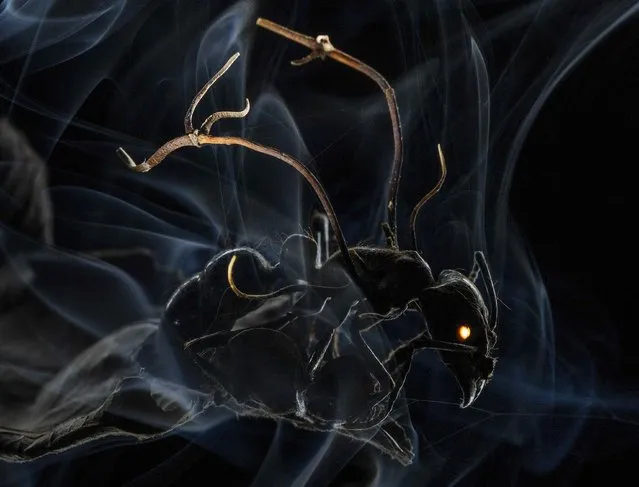
Anand Varma, a U.S. photographer working for the National Geographic, won the First Prize in the Nature Category, Stories, of the 2015 World Press Photo contest with his series of pictures, which includes this one of spores of a fungus landing on an ant, penetrating its exoskeleton and entering its brain, compelling the host to leave its normal habitat on the forest floor and scale a nearby tree, in this picture taken January 22, 2014 and released by the World Press Photo on February 12, 2015. (Photo by Anand Varma/Reuters/National Geographic/World Press Photo)

Anand Varma, a U.S. photographer working for the National Geographic, won the First Prize in the Nature Category, Stories, of the 2015 World Press Photo contest with his series of pictures, which includes this one of spores of a fungus landing on an ant, penetrating its exoskeleton and entering its brain, compelling the host to leave its normal habitat on the forest floor and scale a nearby tree, in this picture taken January 22, 2014 and released by the World Press Photo on February 12, 2015. (Photo by Anand Varma/Reuters/National Geographic/World Press Photo)
Details
15 Feb 2015 15:21:00
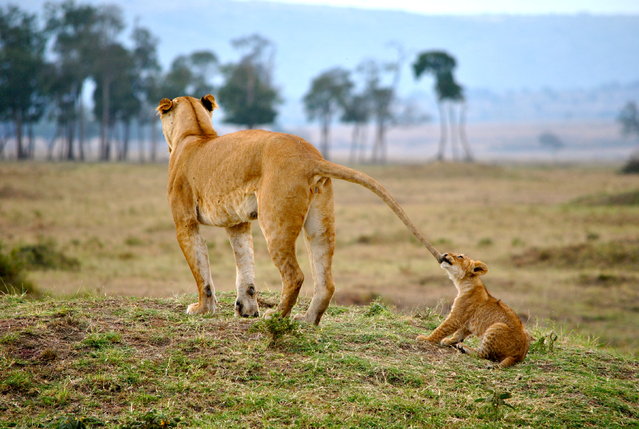
“A Mothers Tail”. A baby cub pulls on his mother's tail to get attention. Photo location: Masai Mara, Kenya. (Photo and caption by Tori Marsh/National Geographic Photo Contest)

“A Mothers Tail”. A baby cub pulls on his mother's tail to get attention. Photo location: Masai Mara, Kenya. (Photo and caption by Tori Marsh/National Geographic Photo Contest)
Details
21 Oct 2014 12:40:00