Loading...
Done
Hand-Painted Stones By Elspeth McLean

Elspeth McLean is a talented painter from Australia’s western suburbia. She is perhaps the most vibrant painter I have even seen, hence her degree and passion in Art Therapy. She has a strong belief that art has the power to bring immense joy into people lives and her vibrant creations accurately reflect that.
Details
27 Aug 2015 13:39:00
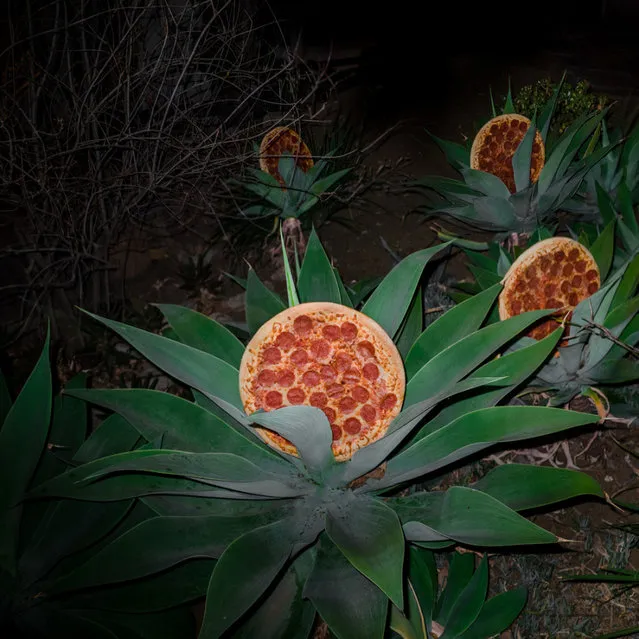
Pizza In The Wild By Jonpaul Douglass

Every once and a while an artistic endeavor is so bold, so courageous and so innovative we are left speechless in its wake. Today, that project is “Pizza in the Wild”. The brainchild of Los Angeles-based photographer Jonpaul Douglass, the Instagram series that is so much more follows unsupervised pizzas – pepperoni pizzas, to be exact – living the L.A. life.
Details
18 Sep 2014 12:37:00
Beautiful Photography By Daniel Rericha

Daniel Rericha born in 1972 in the Czech Republic. Living in a small town, located near the mountain ridge, from childhood he was inspired by the mountains and fell in love with them. In his spare time he enjoys traveling with his wife. In these travels, he tries to capture in his lens as many beautiful places. His work is imbued with the spirit through the mountains, air and space.
Details
06 Sep 2015 13:03:00
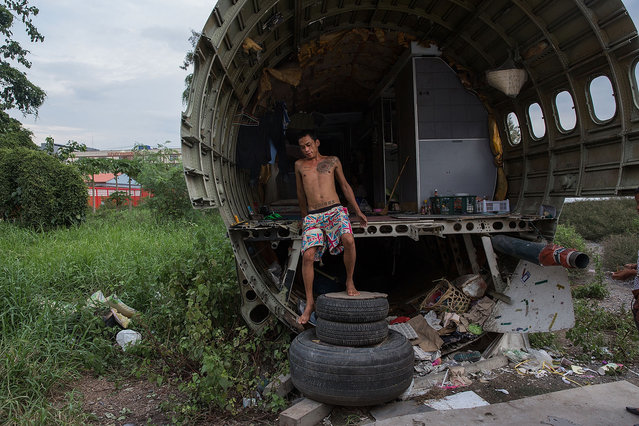
A Thai man climbs down from his home in a disused airplane on September 12, 2015 in Bangkok, Thailand. 3 impoverished Thai families have begun living in disused airplanes on a private field. The families, who collect and recycle garbage earning a few dollars a day, can't afford to rent and prefer to stay in the planes. (Photo by Taylor Weidman/Getty Images)

A Thai man climbs down from his home in a disused airplane on September 12, 2015 in Bangkok, Thailand. 3 impoverished Thai families have begun living in disused airplanes on a private field. The families, who collect and recycle garbage earning a few dollars a day, can't afford to rent and prefer to stay in the planes. (Photo by Taylor Weidman/Getty Images)
Details
05 Oct 2015 08:04:00
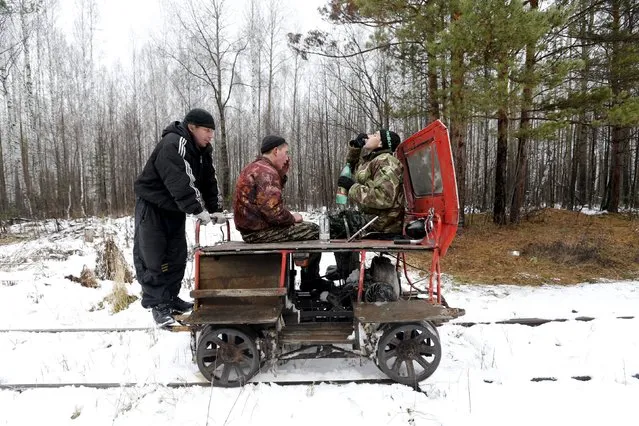
(L-R) A man nicknamed "Barcelona", Alexey Bolotov and Alexey Jakushin drink vodka as they travel by a pioneer motorised railcar on their way to Kalach, Sverdlovsk region, Russia October 18, 2015. The "pioneer," a light auxiliary rail vehicle, is a popular form of transport among people who live along the Alapayevsk railway. (Photo by Maxim Zmeyev/Reuters)

(L-R) A man nicknamed "Barcelona", Alexey Bolotov and Alexey Jakushin drink vodka as they travel by a pioneer motorised railcar on their way to Kalach, Sverdlovsk region, Russia October 18, 2015. The "pioneer," a light auxiliary rail vehicle, is a popular form of transport among people who live along the Alapayevsk railway. In a remote corner of the Urals region at the end of a narrow-gauge railway is Kalach, population about a dozen. Three decades ago 600 people called the village home, but the local forestry industry suffered as the former Soviet Union imploded and people moved away in search of work. In Kalach today there are no telephones, no mobile reception and only a few hours of electricity a day. (Photo by Maxim Zmeyev/Reuters)

Details
15 Nov 2015 08:06:00
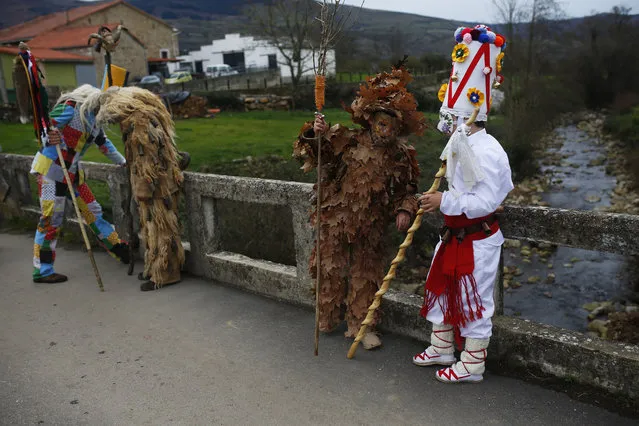
People dressed in costumes have a break while marching during the Vijanera Festival, in the small village of Silio, northern Spain, Sunday, January 3, 2016. The Vijanera masquerade, of pre-Roman origin, is the first carnival of the year in Europe symbolizing the triumph of good over evil and involving the participation of crowds of residents wearing different masks, animal skins and brightly coloured clothing with its own complex function and symbolism and becoming the living example of the survival of archaic cults to nature. (Photo by Francisco Seco/AP Photo)

People dressed in costumes have a break while marching during the Vijanera Festival, in the small village of Silio, northern Spain, Sunday, January 3, 2016. The Vijanera masquerade, of pre-Roman origin, is the first carnival of the year in Europe symbolizing the triumph of good over evil and involving the participation of crowds of residents wearing different masks, animal skins and brightly coloured clothing with its own complex function and symbolism and becoming the living example of the survival of archaic cults to nature. (Photo by Francisco Seco/AP Photo)
Details
04 Jan 2016 10:17:00
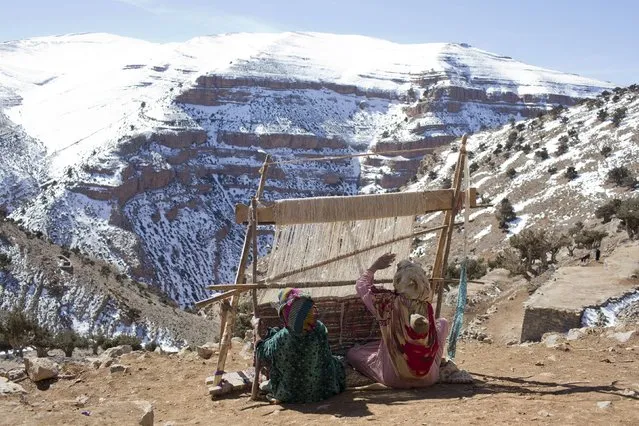
Berber women weave traditional carpets in the village of Ait Sghir in the High Atlas region of Morocco February 15, 2015. The snowy foothills of the High Atlas mountains in Morocco are home to several Berber villages where the inhabitants make their living by farming, baking bread in traditional ovens, herding cattle, and the making and selling of honey, olive oil and pottery. Extreme weather fluctuations and erosion that causes flooding and landslides have led to a drop in agricultural productivity, the United Nations said. (Photo by Youssef Boudlal/Reuters)

Berber women weave traditional carpets in the village of Ait Sghir in the High Atlas region of Morocco February 15, 2015. The snowy foothills of the High Atlas mountains in Morocco are home to several Berber villages where the inhabitants make their living by farming, baking bread in traditional ovens, herding cattle, and the making and selling of honey, olive oil and pottery. Extreme weather fluctuations and erosion that causes flooding and landslides have led to a drop in agricultural productivity, the United Nations said. (Photo by Youssef Boudlal/Reuters)
Details
26 Feb 2015 06:07:00
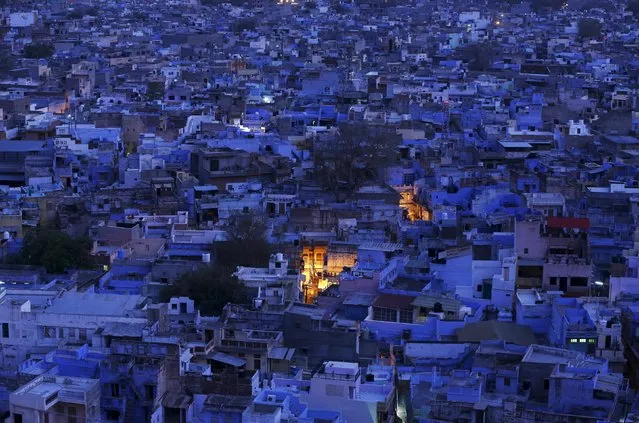
A general view of the residential area is pictured during dusk at Jodhpur in Rajasthan, April 5, 2015. Jodhpur, also known as the blue city in the desert Indian state of Rajasthan, which residents say originally, was used to show where the highest caste of priestly Hindus live, who wanted to set them apart from the rest of the population. Later the rest of the population followed suit. Another reason for the city to be blue is to keep the buildings cool during the summers, local residents said. (Photo by Adnan Abidi/Reuters)

A general view of the residential area is pictured during dusk at Jodhpur in Rajasthan, April 5, 2015. Jodhpur, also known as the blue city in the desert Indian state of Rajasthan, which residents say originally, was used to show where the highest caste of priestly Hindus live, who wanted to set them apart from the rest of the population. Later the rest of the population followed suit. Another reason for the city to be blue is to keep the buildings cool during the summers, local residents said. (Photo by Adnan Abidi/Reuters)
Details
12 Apr 2015 08:27:00